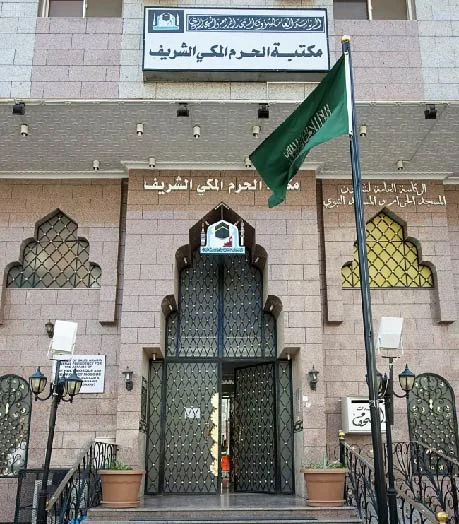
Pilgrims and performers benefit from its services annually .. Makkah Haram Library .. A scientific beacon 13 centuries old
Ahwal Al-Ma'rifa: Special
In every Hajj season and throughout the year, pilgrims and visitors to the House of Allah take the opportunity to visit the Makkah Haram Library, where they interact with it and flock in density to browse its contents. They are attracted to it by the information vessels it provides in various forms, and by the diverse services it offers to them, researchers, readers, and seekers of knowledge, which keep pace with modern developments, making it worthy of being one of the most important libraries in the world, qualified by its contents and by the association of its name with the purest of places.
The library welcomes more than two thousand visitors daily, including pilgrims, performers of Umrah, and visitors from among those seeking the Grand Mosque, around the clock. It also receives student delegations, professors, university academics, sheikhs, scholars, and students of knowledge from all over the Arab and Islamic world. It opens its doors in three shifts, each shift working 8 hours, for which the library management mobilizes more than 30 specialized employees, both permanent and temporary. The library provides gifts to all visitors, including booklets and pamphlets related to Hajj and Umrah rituals as well as awareness publications.
The library has not neglected the female element, as they have their share like the men. There is a women's section in the library that serves female visitors and researchers in two shifts, morning and evening. The library has also allocated a section for acquisition to build and develop collections.
The Oldest Library in the Islamic World
The history of the establishment of the Makkah Haram Library confirms that it is the oldest library in the Islamic world. Although it is difficult to know the exact origin of this library and its true beginning, there are some indicators through which the date of its inception can be known approximately. The Makkah Haram Library has been associated with the presence of Qurans and religious books, whose presence in the Grand Mosque is as old as Islam itself. Thus, it can be said that the establishment of the Makkah Haram Library was generally associated with the sessions of fatwas and remembrance that the companions and followers held in the Grand Mosque, and the results of those sessions produced this library. Although history books did not mention the existence of a library inside the Grand Mosque, its existence is inferred; the sanctity of the place was an incentive for Muslim caliphs, rulers, wealthy individuals, and authors to dedicate Qurans and books and preserve them either in cabinets inside the Grand Mosque or in nearby schools or lodges. Most historians agree that the nucleus of the Makkah Haram Library existed at the beginning of the Abbasid Caliphate during the time of Al-Mahdi Al-Abbasi in 160 AH, and that there were two domes established by Caliph Muhammad Al-Mahdi bin Abi Ja'far Al-Mansur, one for water provision and the other for records, called the Dome of the House of Records, where Qurans and some religious books were kept.
The contribution of the library continued in enriching the cultural and scientific scene in Makkah until the Ottoman Sultan Abdulmejid I ordered in 1262 AH the repair of the dome and its conversion into a library, naming it the Majeedi Library. After that, it moved to the Dar al-Hadith building next to Bab al-Duraiba, containing (9,000) books in Arabic, Persian and Turkish.
The Library in the Era of the Saudi State
In 1357 AH, King Abdulaziz ordered it to be named by its current name (Makkah Haram Library) and a management board was formed for it, including the most prominent Makkah scientific figures under the supervision of the Directorate of General Knowledge. Then its headquarters moved to the Ashraf buildings in Ajyad, then to the building of the Haram project next to Safa, then to the Taysir neighborhood, then next to the Grand Mosque, then to Mansour Street, then to Aziziyah, waiting for the completion of the third expansion project to return to the embrace of the Grand Mosque in its new headquarters. From then until the era of the Custodian of the Two Holy Mosques King Salman bin Abdulaziz Al Saud, the library has witnessed remarkable development and unparalleled support in all capacities, under the supervision of the General Presidency for the Affairs of the Grand Mosque and the Prophet's Mosque.
Sections and Contents of the Library
The Makkah Haram Library has been expanded and now includes many sections, including the Library Service Department, which receives readers of different levels and nationalities, providing service to them and supplying them with what they need of books and references and assisting them in reaching information. Those books total more than 100,000 titles. The Manuscripts Department provides its services to researchers and investigators, assisting them in reaching the manuscript they want. The section includes 6,523 original manuscripts, 358 non-Arabic manuscripts, 2,314 photographed manuscripts, a collection of scientific theses, and indices of manuscripts of Arab and international libraries. The Periodicals Department displays local and Arab newspapers and magazines, both modern and old, to readers and visitors, and keeps two copies for the library, binding one for preservation. The number of titles there reaches nearly a thousand.
The library also includes an audio library that records tapes for visitors and readers of sermons, speeches and lessons given in the Grand Mosque, numbering more than 80,000 tapes. There is also a microfilm section that enables visitors and readers to view films related to manuscripts and old newspapers on reading devices in the section, containing more than 5,671 films. There is also the Two Holy Mosques Pavilion which displays everything related to the Two Holy Mosques of old or modern photos, maps, books and manuscripts to readers and visitors.
The Makkah Haram Library has an electronic library to enable patrons to view mother books kept on (CD) with the aim of keeping pace with developments and providing fast service to them.
Rare Manuscripts
The Makkah Haram Library possesses many rarities of manuscripts and periodicals; it is rich in its religious, scientific and reference holdings. It has a manuscript of one of the oldest Qurans, which is the Quran of Othman bin Affan (RA). Among the rare manuscripts found there, for example:
- Al-Ghaylaniyyat by Muhammad bin Muhammad bin Ibrahim bin Ghaylan al-Bazzar, which is the oldest manuscript in the library, its copying date es back to the early fifth century AH, and it is eleven parts in one volume.
- Horsemanship and Military Positions by Najm al-Din Husayn bin al-Ramah, who died in 780 AH.
- Musnad al-Muwatta by al-Ghafiqi, who died in 381 AH, and its copying date es back to 693 AH.
- Majma' al-Bahrayn fi Zawa'id al-Mu'jamayn by Ibn Hajar al-Haytami, who died in 807 AH.
The library also includes a collection of rare lithographs, the most important of which is the Diwan of Ibn al-Nabih in 1280 AH, the book of the Poem of Kadhim al-Rashti printed in 1269 AH, the History of Thursday in the Lives of the Soul of the Precious by Muhammad al-Diyarbakri printed in 1283 AH, the Arabic First Fruit in explaining the text of Al-Ajurrumiyya by Muhammad bin Ismail al-Ansari printed in 1288 AH, and the Useful Companion for the Benefiting Student printed in 1296 AH.
The library includes a number of rare Saudi periodicals, the most important of which are Barid al-Hijaz from the first year, first issue, 1343 AH (film), Sawt al-Hijaz from the first year, first issue, 1350 AH (film), and Al-Idha'a from the first year, first issue, 1357 AH. Among the Arab newspapers and magazines it includes is Al-Muqtataf from the first year 1870 AD, Al-Diya from the first year 1898 AD, Al-Manar from the first year 1315 AH, Al-Muqtabas from the first year 1324 AH, and Nawadir al-Asam from the first year 1349 AH.
Private Libraries
The Makkah Haram Library includes several private libraries dedicated by their owners, including:
- The library of Abd al-Sattar al-Dahlawi, who died in 1355 AH: Sheikh al-Dahlawi's library contains 1,850 books between manuscript and printed, most of them in his own handwriting. This library was transferred after his death to his brother based on his will, and was added to the Haram library after his death.
- The Kilani Library: It is a private library that was added to the Haram library after his death in 1367 AH. The number of its volumes reached 938 printed books and a few manuscripts in various Islamic studies and Arabic language.
- The library of Abd al-Rahman al-Mu'allimi, who died in 1386 AH, one of the library curators. His library was added to the Haram library in 1387 AH, and its contents reached 642 printed books.