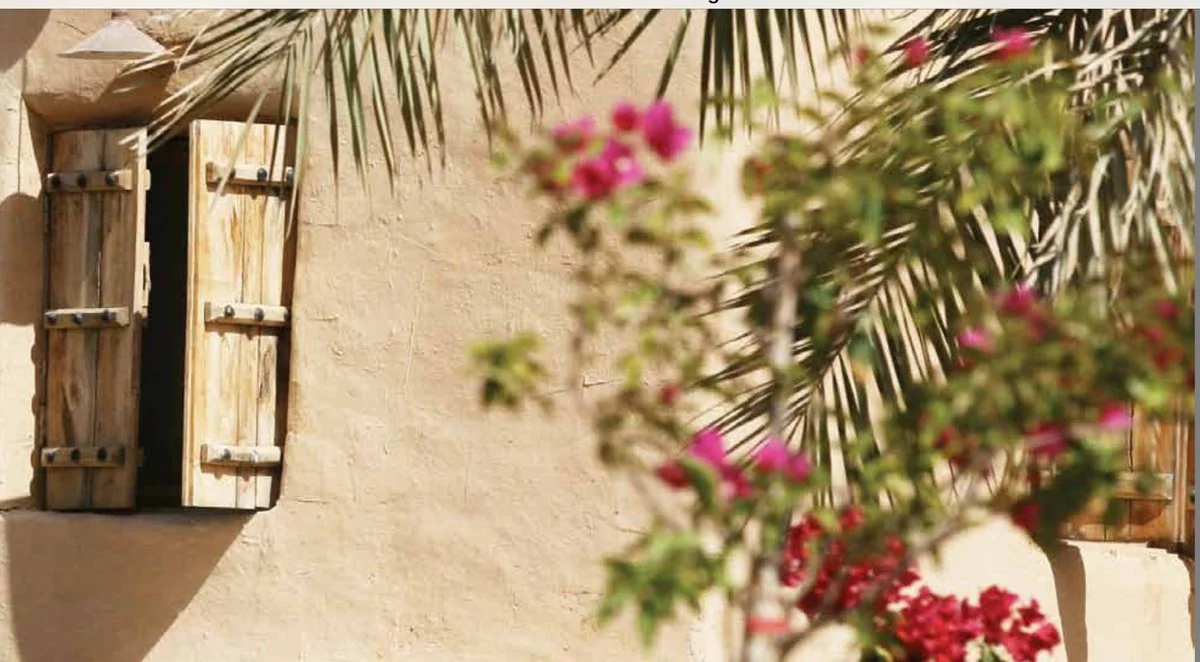
Returning to the Land and Returning to Identity Building with Mud in the Kingdom of Saudi Arabia
Mud architecture in Diriyah in Riyadh was considered for long centuries, a sign of the building heritage of the Najd region where it was characterized in its formation by magnificence and majesty, and expressed with its simple elegance the personality of the people who built it and lived in it, as well as expressed their style in responding to the difficult environmental conditions that were facing them..
And since the seventies of the last century and with the era of the boom and petroleum prosperity in the Kingdom, this architecture witnessed a long period of deterioration and decomposition, where this period is characterized by a massive wave of building, a wave that rejected mud architecture specific to the traditional environment and instead of it turned to the new cities built from concrete, steel and glass which were a symbol of the new aspirations of the country and the era..
And in the book : " Back to the Land" written by William Facey author of the book: "Riyadh the Old City" which was translated by Sahar Tawfiq, the author monitors the traditional building aesthetics , the book is prefaced by HRH the Prince of Wales Prince Charles , and updated and reviewed by HRH Prince Sultan bin Salman bin Abdulaziz Al Saud, and from the publication of the Heritage Charity Foundation in Riyadh and consists of 242 pages .
The book includes seven chapters , where the first chapter deals with mud and modern life, and the second chapter deals with : Al-Udhaibat Palms in terms of environmental background and historical background and agricultural communities in Wadi Hanifa, and agriculture and animal husbandry, and the third chapter talks about building with mud in Najd, and the house with the courtyard, and traditional building techniques, and the rest of the chapters talk about bricks easy to form, and restoring the house of Al-Udhaibat Palms, and soil reclamation and agriculture and site landscaping, and wells and irrigation, and the great well, and bricks for living, and bricks versus mental rigidity, and bricks and the modern house, and what is after Al-Udhaibat Palms. As well as the book includes a dictionary of some Najdi terms..
Return to Architectural Traditions:
The Kingdom has worked in recent years through the General Commission for Tourism and Antiquities which is headed by HRH Prince Sultan bin Salman on providing intensive programs and projects to preserve heritage and restore antiquities and maintain traditional architecture..
It started by returning Al-Udhaibat Palms in Diriyah to life. HRH Prince Sultan bin Salman says in the introduction of the book about this experience:
" It seemed to us that the rebuilding project of the house in Al-Udhaibat Palms in Diriyah was a modest project, but in the end it appeared that it was an inspiring project and a deep experience in learning and life, as it was a reason for my feeling the beauty of life truly, and changing my life in many dimensions for the better"
HRH the Prince mentions that this beginning was a motivating reason for rehabilitating "our national urban heritage, and spreading the culture that explains the importance of preserving it for future generations. The house in Al-Udhaibat played an important role that was a beacon for the start of joyful changes that we are witnessing now in the urban heritage of the Kingdom of Saudi Arabia."
William Facey, author of the famous book "Riyadh: The Old City," talks at the beginning of the first chapter of the book about building according to traditions. He believes that building with silt and mud costs nothing and is available to everyone, and that unfired mud is the best material for building a house independently, so any person can do that without the need for specialized engineers or contractors.
William Facey points out that the Kingdom is a young country, yet it has covered a long distance in an impressive way in a short time, and witnessed major transformations, especially with the 1970s. Building methods in Riyadh transformed to international means, and the first buildings executed in non-Najdi style rose. The Nasiriya Palace complex, completed in 1953, is considered the first group of buildings in Riyadh built using modern materials and in a modern style.
Visual Culture:
The author shows that in the years of the 1950s decade, and with the increase in oil revenues year after year since the post-WWII period, the development of Riyadh accelerated. But the reality is that its first expansion dates back to the pre-war years, to the reign of King Abdulaziz – may d rest his soul – modernization began in the early years of the 1920s decade with the entry of the first car and first wireless telegraph. Riyadh began expanding outside its old mud walls that surrounded a city no more than one kilometer wide. This expansion accelerated with the increase in the city's population until the founding King decided in 1936 to build a new palace and vernment headquarters north of the old city. This vast new complex, surrounded by a wall, was completed and called "Al-Murabba Palace." It was built entirely of sun-dried bricks using mud as mortar, representing the last large-scale attempt to adapt mud architecture to the requirements of modernization.
The author believes that with people losing their specific architectural styles and building methods, they lose an essential part of their cultural identity. Saudis retained their traditional dress and were able to make it adapt to the modern world, so why don't they do the same with their architecture?