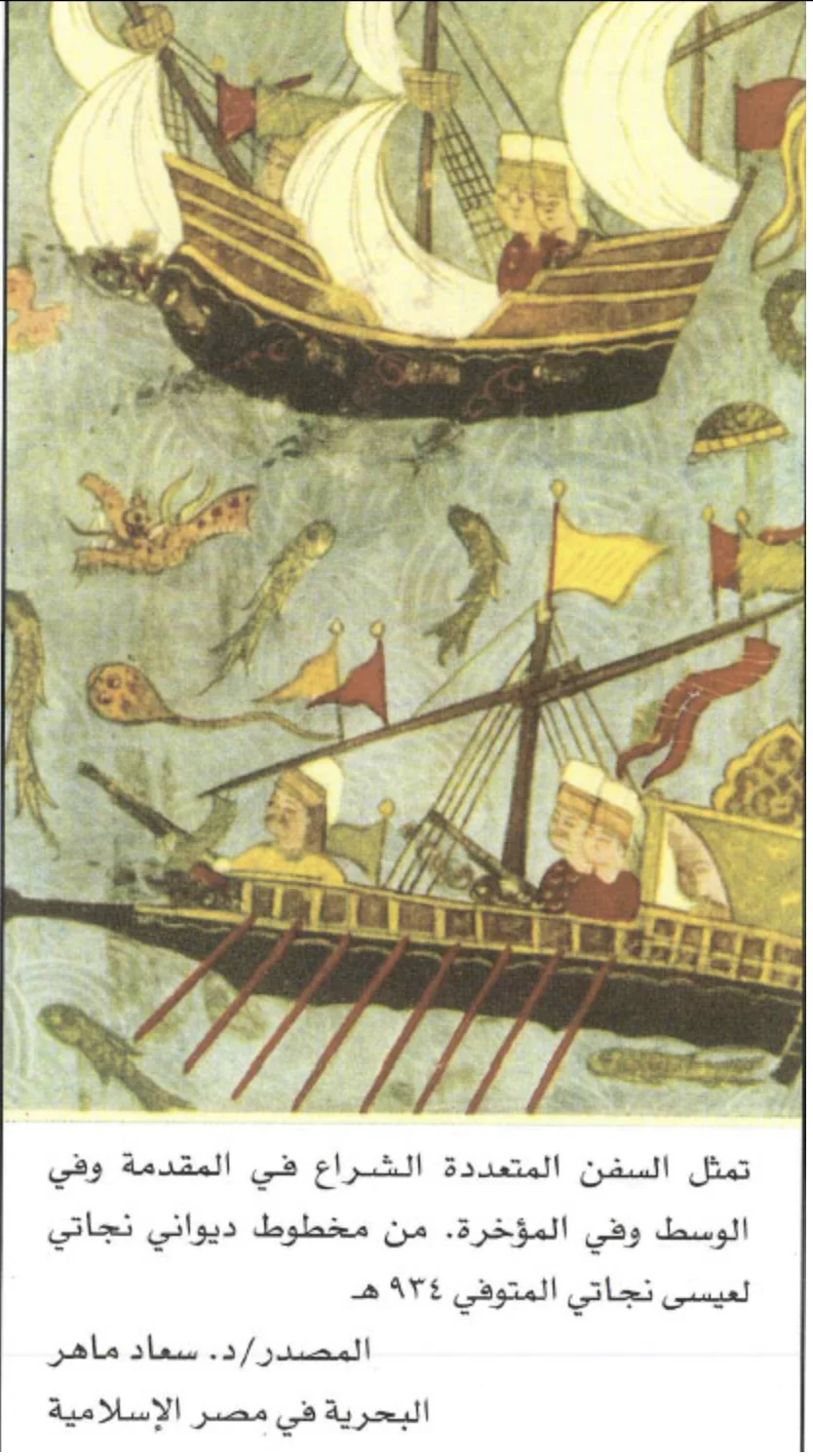
The Islamic Navy... A History to be Proud of: The Mediterranean as a Model
Prepared by: Abdul Karim Ibrahim Al-Samak
When US President Franklin Roosevelt announced his participation in World War II in 1942, before the radio broadcast of the speech, the American announcer addressed the American and international audience following his speech by saying: (All listeners to President Roosevelt's speech must follow the speech with a map of the world in their hands), and the Mediterranean Sea represents the heart of the world in ancient and modern times and was a battlefield in this war.
As it was in ancient times in the same image, and this statement is direct evidence of its geostrophic importance, it is in ancient times the base of the ancient world's right-angled triangle, and when it became an Islamic sea its status became different from what it was, for this status of this sea which was absent from the Arabs of this era today although the sea is considered in its geography an Arab sea, our Islamic nation knew its status. Sovereignty continued in it until the Ottoman era, and with the Balkan wars and the Morea peninsula, the Western countries sought to drop the Ottoman naval sovereignty and Britain, France and Russia agreed to strike the Ottoman fleet on November 20, 1827, where it belonged to both Algeria, Egypt and the Ottoman state and after the elimination of this fleet, the Mediterranean naval sovereignty of Arabs and Muslims weakened, and from that date to today the Mediterranean is controlled by ships and fleets of major powers that knew its geostrophic importance.
The migration of Muslims to Abyssinia was the first in riding the sea:
Muslims knew the sea since the dawn of Islam, through the migration of a team of them to Abyssinia fleeing the harm of Quraysh and fleeing with their religion, so this incident was their first connection with the sea and riding it.
And when the Arabian Peninsula expanded the message of Islam, and the sons of the Peninsula set out carrying the message of Islam, and riding the sea became a necessity of Jihad for the sake of supporting Islam, the Messenger of d, peace and blessings be upon him, while digging the trench after the Jews of Medina and Quraysh and their Arab allies besieged him, looked forward to the conquest of the Levant, Persia and Yemen, and the end did not come to the Messenger of d, peace and blessings be upon him, except that he had knocked on the door of the Levant with the battle of Tabuk and Mu'tah and his mobilization of the army of Usama bin Zaid, may d be pleased with him, believing in pushing his companions to strive and work to spread the message of Islam after him, and if the era of the Messenger of d, peace and blessings be upon him, did not witness Muslims riding the sea as mujahideen for the sake of d, then the era of the Rightly Guided Caliphs witnessed Muslims riding the sea working to spread the message of Islam.
The researcher in the memory of Islamic history finds that what this memory left in how Islam refined the Arab personality when it believed in it as a Sharia and a life system, the Muslim Arabs surpassed their contemporaries of nations, and were more civilized and advanced than them, and from the Arabian Peninsula the Arabs came out for the sake of supporting Islam and internationalizing its message among countries and nations, so for that they rode the backs of ships and rode the seas as if they were on the backs of their horses and camels, and this image in the story of riding the sea by Muslim Arabs, Ibn Khaldun had dealt with it in his introduction, so he spoke about the factor of fear among Muslim Arabs from the residents of central Arabian Peninsula unlike their brothers from the Arabs of South Yemen, who were sea people and masters of the Indian and Chinese seas, but Ibn Khaldun followed his words with words that replaced what preceded them, which is his saying that the Arabs when they became scholars of its arts and sciences broke the complex of fear from it and rode and the seas and deserts became theirs.
Caliph Umar bin Al-Khattab's position on riding the sea:
Dr. Suad Maher, may d have mercy on her, Professor of History and Islamic Civilization at Cairo University, is considered the best to deal with the subject of Muslims' relationship with the sea and riding it through her valuable book "The Navy in Islamic Egypt and its Remaining Effects". In this book, she adopted the subject of responding to Ibn Khaldun in explaining the lack of Muslims riding the sea, and she worked hard to make Ibn Khaldun say these words about Muslims not riding the sea based on the words of Umar Al-Khattab, may d be pleased with him. Muawiyah, Umar's vernor over the Levant, asked Umar for permission to ride the sea, but he did not allow him, and he consulted Amr ibn al-Aas, may d be pleased with him, over Egypt and he was eligible for consultation, so Amr wrote to him saying: O Commander of the Faithful, I saw the sea as a great creation ridden by a small creation, nothing but sky and water, if it settles it saddens the hearts and if it rages it confuses the minds, certainty decreases in it, and doubt increases, they are in it like worms on a stick, if it tilts it drowns and if it survives it flashes. When the book reached Umar, may d be pleased with him, he sent a book to Muawiyah preventing him from riding the risks of the sea. This image was pointed out by Ibn Khaldun as we previously mentioned, that the Arabs because of their bedouin nature were not at first skilled in sea culture and its arts and riding, so they are people who fear riding it. Here comes Dr. Suad Maher in defense of Umar's policy towards preventing Muawiyah from what happened to him in this prevention, so she says: The Arabs in the center of the Arabian Peninsula were not concerned with the sea at the beginning of the Islamic state, and that Umar, may d be pleased with him, with what he was gifted with of deliberation and sobriety, is guided by sound logic, and he restrains the reins of his leaders from raids that seem to him to have even a tiny bit of risk to the lives of Muslims. If his opinion on land raids is based on this deliberation and wisdom, then how about riding the sea?? He opposed the conquest of Egypt and it was land, and for this reason Ibn Al-Khattab, may d be pleased with him, did not find consultation with Amr ibn al-Aas at all, especially since the state he is over overlooks this sea, and it was from his prevention because of fear for Muslims, and for this reason he did not agree to Muawiyah's request to invade Cyprus. Dr. Maher es on to defend Umar and acquit him, pointing out at the same time the position of the sea in the Book of d, and its subjugation by d for human beings, ing on to say about Umar's approval of cutting the canal from the Nile to the Red Sea, and this canal was used to transport wheat from Egypt to Medina. I say: Those who look at Umar's opinion, may d be pleased with him, on Amr ibn al-Aas's project, in cutting a canal from Lake Timsah to the Mediterranean Sea north of the current Suez Canal, see in it correctness when he feared for the Muslim pilgrims from the Roman fleets, and their threat to them addition to the danger to the security of the lands of Muslims in their lands, so when Umar's vernor over Bahrain Uthman bin Al-Aas Al-Thaqafi carried the first naval campaign he carried out in the Indian Sea, when he sailed from Oman and reached "Tana" near Bombay, and his brother went in another line to the mouth of the Indus River where there is the entry of "Al-Daybul". When he returned, he wrote to Umar informing him of that, so Umar wrote to him in response to his book saying in it ((O brother of Thaqif, you carried worms on a stick, I swear by d if they were afflicted, I would have taken as many of them from your people)), and the great companion Al-Ala bin Abdullah Al-Hadri, vernor of Bahrain after the vernor Uthman, invaded the land of Persia by sea and when the Caliph knew of that, he denounced him for that because he did not consult him, even though Al-Ala was the writer of the revelation of the Messenger of d, peace and blessings be upon him, and the carrier of his message to the King of Bahrain Al-Mundhir bin Sawa, so that is Umar's position, may d be pleased with him, towards the sea and invasion in it.
And when Uthman bin Affan, may d be pleased with him, succeeded him, he agreed to Muawiyah riding the sea after refusing a previous request, and Muawiyah invaded Cyprus in the year 27 AH and the female companion Umm Haram participated in the campaign and was martyred there and her grave is still there, and by this Muawiyah would be the first vernor over the Levant who rode the sea invading, and the raids of Muslims in the Mediterranean were repeated, and in the Ayyubid era the sea was completed after it was known as the Sea of the Romans.
The Mediterranean Sea became an Islamic sea in the Umayyad era:
With the establishment of the Umayyad Caliphate on the land of the Levant, the Islamic conquest by land and sea became active, so the raids of Muslims on the lands of the Romans by sea increased. The Muslim naval commander Abdullah bin Qais invaded more than fifty naval raids in summer and winter. In the year 30 AH, Junada bin Umayya Al-Azdi conquered the island of Rhodes belonging to the Romans, and in the year (34- 655 AD) the Battle of the Masts took place. The Muslims intended through this campaign to discipline the Romans, where the Levantine fleet led by Ibn Qais and the Egyptian fleet led by Abdullah bin Abi Al-Sarh went out. In this battle, the Muslims defeated the Romans, and the leader of the Romans was Constans II, who miraculously escaped fleeing to Sicily and there its people killed him. In the year 49 AH, the Muslims attacked Constantinople led by Sufyan bin Awf and Junada Al-Azdi. The number of the Muslim fleet in this campaign reached 1700 ships. Muawiyah supported the campaign with reinforcement led by his son Yazid and a number of companions walked with him, including Abu Ayyub al-Ansari, who was martyred under its walls and his grave is still known there. Because of the lack of non-Islamic naval powers in the Mediterranean, the shores of the sea and its islands were opened to the Muslims. In the year 54 AH, the Muslims invaded Crete, and in the year 68- 69 AH the Muslims invaded Sicily and returned loaded with booty. The raids of the Muslims continued in all parts of the Mediterranean, and they invaded Constantinople again in (59-679 AD) resulting in the signing of a peace treaty between Constantine IV, King of the Romans, and the Umayyad state and by this Islamic sovereignty over the Mediterranean was achieved. Dr. Hussain Monès, may d have mercy on him, comments on the Muslims' inability to conquer Constantinople since the Umayyad era to change the face of European history. Its subjects provided it with nearly nine centuries after the Umayyad attempts to complete its great historical role in preserving the Sicilian character of the Balkans, and the second is the introduction of all Slavs including the Russians into Christianity. For this reason, when Constantinople fell at the hands of the Ottomans in 1453 AH, this city had completed its mission and its historical role in these two aspects, which had the furthest impact on the path of Islam in Eastern Europe, rather in the history of all Europe. His words end, may d have mercy on him, and after its conquest its name became the city of Islam, Islambol or Istanbul.
This sovereignty came after the Muslims took care of the navy weapon, so they built houses and basins for it. Amr ibn al-Aas was one of the first to care about building ships and established a special house for them in the Egyptian island of Rawda because the Egyptians were people of knowledge in shipbuilding. On the Levantine coast, Muawiyah built a number of houses for shipbuilding, and brought Egyptian workers and employees for them. The ships of the Umayyad fleet reached 1800 ships in number, and they were divided into five fleets. There was the fleet of Egypt and its base was Alexandria, the fleet of Africa and its base was Tunis, the fleet of the Nile and its base was Babylon, a special fleet for the Indian Ocean, and there was a fleet protecting the entrances of the Nile. The memory of Islamic history has preserved for us the active naval activity of Muslims, because the Umayyad state spent (7000) dinars annually on manufacturing houses. In the era of Abd al-Malik ibn Marwan, a house for ships was established there, and this house built a naval fleet that reached around a hundred ships specifically for the Muslim leader Musa bin Nusayr, may d have mercy on him.
We must mention with odness here, in addition to Dr. Suad Maher, Dr. Hosni Monès in his valuable effort when he published his precious book Atlas of the History of Islam, where he devoted a special chapter to the Islamic Navy with more than ten naval maps in which he documented Islamic sovereignty over the Mediterranean, and that the Umayyads were the owners of this matter. He also wrote another book and titled it (History of Muslims in the Mediterranean), in which he also spoke about the place of the Umayyads in the Islamization of this sea.
As for the Abbasid era, the state's interest in the sea and riding it decreased, and for this reason the Muslims' naval activity declined, due to the distance of the capital of the caliphate from the sea. Islamic sovereignty over the sea remained with the succession of Islamic states between strength and weakness, especially in the periods of the Fatimid -Obaidi- Middle Ages and periods of the Crusades until our modern contemporary history - the era of the Ottoman state. On the reality of the Crimean and Morea war which resulted in the independence of Greece in 1826 AD, the Battle of Navarino on 20/10/1827 AD was a separator in the weakness of the Islamic fleet in the Mediterranean, where Islamic sovereignty collapsed in this sea with the growth of the fleets of the Western colonial countries in it, and the collapse of the Ottoman Caliphate with the establishment of the Turkish state and the fall of most countries of the Arab world into the clutches of European colonialism.
The Mediterranean Sea, in the importance of its geopolitical site, occupies the global status it was known for in its past, for it is in its present as its past in terms of status and importance, representing the heart of the world as classified by the British geographer "Mackinder" and who owns the heart owns the world. All this and the Arab reality were absent from the status of this sea which the ancestors of the Arabs previously knew and they had sovereignty over it for more than twelve centuries through the warships they owned which were a direct cause of this Islamic sovereignty.