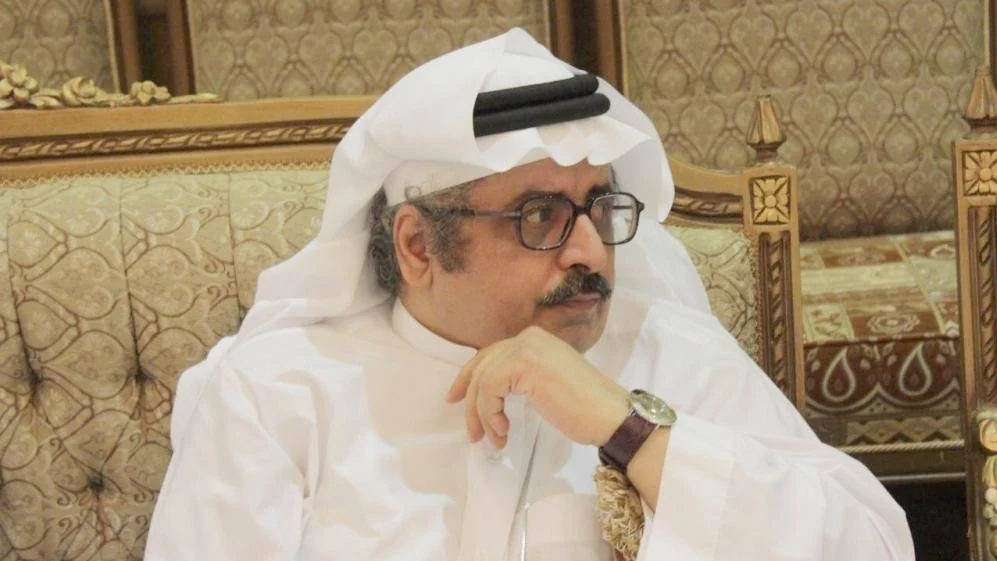
The passing of poet Mohammed Zayed Al-Almai, author of "In the Wind of Childhood", at age 65
Ahwal Al-Marifa – Special
The Saudi poet Mohammed Zayed Al-Almai passed away this morning in Cairo at the age of 65 after suffering a stroke two days a. The Ambassador of the Custodian of the Two Holy Mosques to the Arab Republic of Egypt, Osama Naqli, closely monitored the health condition of the poet who suffered an emergency situation and was admitted to a private hospital in Cairo, where he passed away.
The poetry of Mohammed Zayed Al-Almai—most of which was not collected in poetic collections—represents an advanced experience of renewal in contemporary Saudi poetry. He focused on the questions of the poetic self in the face of existence and was always obsessed with small daily details, addressing his poetic self at times or objectifying it, in a pictorial poetic experience with multiple visions, as in his famous poem: "In the Wind of Childhood", including:
At a punctuation in the wind of childhood... He stopped me where the boy was... He showed me his notebooks and maps of his dreams... He was a glorious plant like his mountain ancestors... From the pre-eternity of the soul to eternity... He was reading them and restoring their dictionaries like them... So he names the villages a homeland... and the fields a country... And he was boasting that they planted a sidr tree in his name when he was born... And he said I will house pigeons in it to drown it with cooing... Whenever I meet the girls on Sunday morning... And he said I will choose one of them and age her in the jars of the city until she wafts like summer... and smells of basil and flows like hail... And he said I will release her in the paths of the city... as a free mare... Oh, this old boy.
Mohammed bin Zayed bin Mohammed Al-Almai was born in 1377 AH / 1958 AD in Rijal Almaa in the Rijal Almaa vernorate located in the Asir region in southwestern Saudi Arabia. He graduated from teachers' college and then studied agriculture at King Abdulaziz University. He worked in education for several years and then entered journalism, where he was editor of the cultural pages in Al-Bilad newspaper and founded the cultural section in Al-Watan newspaper in its early days in Abha. He founded with colleagues the literary magazine Bayader issued by the Abha Literary Club. He was a member of the Saudi Arabian Society for Culture and Arts, the Abha Literary Club, and the Jeddah Literary Club. He had participations in poetry evenings, seminars, and meetings inside and outside the Kingdom.
Mohammed Zayed Al-Almai, who lived most of his final years between Paris and Cairo, was sketching the outlines of the final scene of his life, writing: "To believe my watch I need time, to be temporary, immortalized, and eternal I need death." One writer says of him: Mohammed Zayed the poet writes the poem as mature as the language intended for it since the mid-seventies, before a thousand poems matured in the new Saudi poem. Since that age, he has been spinning between the whirlpools of a third poem, which turns him whenever it hangs from the ceiling of a new tragedy, and he turns it as his true poetic nature intended, until his poem became his biography, since he was a child until he became an old boy. "Oh, this old boy" who "did not reach, for fifty years, what he intended."
Mohammed Zayed the poet feels much alienation, an intuitive result of the sharp turns his life passed through, which no one crosses safely except one who wants the truth with a sound heart. Therefore, we see him in most of his poems leaning on social contexts and the patterns of strange relationship between the intellectual poet and people and what surrounds them. Then his poem dissolves into a deep philosophy of his conditions, and many times he strips from his self a child with large and beautiful ambitions at the same time, then wanders in his heart, and always increases the restorative narrative of the dreams and characteristics of Mohammed Zayed the child. Mohammed Zayed the poet sails with the poem into worlds of imagination, internalizing the self, making the poem a poetic knowledge message, building the present on the past at times and cutting it from it at other times, looking at the outcome that was not from the dreams of childhood, until the child dies in it—that is, he dies as an ambitious person, and anchors on shores of anxiety, frustration, and unfulfilled hopes, which suggests a desire to rebel against the causes of death for the child Mohammed Zayed, who has nothing left for contemplation except granting the child the chance to "spell his elegies."