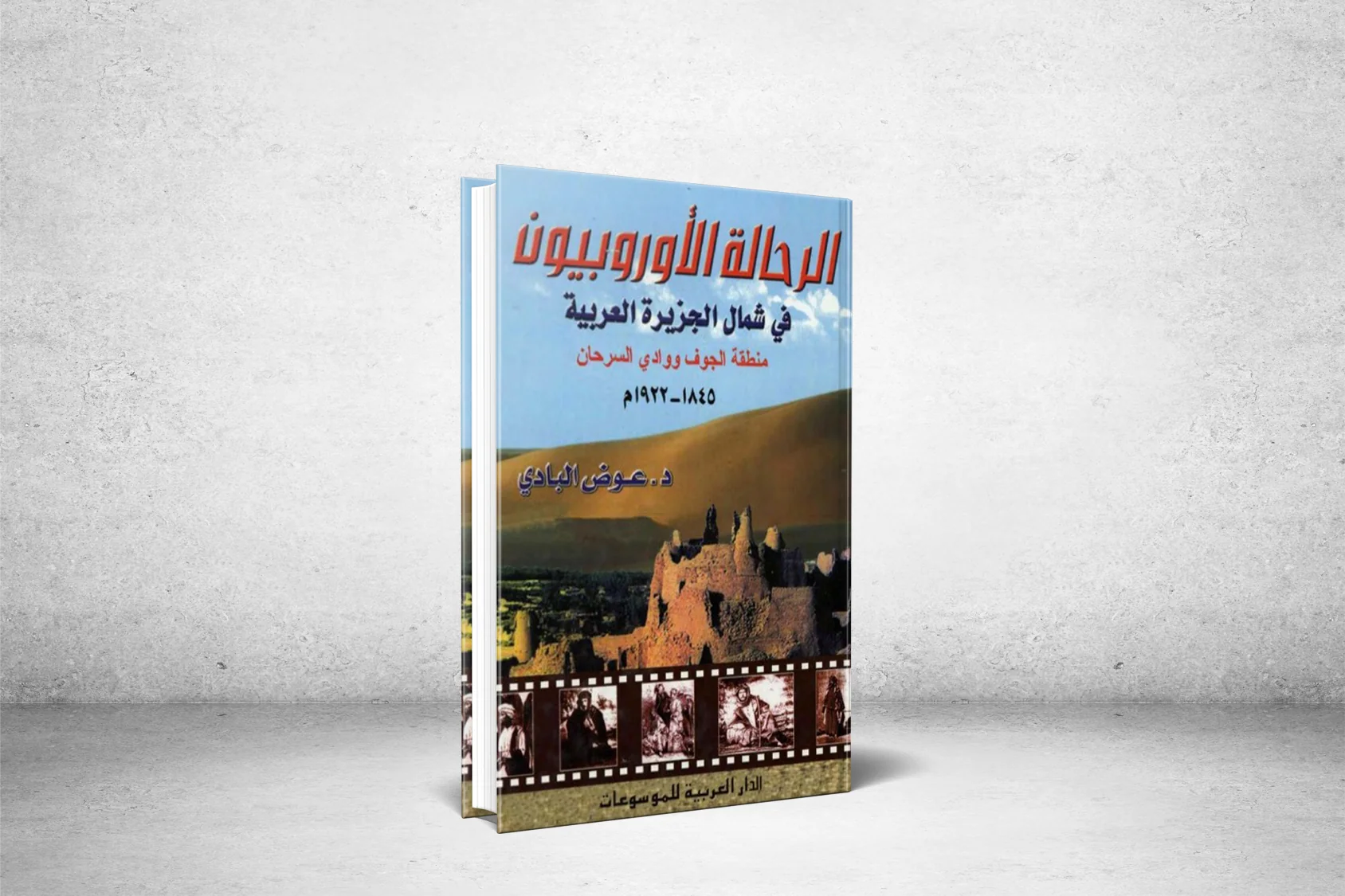
An overview of the book "European Travelers in Northern Arabia: Al-Jouf Region and Wadi Al-Sirhan 1845–1922"
Hajjaj Salama
In his book "European Travelers in Northern Arabia: Al-Jouf Region and Wadi Al-Sirhan 1845–1922," Dr. Awadh Al-Badi monitors the arrival of a large number of travelers and orientalists from various backgrounds and als to the Arabian Peninsula during the 19th century. He shows how these individuals, each according to their purpose, provided a wealth of information about the unknown conditions of the peninsula in books or reports they submitted to their sponsors, documenting what they saw and heard. Al-Badi, in his book published by the Arab Encyclopedia House in Beirut, points out the varying scientific value of these writings, but emphasizes that they remain essential primary material for any researcher in the history of the peninsula across political, social, and economic fields.
The author notes that the scientific history of discovering the peninsula began with Carsten Niebuhr's 1761 Danish expedition to Yemen. In 1772, Niebuhr's first work appeared, including a general description of the land and regions like Yemen, Hadramaut, Oman, the Gulf, Najd, Hijaz, and Sinai. Niebuhr is considered the first to bring news of the Wahhabi movement in Najd to Europe. Following his footsteps in the 19th century, Europeans arrived in various regions, and their writings became the primary source of Western knowledge about these areas. Important figures included Seetzen and Burckhardt. By the mid-19th century, interest shifted to the central peninsula, which was undering significant political changes. Between 1845 and the end of the century, travelers recorded many details about the region's political, social, and tribal structures.
The Al-Jouf and Wadi Al-Sirhan region, forming the northern section of the peninsula, served as the primary gateway for European travelers to central Arabia, making it one of the most documented regions for nearly a century. Dr. Awadh Al-Badi considers providing these writings a scientific duty to facilitate knowledge about this strategic part of Arabia. He states that Al-Jouf and Wadi Al-Sirhan were the first origin of the Arab person, as proven by archaeological inscriptions. During the preparation of his book, he found it impossible to present a complete picture of the region without knowing what Western travelers wrote. After a comprehensive survey of English, French, and German sources, he found over fifteen travelers—including scientists, merchants, spies, and missionaries—between 1808 and 1922. He chose a simplified approach, introducing the traveler and the journey, then providing the original text to allow readers to judge for themselves, correcting only names or dates for clarity. The book covers travelers like Georg August Wallin, Gifford Palgrave, Carlo Guarmani, Charles Huber, Lady Anne Blunt, Julius Euting, Baron Eduard Nolde, Archibald Forder, S.S. Butler, Alois Musil, and St. John Philby.