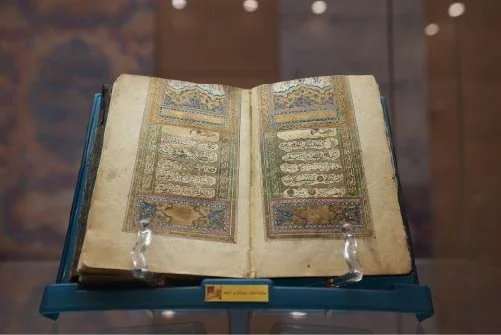
Writing... and its role in cultural advancement
Yousry Abdel Ghani Abdullah*
We might not be exaggerating if we decide that the first seed in forming Arab-Islamic heritage was born with the revelation of the first verse of the Quran, and our evidence for that is that the first word of the first surah revealed to the Prophet Muhammad was: (READ).... This means that Islam asks all people to care for science and knowledge through reading and writing. The word (READ) means reading as recitation that does not require something written, or the recitation of something written. The first was assigned to the Messenger of Allah Muhammad, and the second requires everyone who believes and becomes Muslim to learn writing to read it, and this means every Muslim man and woman, each according to their circumstances, capabilities and energy. It is certain that the Arabs knew reading and writing before Islam, rather there are books that appeared and were known in the first century AH relying on pre-Islamic records. Among these books: a book dealing with the history of the Himyarites in Yemen, titled: (History of Yemen, its Poems and Genealogies) by Ubaid bin Sharya al-Jurhumi, and another book titled (The Book of Kings) written by Wahb bin Munabbih, who mentioned that he included in this book the works of his predecessors on the same subject. If we look at the old Arabic books of genealogy, it is likely that most of the famous genealogists who authored books on genealogy lived before Islam, and some of them were veteran (lived in both Jahiliyyah and Islam). Among the oldest: the genealogist Satih al-Dhabi, who died in 552 AH - 472 AD. It is said that he was a soothsayer and wise man, and he did not rely on memory alone in preserving knowledge of genealogy, wisdom and others, but rather he returned to books previous to him. This applies to the stories of the Days (Ayyam al-Arab) which cannot in any case be the inventions of a writer in Iraqi Baghdad or Syrian Damascus (1),. Therefore, the stories of the Arab days and the heritage of genealogies in addition to some historical forms whose cradle was the middle of the Arabian Peninsula and the Hijaz especially were recorded due to the influence of some countries neighboring the Arabs which were closer to cultural influence like Yemen and the North (2). As for the scripts that appeared in this milieu, the first was the Makki script, then followed by the Madani script, both of which had Alifs tilting to the right (the fingers), and in its form there is a slight reclining (3). Also, the difficulty of the means used in writing did not prevent Arabs from recording, codifying or writing; they had branches, thin white stones, saddle pads, shoulder bones, and skins that were tanned in Arab Taif, and the difficulty of writing on them did not stop them; they used them, and the later inherited them from the former. If the historian al-Baladhuri, author of (Futuh al-Buldan), indicated the small number of writers in Quraish when Islam rose, and set their number at seventeen only (4), it has been proven by study and scrutiny from the sources that came after al-Baladhuri, as well as the numerous names mentioned by other historians and writers, that the information he mentioned was inaccurate. And if Muhammad bin Sa'd, author of (Al-Tabaqat), followed the information stated by al-Baladhuri in mentioning this matter, one of the modern researchers, Professor Dr. Nasir al-Din al-Asad, examined Ibn Sa'd's Tabaqat specifically, as well as other sources generally, and studied them carefully. Dr. al-Asad says: Ibn Sa'd forgets a large number of men who used to write in Jahiliyyah, but he hardly mentions that before commenting on it by saying: (And writing among Arabs was little). That is when mentioning the biography of all those who wrote in the pre-Islamic era, for the number of those mentioned by Ibn Sa'd is so large that it is not right for him to repeat his phrase every time he mentions a pre-Islamic reader (5). We say in turn: It is truly unfortunate that there is a massive void among many researchers regarding the issue of writing among Arabs, and all of them rely on al-Baladhuri's narration without scrutiny or study. Perhaps this is what led to abusing the Arabs generally, and thus abusing Islam - the religion of science and knowledge - in a hidden way. Among those who played a role in this was Jurji Zaydan, whom we appreciate and respect despite our disagreement with him on several issues, who wanted to give some logical reasoning in an attempt to influence Arab thought generally and Islamic specifically, where he attributed the delay of script, reading and writing in the Hijaz and Mudar Arabs to the prevailing Bedouin nature!! Writing is one of the urban crafts (6). Despite the many remarks on Jurji Zaydan's words, we will limit ourselves to what was addressed by some modern researchers who researched the case and responded with a scientific response refuting the narrations we previously mentioned. We say: the word "reading" and its various derivatives appeared before Islam, and Islam honored it in the Quran, when the first of its pure verses was revealed, the Almighty says: (Read in the name of your Lord who created (1), Created man from a clot (2) Read and your Lord is the most Generous (3) Who taught by the pen (4) Taught man what he knew not (5)). What is coupled with reading is writing and its means, and writing was known among the ancient Arabs by the pen, and that came in the Almighty's saying: (Nun. By the pen and what they write) (Al-Qalam:1), and this "writing" is script. And it came in the Almighty's saying: (Or you have a house of ornament or you ascend into the sky, and we will never believe in your ascension until you bring down to us a book we read. Say, Glory be to my Lord! Am I anything but a human messenger?) (Al-Isra: 93). The meaning: or you have a house of ld, or you ascend in the stairs of heaven, and we will never believe that you ascended to it until you bring down to us a book from it that we read witnessing to the truth of your prophecy, so say I glorify my Lord from being controlled by such imaginations, for am I anything but a human messenger from those whom Allah sends to their people (7). The verse expresses the suggestions of the polytheists or pre-Islamic Arabs, and we clearly conclude from it that the nation that does not know writing nor reading does not ask for a book to be revealed to it, and the nation that only owns a few readers is impossible to ask for a book as a general guide for it. As it came in another verse of the Holy Quran: (Nay, every man of them desires that he be given scrolls spread open) (Al-Muddathir: 53). And "scrolls spread open" means papers spread and read, and the meaning is that every man of them wants special scrolls to be revealed to him specifically addressed in his name (8). Meaning: they ask for books to read collectively or individually, rather each of them desires that a book specifically for him be revealed from heaven. Can we after that accept the saying that writing was little in an environment where the Quran was revealed? The Glorious Quran including its complete depiction of this society in which reading and writing spread alongside the faculty of memorization in which the Arabs excelled (9). We say: the Holy Quran mentioned the tools of writing that were common, familiar and used in the Arab environment, and which the Arab society knew well, otherwise the Quran wouldn't have mentioned them. From that what came in the Almighty's saying: (And if We had sent down to you a book on a scroll and they touched it with their hands, those who disbelieved would have said: This is nothing but clear magic) (Al-An'am: 7). The scroll (Qirtas) is the page on which one writes, and the meaning: if We revealed to you a book written on paper and they touched it with their hands, those who disbelieve would have said: what is this but clear magic (10). And He says: (And if all the trees on earth were pens and the sea [were ink], with seven seas yet added to it, the words of Allah would not be exhausted. Indeed, Allah is Exalted in Might and Wise) (Luqman: 27). The meaning: if what is on earth of trees were pens, and the sea were ink supplied by seven seas like it, the wisdom of Allah and His perfect signs would not perish, He is Mighty and Wise (11),. And the Almighty says: (By the Mount (1), And a Book inscribed (2) In a scroll spread open (3)) (At-Tur). "A Book inscribed" means written. The intended Book in the Quranic verses is either what Allah wrote in the Preserved Tablet, or in the tablets of the Prophet of Allah Moses (AS). And "In a scroll spread open", the scroll is the skin written upon, as was the habit of the ancients before the invention of paper (12). We return to say: these verses all confirm the ancient Arabs' knowledge of writing and its various tools, rather it is not limited to what we mentioned, but extends beyond that, where it mentions skins, scrolls (paper from papyrus or others), and the means used in writing is the pen, and the liquid used is the ink. In conclusion: that was what we were able to reach from our reading of some known books of interpretation of the Glorious Book of Allah, as well as what some venerable researchers concluded, among them: Professor Muhammad Izzat Darwaza in his article titled: (A look at the narration of the delay of the Arabic script) published in the Journal of the Arabic Language Academy in Cairo in 1964/1965 AD. And the book of Professor Amin Madani (Arab History and its Sources) which he published within the series (Arabs in the Eras of History) – The Book: (Sources of Pre-Islamic Poetry) by Dr. Nasir al-Din al-Asad, and others from which we benefited in these lines.
Footnotes:
1. Hussein Muhammad Suleiman, Arab-Islamic Heritage, Cairo, 1987, p. 316.
2. Rosenthal, History of Historiography in Islam, trans. Saleh al-Ali, Beirut, pp. 21-25.
3. Ibn al-Nadim, Al-Fihrist, Beirut, p. 7.
4. Al-Baladhuri, Futuh al-Buldan, Cairo, 1956, 2/580.
5. Nasir al-Din al-Asad, Sources of Pre-Islamic Poetry, Cairo, pp. 42-43.
6. Jurji Zaydan, History of Islamic Civilization, 2/51.
7. Muhammad Farid Wajdi, The Interpreted Quran, Cairo, 1977, Surah Al-Isra.
8. Ibid, Surah Al-Muddathir.
9. Hussein Muhammad Suleiman, Arab-Islamic Heritage, p. 218.
10. Muhammad Farid Wajdi, The Interpreted Quran, Surah Al-An'am.
11. Ibid, Surah Luqman.
12. Ibid, Surah At-Tur.
We might not be exaggerating if we decide that the first seed in forming Arab-Islamic heritage was born with the revelation of the first verse of the Quran, and our evidence for that is that the first word of the first surah revealed to the Prophet Muhammad was: (READ).... This means that Islam asks all people to care for science and knowledge through reading and writing. The word (READ) means reading as recitation that does not require something written, or the recitation of something written. The first was assigned to the Messenger of Allah Muhammad, and the second requires everyone who believes and becomes Muslim to learn writing to read it, and this means every Muslim man and woman, each according to their circumstances, capabilities and energy. It is certain that the Arabs knew reading and writing before Islam, rather there are books that appeared and were known in the first century AH relying on pre-Islamic records. Among these books: a book dealing with the history of the Himyarites in Yemen, titled: (History of Yemen, its Poems and Genealogies) by Ubaid bin Sharya al-Jurhumi, and another book titled (The Book of Kings) written by Wahb bin Munabbih, who mentioned that he included in this book the works of his predecessors on the same subject. If we look at the old Arabic books of genealogy, it is likely that most of the famous genealogists who authored books on genealogy lived before Islam, and some of them were veteran (lived in both Jahiliyyah and Islam). Among the oldest: the genealogist Satih al-Dhabi, who died in 552 AH - 472 AD. It is said that he was a soothsayer and wise man, and he did not rely on memory alone in preserving knowledge of genealogy, wisdom and others, but rather he returned to books previous to him. This applies to the stories of the Days (Ayyam al-Arab) which cannot in any case be the inventions of a writer in Iraqi Baghdad or Syrian Damascus (1),. Therefore, the stories of the Arab days and the heritage of genealogies in addition to some historical forms whose cradle was the middle of the Arabian Peninsula and the Hijaz especially were recorded due to the influence of some countries neighboring the Arabs which were closer to cultural influence like Yemen and the North (2). As for the scripts that appeared in this milieu, the first was the Makki script, then followed by the Madani script, both of which had Alifs tilting to the right (the fingers), and in its form there is a slight reclining (3). Also, the difficulty of the means used in writing did not prevent Arabs from recording, codifying or writing; they had branches, thin white stones, saddle pads, shoulder bones, and skins that were tanned in Arab Taif, and the difficulty of writing on them did not stop them; they used them, and the later inherited them from the former. If the historian al-Baladhuri, author of (Futuh al-Buldan), indicated the small number of writers in Quraish when Islam rose, and set their number at seventeen only (4), it has been proven by study and scrutiny from the sources that came after al-Baladhuri, as well as the numerous names mentioned by other historians and writers, that the information he mentioned was inaccurate. And if Muhammad bin Sa'd, author of (Al-Tabaqat), followed the information stated by al-Baladhuri in mentioning this matter, one of the modern researchers, Professor Dr. Nasir al-Din al-Asad, examined Ibn Sa'd's Tabaqat specifically, as well as other sources generally, and studied them carefully. Dr. al-Asad says: Ibn Sa'd forgets a large number of men who used to write in Jahiliyyah, but he hardly mentions that before commenting on it by saying: (And writing among Arabs was little). That is when mentioning the biography of all those who wrote in the pre-Islamic era, for the number of those mentioned by Ibn Sa'd is so large that it is not right for him to repeat his phrase every time he mentions a pre-Islamic reader (5). We say in turn: It is truly unfortunate that there is a massive void among many researchers regarding the issue of writing among Arabs, and all of them rely on al-Baladhuri's narration without scrutiny or study. Perhaps this is what led to abusing the Arabs generally, and thus abusing Islam - the religion of science and knowledge - in a hidden way. Among those who played a role in this was Jurji Zaydan, whom we appreciate and respect despite our disagreement with him on several issues, who wanted to give some logical reasoning in an attempt to influence Arab thought generally and Islamic specifically, where he attributed the delay of script, reading and writing in the Hijaz and Mudar Arabs to the prevailing Bedouin nature!! Writing is one of the urban crafts (6). Despite the many remarks on Jurji Zaydan's words, we will limit ourselves to what was addressed by some modern researchers who researched the case and responded with a scientific response refuting the narrations we previously mentioned. We say: the word "reading" and its various derivatives appeared before Islam, and Islam honored it in the Quran, when the first of its pure verses was revealed, the Almighty says: (Read in the name of your Lord who created (1), Created man from a clot (2) Read and your Lord is the most Generous (3) Who taught by the pen (4) Taught man what he knew not (5)). What is coupled with reading is writing and its means, and writing was known among the ancient Arabs by the pen, and that came in the Almighty's saying: (Nun. By the pen and what they write) (Al-Qalam:1), and this "writing" is script. And it came in the Almighty's saying: (Or you have a house of ornament or you ascend into the sky, and we will never believe in your ascension until you bring down to us a book we read. Say, Glory be to my Lord! Am I anything but a human messenger?) (Al-Isra: 93). The meaning: or you have a house of ld, or you ascend in the stairs of heaven, and we will never believe that you ascended to it until you bring down to us a book from it that we read witnessing to the truth of your prophecy, so say I glorify my Lord from being controlled by such imaginations, for am I anything but a human messenger from those whom Allah sends to their people (7). The verse expresses the suggestions of the polytheists or pre-Islamic Arabs, and we clearly conclude from it that the nation that does not know writing nor reading does not ask for a book to be revealed to it, and the nation that only owns a few readers is impossible to ask for a book as a general guide for it. As it came in another verse of the Holy Quran: (Nay, every man of them desires that he be given scrolls spread open) (Al-Muddathir: 53). And "scrolls spread open" means papers spread and read, and the meaning is that every man of them wants special scrolls to be revealed to him specifically addressed in his name (8). Meaning: they ask for books to read collectively or individually, rather each of them desires that a book specifically for him be revealed from heaven. Can we after that accept the saying that writing was little in an environment where the Quran was revealed? The Glorious Quran including its complete depiction of this society in which reading and writing spread alongside the faculty of memorization in which the Arabs excelled (9). We say: the Holy Quran mentioned the tools of writing that were common, familiar and used in the Arab environment, and which the Arab society knew well, otherwise the Quran wouldn't have mentioned them. From that what came in the Almighty's saying: (And if We had sent down to you a book on a scroll and they touched it with their hands, those who disbelieved would have said: This is nothing but clear magic) (Al-An'am: 7). The scroll (Qirtas) is the page on which one writes, and the meaning: if We revealed to you a book written on paper and they touched it with their hands, those who disbelieve would have said: what is this but clear magic (10). And He says: (And if all the trees on earth were pens and the sea [were ink], with seven seas yet added to it, the words of Allah would not be exhausted. Indeed, Allah is Exalted in Might and Wise) (Luqman: 27). The meaning: if what is on earth of trees were pens, and the sea were ink supplied by seven seas like it, the wisdom of Allah and His perfect signs would not perish, He is Mighty and Wise (11),. And the Almighty says: (By the Mount (1), And a Book inscribed (2) In a scroll spread open (3)) (At-Tur). "A Book inscribed" means written. The intended Book in the Quranic verses is either what Allah wrote in the Preserved Tablet, or in the tablets of the Prophet of Allah Moses (AS). And "In a scroll spread open", the scroll is the skin written upon, as was the habit of the ancients before the invention of paper (12). We return to say: these verses all confirm the ancient Arabs' knowledge of writing and its various tools, rather it is not limited to what we mentioned, but extends beyond that, where it mentions skins, scrolls (paper from papyrus or others), and the means used in writing is the pen, and the liquid used is the ink. In conclusion: that was what we were able to reach from our reading of some known books of interpretation of the Glorious Book of Allah, as well as what some venerable researchers concluded, among them: Professor Muhammad Izzat Darwaza in his article titled: (A look at the narration of the delay of the Arabic script) published in the Journal of the Arabic Language Academy in Cairo in 1964/1965 AD. And the book of Professor Amin Madani (Arab History and its Sources) which he published within the series (Arabs in the Eras of History) – The Book: (Sources of Pre-Islamic Poetry) by Dr. Nasir al-Din al-Asad, and others from which we benefited in these lines.
Footnotes:
1. Hussein Muhammad Suleiman, Arab-Islamic Heritage, Cairo, 1987, p. 316.
2. Rosenthal, History of Historiography in Islam, trans. Saleh al-Ali, Beirut, pp. 21-25.
3. Ibn al-Nadim, Al-Fihrist, Beirut, p. 7.
4. Al-Baladhuri, Futuh al-Buldan, Cairo, 1956, 2/580.
5. Nasir al-Din al-Asad, Sources of Pre-Islamic Poetry, Cairo, pp. 42-43.
6. Jurji Zaydan, History of Islamic Civilization, 2/51.
7. Muhammad Farid Wajdi, The Interpreted Quran, Cairo, 1977, Surah Al-Isra.
8. Ibid, Surah Al-Muddathir.
9. Hussein Muhammad Suleiman, Arab-Islamic Heritage, p. 218.
10. Muhammad Farid Wajdi, The Interpreted Quran, Surah Al-An'am.
11. Ibid, Surah Luqman.
12. Ibid, Surah At-Tur.