Holy Quran Exhibitions in the West
Israa Hussein
Many Westerners always look forward to studying Eastern civilization and the works and manuscripts that contributed in past centuries to rescuing humanity from the darkness it was in, enlightening humanity with cultures and sciences in various fields. Researchers and scientists realize how much the impact of what came from the East had in lighting the sky of humanity with light. Therefore, they always study civilizations, books, and works, and they also realize the depth of what was stated in the Holy Quran in the lives of Muslims and its impact on the world as a whole, being the word of d Almighty. Hence, it was necessary to know what came in the Holy Quran, even if in a general way. Therefore, exhibitions and conferences are held from time to time that research the Holy Quran from its various angles, for example: in terms of copies of the Holy Quran written hundreds of years a, the types of calligraphy in which these copies were written, in addition to the decorations found in some copies, as well as knowing the museums that preserve these archaeological and historical copies, in addition to standing on the interpretation of some of the Quranic verses and trying to understand some of the meanings from the interpretations of the Quranic verses. Usually, such occasions enjoy a great turnout among intellectuals, researchers, scientists, and various groups of Western society.
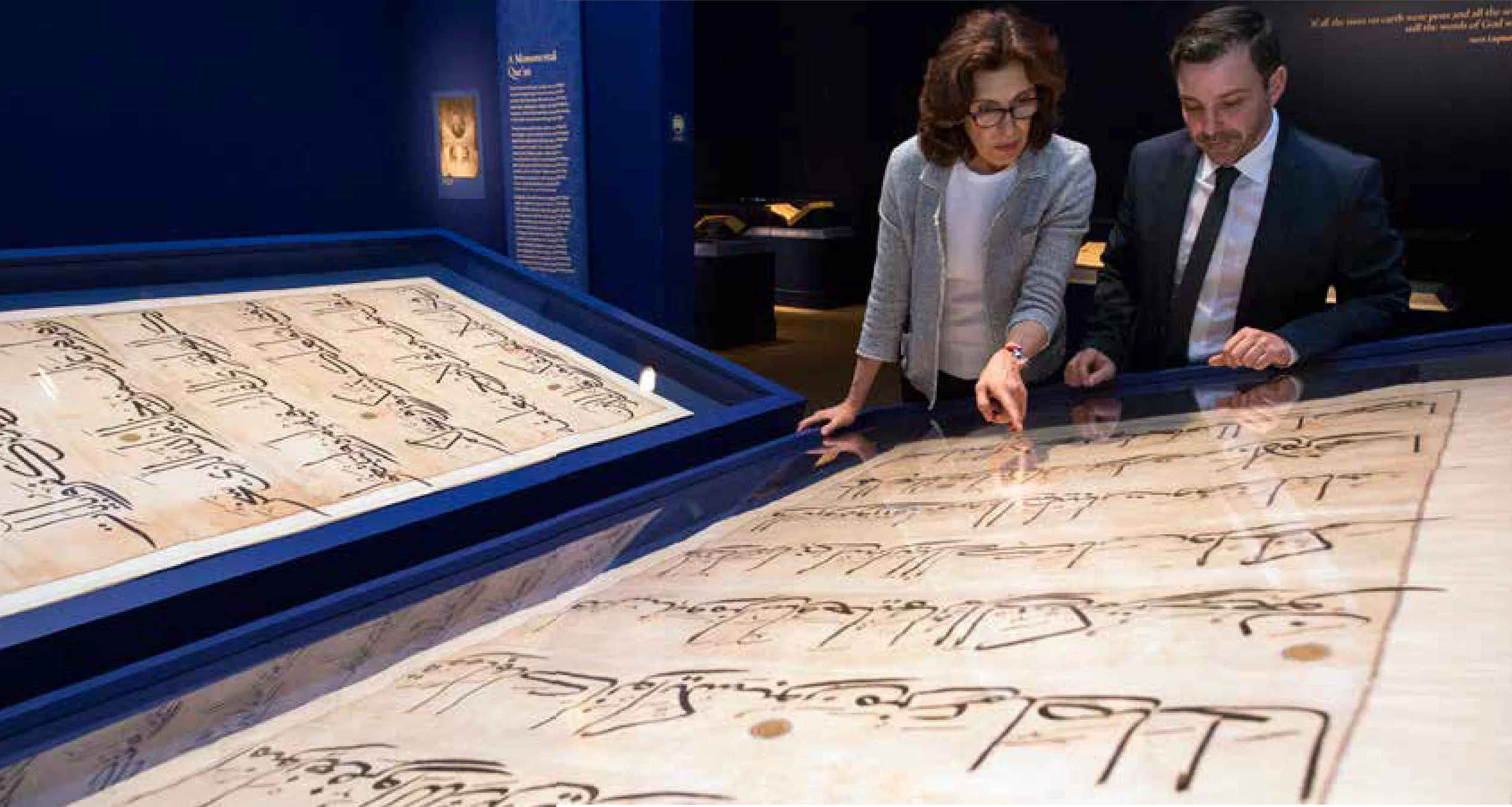
The first exhibition of the Holy Quran in the United States was held in 2016 at the Smithsonian Museum in Washington, D.C., where the exhibition contained (47) hand-written copies brought from Turkey, dating back hundreds of years and preserved in the Museum of Turkish and Islamic Arts in Istanbul, which was established more than a hundred years a. It included several copies of the Holy Quran from different countries. The exhibition also included (18) copies from the permanent collections at the Freer Gallery of Art and the Arthur M. Sackler Gallery, both part of the Smithsonian Institution in Washington, America.
The manuscripts brought to this museum are representative of an important geographical spot of Islamic countries extending from Turkey to Afghanistan, and covering approximately 1,000 years of Islamic art history between the eighth and seventeenth centuries.
Maria DeKit, one of the researchers who attended this exhibition and a professor at George Mason University in America in the subject of the history of the Islamic religion, said: The Holy Quran includes direct directions to the world on the necessity of following virtue and morality. It is a series of exhortations to moral orientations and includes many prophetic stories of prophets who preceded the Prophet Muhammad (peace and blessings be upon him). It also includes events and stories that happened in the time of the Prophet Muhammad (peace and blessings be upon him). It is a book that calls humanity to think, understand their lives, and what is happening around them in the world. She added: The world must look at this heavenly book away from the charges that are falsely and unjustly attributed to this holy book, which is the product of Islamophobia. But when reading the Holy Quran carefully, the world will realize the great truth and the correctness that came in the Holy Quran. Then Professor DeKit adds: The copies displayed in the exhibition show the beauty of the calligraphy and decoration with which these copies were written and drawn, and they appear with a distinctive beauty.
Defining Islamic Civilization:
The importance of holding such exhibitions also lies in the transfer of those valuable copies and their display in important Western museums and galleries to introduce the Western world to the Holy Quran and Arab and Islamic civilization after they remained for long centuries only in the Museum of Islamic Arts in Turkey. Anyone who wants to see them and learn about their content had to to Turkey to visit those exhibitions. In this regard, Massumeh Farhad, the museum's chief curator and curator of Islamic art, says: "This exhibition is indeed a kind of unprecedented opportunity to see a different side of the Quran, and how incredibly beautiful these copies are."
What distinguishes these rare copies of the Holy Quran is that they are historical copies dating back hundreds of years. In this regard, Simon Rettig, assistant curator of Islamic art, says: "They were not just copies of the Quran, but these were historical copies penned by great calligraphers."
The Quranic Influence on Europe:
The interest of the Western world in studying the Holy Quran is also to know the influence that the Book of d Almighty played in cultural and even religious history in Europe when Muslims reached Europe in past centuries, carrying with them diverse books in different fields, including the Holy Quran. Therefore, many universities in the West and America allocate departments for studying Islamic history and religion, including courses for studying and understanding the Holy Quran. For example, at the University of KENT in Britain, 10 million euros were allocated in 2018 for a project to study the major role the Quran played in European cultural and religious history.
Dr. Jan Loop from the School of History will lead a team from (Kent) to examine the many ways the Holy Quran influenced European cultural, religious, and intellectual history in the period from 1150 to 1858. Funding is being provided through the European Research Council ( ERC) Synergy Grant. Kent will receive 2.5 million euros over the next six years. The project will produce comprehensive multidisciplinary research through scientific meetings throughout Europe, with the participation of the universities of Madrid, Nantes, and Naples as well, in addition to holding conferences and printing and studying academic books. The project is scheduled to be available to the non-academic public through a creative multimedia exhibition about the place of the Holy Quran in European cultural history.
The Quran in Translation:
Dr. Loop from the University of Kent said that the reason for establishing such a project is "since the Quran is deeply rooted in the political and religious thought of Europe, and is part of the intellectual intelligence of Europeans in the Middle Ages and early modern times. As such, this research will question the belief that Islam is foreign to the continent of Europe because many sciences and principles originally emanated from the Holy Quran."
Defining the Holy Quran also comes through events and activities organized by Islamic centers and mosques in European and North American countries, and usually these activities are called: Open Door, OPEN DOOR
where those Islamic centers and institutions located in the West allocate a day to open their doors to all people to enter and learn about copies of the Holy Quran available in several languages such as: Arabic, English, French, German, and Spanish. Visitors enter those centers and institutions and direct questions to those in charge of those activities about what is on their minds regarding the Islamic religion and the Holy Quran. They can obtain free translated copies of the Holy Quran from these centers to learn closely about the truth of the Holy Quran and the Islamic religion. Such activities and events are a special occasion in which Western societies learn about the Holy Quran through its copies translated into multiple languages, through which it is easy to translate and explain the Holy Quran to Western societies so that they understand the true meaning of what was stated in the Holy Quran in terms of verses and suras that show the fact that the Holy Quran is a heavenly miracle suitable for every time and place.