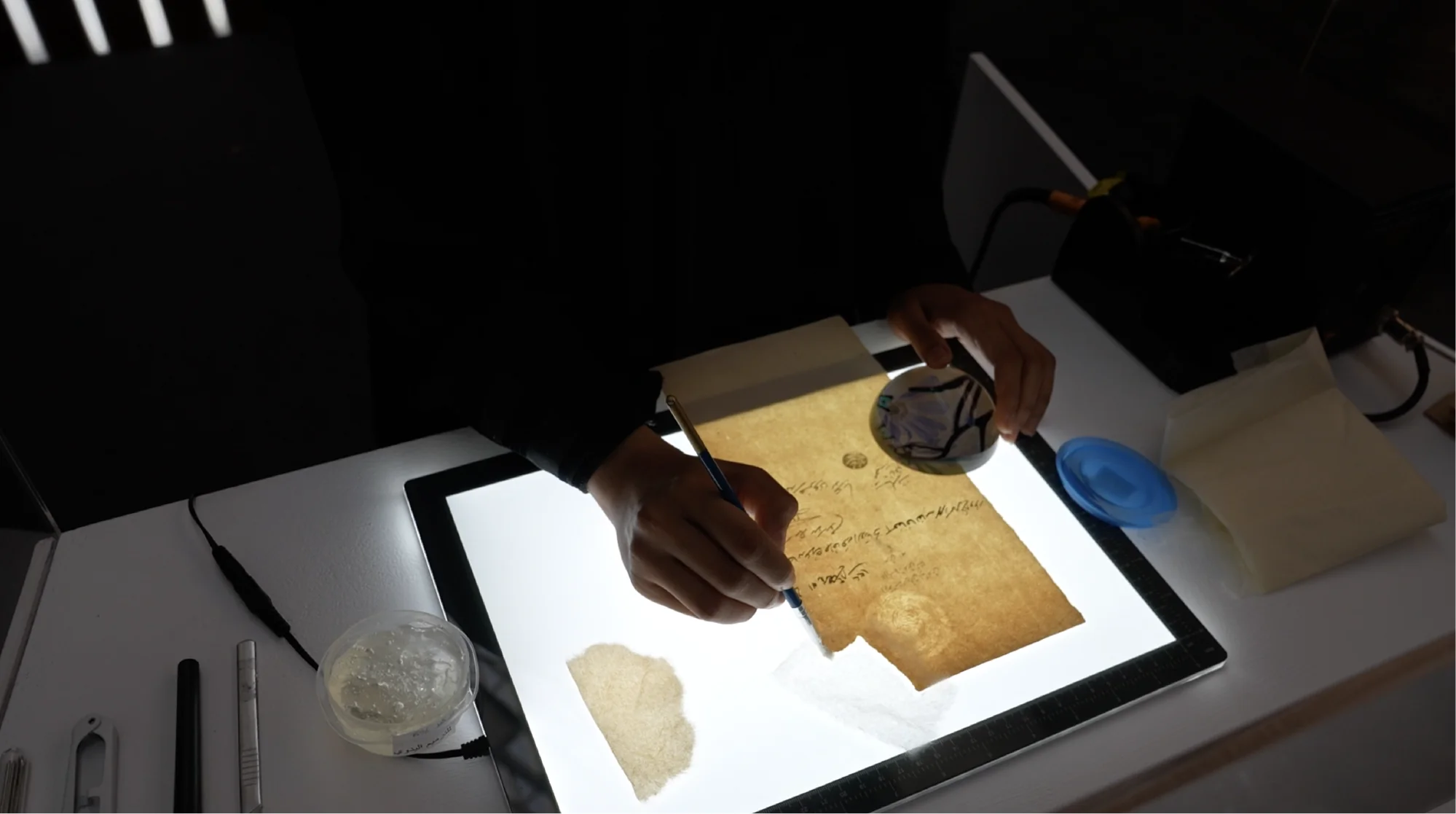
Director of the Institute of Arabic Manuscripts Dr. Faisal Al-Hafian: Interest in manuscripts .. is not a turning back to the past!
Cairo - Muhammad Owais
Today, many national, regional, and international institutions are busy with heritage. Among these institutions is the Institute of Arabic Manuscripts, one of the bodies affiliated with the Arab League Educational, Cultural and Scientific Organization (ALECSO). It is an ancient body established 70 years a within the framework of the Arab League and then attached in the early seventies of the last century to the Organization. This institute has played a major role in serving the heritage and establishing work in it, but the last few years have witnessed a qualitative leap in its activity. After it was directed towards specialists and researchers and addressing an elite segment, it began to be directed towards the general intellectual and youth as well. Furthermore, its ties and relations with Arab and foreign institutions began to take the form of remarkable partnerships indicating a new awareness and a new look at the wide horizons that work in and for heritage should explore in light of the new sweeping globalization. In this context, "Ahwal al-Ma'rifa" magazine met Dr. Faisal Al-Hafian, director of the Institute of Arabic Manuscripts and a well-known researcher in the field of heritage, in this dialogue:
Seventy years in the service of heritage
It seems that the Institute is still unknown despite its long life among a not small segment in Arab societies, how do you see that?
The Arabic manuscript is part of our history and represents a great symbol of our Arab and Islamic heritage, which gave much to the march of science and human civilization. The Institute's mission since its founding in 1946 AD has been to take charge of caring for and collecting manuscripts, sending missions for that purpose to several countries. The Institute seeks through its efforts and cooperation with relevant institutions to shake off the dust from these physical vessels and introduce people to this massive heritage, which exceeds three million original manuscripts in the authors' own handwriting.
The activities and efforts of the Institute are always announced in the media and followed by those interested and specialists. Indeed, we hold many activities aimed at inviting non-specialists to learn about the world of manuscripts, merge it into contemporary culture, open historical treasures, and view their treasures.
Arabic Manuscript Day
Manuscript Day is a celebration organized by the Institute annually: What is the al behind it?
The al, as previously stated, is to invite non-specialists to learn about the world of manuscripts and work on merging heritage into our contemporary culture. This is not a withdrawal into the past nor an involvement in the futile debate between the old and the new, but rather an expansion of the horizons of the contemporary mind by informing it of the achievements of predecessors and the limits at which they stood. Thus, it adds from their cleverness to its own, learns from their experiences, and tastes their arts. If contemporaneity is a veil that prevents contemporaries from seeing their illusions and mistakes, there is nothing better than developing the faculties of criticism and consideration to alleviate the darkness of these veils.
How can we achieve that?
This is achieved through: opening historical treasures and viewing their treasures because manuscripts are the most precious things in historical treasures as they are repositories for the works of minds folded by time. Then, achieving cultural security in the face of the sweeping deluge of globalization that threatens all non-Western cultures, because the most dangerous thing a nation can face is cultural schizophrenia or alienation from its roots and origins. There is a third al we dedicate to the youth catery, which is enhancing self-confidence on both individual and group levels.
The Problem of Indexing
Indexing of manuscripts, where is it from the interests of the Institute of Manuscripts?
Indexing of manuscripts is among the issues to which the Institute devotes its attention. We held a forum in March 2015 addressing these issues, with the efforts of the King Abdulaziz Foundation in the Kingdom of Saudi Arabia as a model.
The Heritage Forum chose for this first year "Problems of Indexing Manuscripts," as it is a pivotal issue that needs study and solutions. It will remain partial issues if not treated within a general or composite theory framework. There are scientific problems that must be looked at through field dealings with manuscripts, and linking political decision-makers on one hand, and manuscript owners on the other.
Manuscripts Magazine
Institute of Arabic Manuscripts without a cultural magazine: Why?
We are in the process of issuing a new cultural magazine under the title "Manuscripts," concerned with the manuscript Arab heritage, and seeking to present heritage knowledge in an easy and smooth style, avoiding the complexity of academics and the closures of specialists, in a modern suit attractive to general intellectuals.
It does not aim to turn back to the past or involve in the futile argument between old and modern, but rather seeks to expand the horizons of the contemporary mind by looking at the achievements of predecessors, learning from their experiences, and tasting their arts.
However, the efforts of most of those interested in heritage have continued to pursue two als: First: Revival and what is related to it of glorification and defense. Second: highlighting the contribution of Muslim scientists in modern science. As for highlighting the uniqueness of this heritage and explaining its differences with contemporary thought, this is something that has not received the care and attention it deserves, even though it is the most reliable question for activation and contemporaneity. From here appeared the need to issue a cultural magazine highlighting various aspects of heritage (wisdom, knowledge, art, etc.) and focusing on its uniqueness and creative potential; with the aim of expanding intellectual horizons, enriching contemporary culture, and mitigating the grip of globalization. Vision: providing a distinguished cultural product that combines the pleasure of reading and the novelty of science (away from complexity) and publication aesthetics.
Diploma in Manuscripts
What is new in the Institute's mission, which is the service of heritage?
A new diploma in manuscript sciences will be introduced at the beginning of the next academic year 2015 / 2016 AD characterized by applied nature, by focusing on the technicalities of written heritage, and by its openness to modern technology. This project is within the framework of the Institute's mission, which is heritage service, by upgrading its preservation means, documentation tools, and the human cadres working in it through preparing specialists in various knowledge fields related to the field of manuscripts.
What about the axes of study?
Six axes as follows: Science of Arabic manuscripts (Codicology). Textual criticism. Indexing of manuscripts. Manuscript arts. Restoration of manuscripts. Digitization of manuscripts. As well as complementary materials helping to understand these subjects.
The Kingdom and its interest in manuscripts
We would like to shed light on manuscripts in the Kingdom of Saudi Arabia?
Very great efforts are being made in the Kingdom connected to serving the manuscript Arab heritage, and they are old efforts. They are no longer limited to institutions only; there are great figures who served the heritage, including Dr. Abdulrahman Al-Othaymeen who recently passed to the mercy of Almighty d. He had great merit, especially in collecting manuscripts from around the world during his presidency of the Manuscript Center at Umm Al-Qura University in Makkah. As for institutions, almost every institution or university in the Kingdom has a contribution to serving the heritage. An example of this is the King Abdulaziz Foundation, which printed the book "Saudi Manuscript Treasures" in cooperation with the Institute and funded by Saudi Aramco. I had the honor of writing its introduction. It may have been one of the first indexes (at least in Arab world) combining two languages (Arabic and English) and achieving more than one purpose: uncovering the Arab-Islamic heritage for its owners and introducing them to it, as well as for non-Arabs and Muslims through the English language. It includes models for a collection of valuable rare manuscripts preserved in the Foundation's library, which was dedicated to rare manuscripts selected from the Kingdom's libraries. The number of each manuscript described in the book in the Foundation's library has been stated, its title fixed, its author's name and death date mentioned, the number of its leaves, its scribe's name, and scientific notes for the authors were written at the conclusion of the speech on each of the manuscripts identified in the book separately.
First Arab Indexing of Manuscripts
What are the contents of the book "Saudi Manuscript Treasures"?
The book includes manuscripts in exegesis, Hanbali, Shafi'i, and Hanafi jurisprudence, grammar, Hadith and its terminology, creed, history, biographies, fatwas, literature, general knowledge, licenses, inheritances, Quranic sciences, arithmetic and preaching, biography, poetry, monotheism, politics, comparative jurisprudence, Tajweed, geography... etc. It provides great services for those involved in editing Arab-Islamic heritage books due to their diversity and clarity of writing. The King Abdulaziz Foundation has the right to be truly proud of issuing this precious travel book which is considered a preserver of some of the scientific legacy presented by Saudi generations to culture, science and knowledge in the history of the Arabian Peninsula in particular and the cognitive Islamic works in general.
Finally .. what about the Kingdom's efforts in serving the heritage of Jerusalem?
These efforts appear in diverse scientific aspects, including: collecting Jerusalem manuscripts and photographing them, collecting books, reference documents, records, paintings and drawings related to Jerusalem, holding seminars and scientific conferences on the Palestinian issue in general, and the issue of Al-Quds Al-Sharif, establishing centers and specialized scientific units in particular, and preparing research and studies about Palestine and Jerusalem, and finally for caring for the heritage of Jerusalem. Among these institutions are the King Abdulaziz Foundation, King Abdulaziz Public Library, King Faisal Center for Research and Islamic Studies, and Imam Muhammad bin Saud Islamic University.