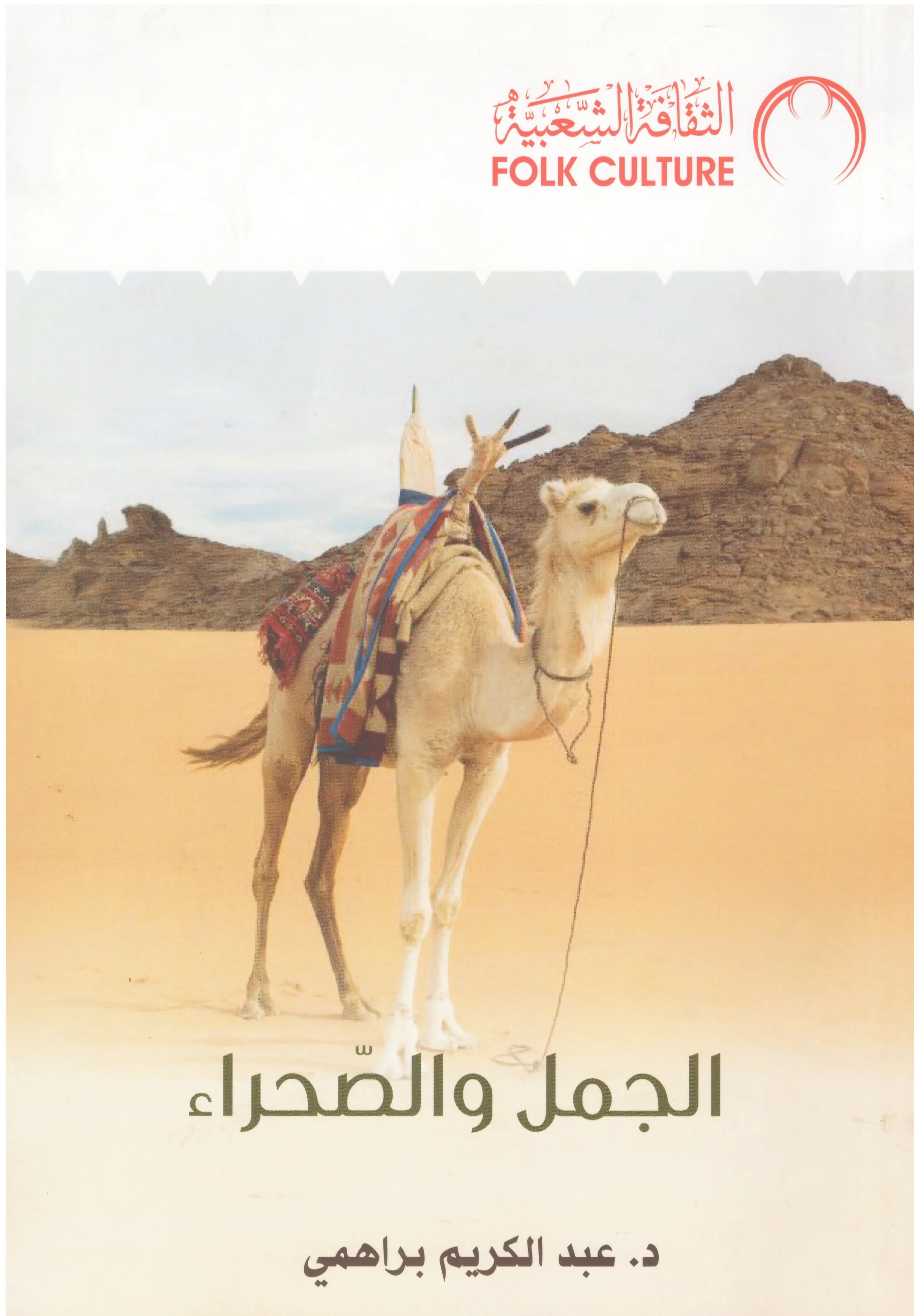
The Camel and the Desert: Tunisia as a Model – A Historical-Anthropological Study
Hajjaj Salama
The camel and the desert are topics that have received a fair share of heritage studies, occupying an advanced position in cultural and historical research, in addition to the position the camel and the desert hold in Arab cultural and popular heritage. Many researchers have devoted themselves to our heritage through description, analysis, and deconstruction. Among these researchers is the Tunisian writer and academic Dr. Abdelkrim El Brahmi, who found in the camel a phenomenon of such richness, breadth, and overlap that qualifies it to be a suitable expression of this heritage present in both memory and practice. In this framework came his book: "The Camel and the Desert: Tunisia as a Model.. A Historical-Anthropological Study," published by Folk Culture for Studies, Research, and Publishing in the Kingdom of Bahrain.
In this book, Dr. Abdelkrim El Brahmi focused on the camel as a historical phenomenon rooted in the culture of many societies from their early beginnings to our current time, and as a comprehensive and complex anthropological phenomenon of multiple dimensions and diverse meanings, due to the camel's connection to most aspects of daily life on one hand, and its overlap with most faces of social urbanization. The author chose Tunisia, North Africa, and the Sahara as the geographical field for his rich research, tracking the camel across different periods from pre-history to the present to observe the various transformations of "camel culture."
The book covers several axes: the camel phenomenon in the Tunisian and North African fields as a growing historical event and a controversial intellectual topic; its overlap with humans as an anthropological event piercing the daily lived reality and collective conscience; the camel as a rooted practice and solid culture; and the transformations occurring in the camel phenomenon and its negative effects on camel heritage which tends towards extinction despite attempts to revive it. The author combined a historical section and an anthropological section. The historical part deals with the camel in North Africa and the Sahara since pre-history, focusing on Tunisia in the modern and contemporary periods. The anthropological part mixes historical and cultural anthropology to highlight the cultural developments of groups that used the camel in their daily lives. The book highlights new functions for the camel today, such as the production of milk, meat, and leather for marketing purposes, and its investment in the tourism sector.
The book consists of four chapters: The first chapter is historical, dealing with the camel's history from its appearance to its decline. The second chapter is titled "Camel Breeding: Culture and Skills," dealing with shepherds, herding culture, and skills like tracking and healing. The third chapter is titled "The Transformation of the Camel from a Way of Life to a Labor Force to a Tourism Product," covering its role in trade, wars, and carrying the Howdah (Houdaj) in weddings. The conclusion summarizes findings, including that the camel was a historical fact that accompanied the formation of the Tunisian field, marking it with a firm collective cultural identity. The author discusses the debate on the camel's origin in the region, believing it was present since pre-history and never went extinct. The book also explains the camel's vital role in achieving integration between different regions through trade caravans and its spiritual role in pilgrimage journeys to Makkah and Madinah.