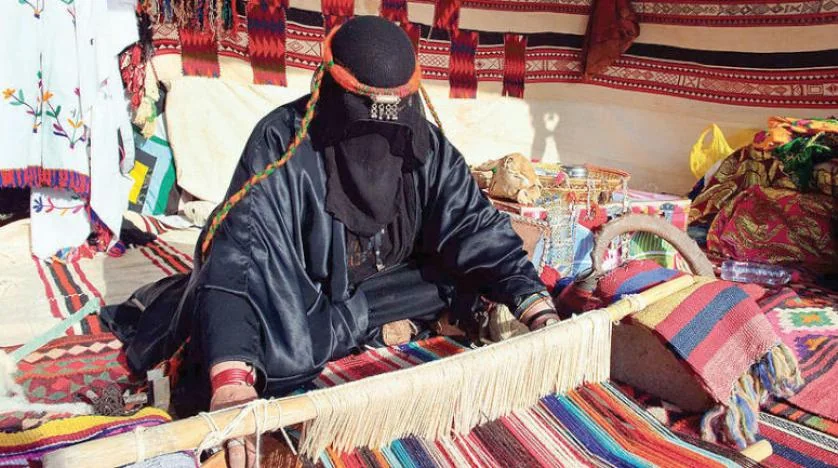
Registered in UNESCO and used as a lo for the G20 summit in Riyadh .. Saudi women when they excel in the art of "Sadu weaving" and embroidery of camel hair and wool
It is one of the most beautiful traditional manual arts produced by the desert in the Kingdom, which in 2020 enjoyed registration in the UNESCO Representative List of the Intangible Cultural Heritage because of its high artistry and accuracy in expressing manual artistic work. It is the art of "Sadu weaving" or "Bedouin embroidery" mostly practiced by Saudi women in villages and rural areas outside major cities.
So what is the art of Sadu and how is it formed?
Sadu is a type of traditional Bedouin embroidered weaving common in Bedouin traditions in the Kingdom. Sadu – from a linguistic point of view – is everything woven in a horizontal style, usually using camel hair, at hair, or sheep's wool for weaving, while colored plants like henna, turmeric, saffron and aloe were the source of dyes that give the white wool threads on the spindle their interwoven colors. As for camel hair, at hair and cotton, they remain in their natural colors without dye, decorating furniture as covers, rugs and pillows, and laid over the backs of camels and horse saddles.
Sadu is also used for weaving the Bedouin tent known as (Beit al-Sha'ar) and for making blankets, rugs and pillows.
Steps of Sadu weaving
The process begins by spinning the Sadu after removing dirt and impurities that easily get caught in the wool, by combing them with wooden combs until the threads stretch and untangle.
However, it is difficult to store untangled wool threads in a straight manner, so women who usually handle the task of weaving this type of fabric wind them on what is called a "spindle," which is like a wooden stick around which the thread is wrapped until used.
Then it is dyed with bright colors extracted from plants and spices that range from black, white, brown, beige and red.
Manufacturing a piece of Sadu requires one to two weeks. Rugs need a longer period that may exceed two months. The time consumed depends on the skill and speed of the maker, as well as on the type and area of the piece, and the number of people working on its production. Rugs, for example, vary in area, so work on them requires more than one person.
Textile dyes tend to be bright colors and beautiful patterns in a bold challenge to an environment that was harsh and scarce in its materials, dark in its colors. In the past, weavers relied on wool in its natural colors and used some desert plants for coloring the wools like: Al-Arjun and Al-Arfaj which has a yellow flower, and the Fayha plant which is available in desert areas, where these plants are dried and used in dyeing. Al-Arjun and Al-Arfaj give yellow, while Fayha gives a pink color tending towards brown.
Diverse Designs:
The patterns, decorations, shapes and symbols used in the Sadu craft are influenced by the desert. These common motifs are characterized by their geometric shapes that highlight the flat grassy lands, sand dunes, palm trees, flowers, camels, sheep, falcons, Quranic verses, mosques and tribe names. They also reflect certain ideas; for example, the shape of the necklace with interwoven rings embodies the unity and cohesion of tribe members.
The most important Sadu patterns consist of basic designs such as: the tree pattern, Owayrayan pattern, and Ghadir Eye pattern, and the Dhila'a, the Madkhar, the Raqam, and designs decorated with leather, beads and horse teeth.
Al-Jouf and Sadu
This art is considered one of the traditional industries in which Saudi women generally excelled, and specifically in the Al-Jouf region located in the northeast of the Kingdom, as hardly a house is without the textiles of this manual traditional activity. Women in Al-Jouf knew since ancient times the dyeing of threads, but they did not use color fixatives, so they mixed when washing the pieces, therefore there was a trend to import natural wool from abroad, where it is colored and added to it a fixing substance. The Sadu season begins immediately after the spring season, where the wool and hair of the cattle have been shorn in preparation for the start of the Sadu weaving season.
Wool weaving was known in desert environments, especially in the Arabian Peninsula, where desert people utilized what the nature around them provided, as they lived in Beit al-Sha'ar (hair houses). Women excelled in the dense Sadu patterns characterized by symbols and meanings perceived only by desert people to distinguish tribe brands or seasons.
The Kingdom has succeeded in registering the "Sadu weaving" element in the UNESCO Representative List of Intangible Cultural Heritage, as a joint file with the State of Kuwait. "Sadu" was a symbol of the lo of the Saudi presidency of the "G20" group of countries for the year 2020, catching the eye of the participating countries as its colored and heritage patterns dominated the lo that mixed authentic Saudi heritage with an innovative modern character. A Sadu festival is held in the city of Tabarjal in the Al-Jouf region, where productive families participate to sell their Sadu products.
The Ministry of Culture is interested in reviving this unique craft, and the National Program for Crafts and Handicrafts is keen to hold training workshops to develop the textile industry, and preserve traditional industries to remain a witness to the close relationship between man and his environment, and an innate genius creativity passed down by generations over the ages.