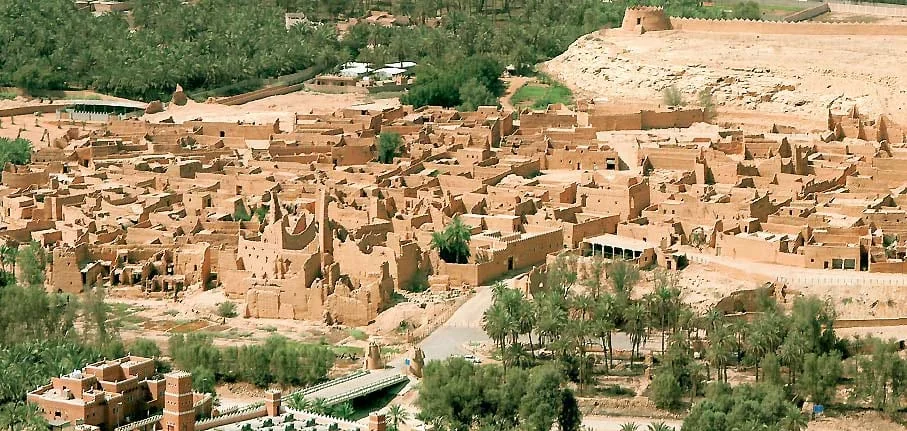
A capital for culture, history, heritage and literature in the heart of the Kingdom .. Diriyah: an open museum narrating the history of foundation and civilizational and knowledge innovation
The choice of Diriyah as the capital of Arab culture for the year 2030 by ALECSO was only a clear global testimony to the value of this historical city that contains an open heritage on history, culture, innovation and knowledge.
And this choice came at a time when the Kingdom of Saudi Arabia works on developing various historical and heritage and archaeological regions with a civilizational global vision, as well it comes in the shadows of including a big group of the Kingdom antiquities and its heritage in the recent years in the list of the human and global heritage through UNESCO.
Diriyah transforms today into a deeply ancient archaeological blog charting its historical and heritage and civilizational dimensions in the horizon of contemporary reality, and providing an open register for the visitors and researchers and those concerned with the Saudi history starting from the corners of foundation and its antiquity, to the features of civilizational development and its technologies and its multiple elements. where Diriyah represents a core for the authentic Arab culture, and a global element of the elements of cultural and civilizational prosperity, in a city whose antiquity ,es back to six centuries, where the poetry and literature and history and the intellectual memory of the central region of the Arab Peninsula settled in it, while it forms the place from which the first Saudi state started on the hand of Imam Muhammad bin Saud.
And the Arab League Educational, Cultural and Scientific Organization "ALECSO", had chosen "Diriyah" as the capital of Arab culture for the year 2030 AD, starting from its historical antiquity and its civilizational center and its role in science and culture and trade, since more than five centuries, to reflect what the Kingdom witnesses of political and economic and intellectual and social renaissance since 300 years, and that as an emphasis for the interest of the Kingdom for the civilization and antiquity of its cities and its ,vernorates. That came after the ratification of the Arab culture ministers in their annual meeting under the umbrella of "ALECSO", to become this time the second that a Saudi city is chosen as an Arab capital for culture, after choosing the capital Riyadh in the year 2000 AD; in reinforcing the position of two cities that have the deep cultural and knowledge effect ..
And Prince Badr bin Abdullah bin Farhan, the Saudi Culture Minister, confirmed that choosing Diriyah as capital of Arab culture for the year 2030, is considered "a crowning for the march of the capital of the first Saudi state, and what it produced through centuries of historical and civilizational wealth that made it the most prominent historical sites teeming with the big movement of cultural effect that continues forever",
The Pearl of the Kingdom:
Diriyah is considered the pearl of the Kingdom and the primary upcoming tourist destination, and one of the distinguished projects being developed continuously to reinforce its position on the map of tourism in the Kingdom, where a budget of (75) billions was allocated to develop Diriyah which is distinguished with an eternal symbolism on the level of culture on the local and regional levels, with what it possesses of witnessed history of civilizational heritage still until today. And that reflects the developments which the ,vernorate witnessed during the past years by the directives and care of the Custodian of the Two Holy Mosques King Salman bin Abdulaziz Al Saud - may Allah protect him - and with personal follow up from His Royal Highness Prince Muhammad bin Salman bin Abdulaziz the Crown Prince the Deputy Prime Minister the Minister of Defense the Chairman of the board of the Diriyah Gate Development Authority, and the interest of His Highness in heritage generally and Diriyah especially with the unlimited support, which contributed to choosing Diriyah as capital for the Arab culture.
And the Diriyah Gate project targets attracting 25 million visitors annually, where Diriyah Gate becomes the largest heritage and cultural project in the world; and it is the project whose inauguration ceremony the Custodian of the Two Holy Mosques King Salman bin Abdulaziz Al Saud - may Allah protect him - sponsored in November 2019 AD, and His Highness the Crown Prince leads its growing achievements, to be the historical Diriyah one of the most important tourist and cultural destinations and places of human gathering in the region and the world.
And the project seeks to establish a number of distinguished museums, and the global hotels of historical style, for the visitor to live a unique experience through the antiquity of the old cities, according to the best distinguished modern global standards, in addition to commercial markets on the old style, where the open markets spread on the two sides of Wadi Hanifa, to re-embody its ancient seasonal roles. As it contains the Yamama market which activates with the trade of natural fresh organic products, with its name inspired from Yamama region which was known as "The Green" for the fertility of its lands and the abundance of its waters, and many educational centers, and distinguished cultural and heritage academies, and professional education institutions, which will be through them holding programs and workshops to teach the visitors and tourists a series of ancient historical and heritage professions that the country cherishes.
Cradle of Foundation:
Diriyah city is the cradle of the first Saudi state and the meeting point of the pilgrim and merchant caravans and a foster for the largest heritage revival projects in the Kingdom.
And Diriyah is located on the edges of Riyadh and the banks of Wadi Hanifa, and it is distinguished with its archaeological architectural style and its arched mud walls, to be immortalized by history as one of the most important centers of culture and trade in the Kingdom. And from its most prominent landmarks At-Turaif district which contains its most important castles and buildings in addition to its being a rule area of the first Saudi state when it was announced in 1745 as capital for the country, to put the foundation stone for the emergence of the dawn of the Kingdom of Saudi Arabia.
And Diriyah entered history as one of the most important heritage landmarks of the Kingdom recognized in UNESCO in 2010, and it still today is a foster for the most important developmental projects seeking to revive its heritage and sending its historical luster for life.
And Al-Bujairi district is considered one of the most important open tourist destinations in the region, and Al-Bujairi urban building is distinguished with its traditional designs rich with colors and its mud walls and its heavy wooden doors, in addition to the containment of its streets on some traditional craft shops like weaving and calligraphy.
And the palace of Saad bin Saud recently restored which was built on the traditional Najdi style and the wall of Faisal tower, is considered one of the most prominent historical landmarks rooted in the city and a wall protecting its antiquities as the Diriyah wall protected its people in the past.
And the work on developing At-Turaif district still continues which is linked by a bridge to Al-Bujairi district, and that to transform it into an open museum containing a group of the archaeological pieces beside the mosques and the exhibitions and the traditional markets for selling the original souvenir products.
And the development of Diriyah comes in the context of the axes of Vision 2030 which include the indication to heritage and antiquities in the Kingdom and putting a comprehensive strategy for the heritage, and developing the historical cities like: the Historical Jeddah project, and the development of historical mosques project which include the development of (130) historical mosques, and restoring the heritage buildings in central Riyadh, and include historical palaces, and returning the (Al-Ula) region to the world heritage front.
And the Kingdom hosts a group of the civilizations that appeared on the span of history, from them civilizations emerged and prospered in the pre-Christian eras ,ing back to more than 16 thousand years as most researchers see, and other civilizations extending with the appearance of Islam and its various eras.
And the Kingdom registered 6 sites for it in the list of the global heritage, and they are: beside Al-Hijr site listed (2008), At-Turaif district in historical Diriyah (2010), Historical Jeddah (2014), the rock art sites in Hail region (2015), then Al-Ahsa Oasis (2018), Hima (2021).
And the six sites form a big share of the heritage and cultural diversity that the Kingdom includes,
And the temporary list of the global heritage sites expected to be added by UNESCO contains several heritage sites from them: Hijaz railway line between Tabuk region and Madinah region, and the Syrian Hajj road between Tabuk and Madinah and Makkah, and the Egyptian Hajj road between Tabuk and Madinah, and Makkah, and Al-Faw archaeological village in Riyadh region, and Rijal Alma'a heritage village, and Dhee Ayn heritage village in Baha region, and the historical Dumat Al-Jandal Oasis in Al-Jouf region, and Uruq Bani Ma'arid reserve in Najran region, and Farasan islands reserve in Jazan region.
Signals:
Wikipedia: Global Heritage Sites
Saudi Press Agency (SPA)
https://www.visitsaudi.com/ar/see/highlights/historical-Dir-iyah
https://sabq.org/6W7dvG?utm
https://www.al-jazirah.com/2021/20211222/ln30.htm