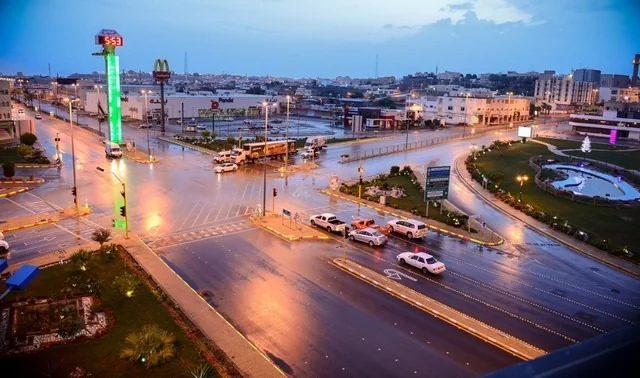
From it emerged the first minister, academic, doctor and female doctor .. Unaizah: the city of four gates and the pole of taste and literature and the Paris of Najd
The naming of: "Paris of Najd" given to the city of "Unaizah" in the Al-Qassim region did not come from a vacuum. The city has been a metropolis of Najd since ancient times, and the naming given by the writer Ameen Rihani to the city came compatible with its temperate weather and distinguished geographic location, in addition to its distinction in nature, trees and water resources, and the passage of Hajj routes through it, and hosting a large number of scholars and writers.
A number of historians believe that (Unaizah) was among the first to join the banner of the founding King Abdulaziz Al Saud - may d have mercy on him - as history records that several of the prominent men of Unaizah signed an agreement with Imam Abdulrahman al-Faisal and his son King Abdulaziz to recover Riyadh, providing that the Unaizah region would fall under the direct rule of King Abdulaziz.
It is also clear that the first Saudi minister emerged from Unaizah, who was "Abdullah bin Sulaiman al-Hamdan," Minister of Finance during the period between (1932-1954), and the first academic, the first doctor, and then the first female doctor. Summer tourist festivals are held there, as well as the first specialized festival for marketing dates, which has been held since 2005 titled: "Unaizah International Date Festival."
Naming of Unaizah:
The reason for the naming of Unaizah is traced back to a hill (Akm) which has a black color (like a small black mountain) located to the east of Unaizah, because the black hill or Akm was called "al-Anz" by the ancient Arabs. The name Unaizah is just a diminutive of this word because the black hill called by this name is small in size. Unaizah was inhabited in pre-Islamic times, evidenced by what the poet Imru' al-Qais said:
She appeared to us between al-Naqa and Unaizah .. and between al-Shaja from what turned to the valley
And al-Muhalhil mentioned it in his saying:
Ransom for the sons of Shaqiqa the day they came .. like lions of the forest persisted in roaring
As if their spears are the ropes of a well .. distant between its builders of pull
Early as if we and our father's sons .. beside Unaizah are two millstones of a manager
It also appeared in the poetry of Malik bin al-Rayb in his famous poem in which he eulogized himself:
When the riders gathered between Unaizah .. and Boulan they drove the remainders the survivors
Unaizah is considered a historical city, and has its heritage dimension, it gained its importance since ancient times due to its unique geographic location as it is located in the north-central part of the Najd Plateau to the south of the Wadi Al-Rummah course, and is surrounded by sand dunes from the north and west called Ghamis sands while to its south lies the sands and forests of Al-Ghadha in the Shaqiqa area.
The meadow of Unaizah has remained since ancient times an important water resource, on the Iraqi Hajj route, and for merchants and desert crossers in the Arabian Peninsula. Then at the end of the fifth century AH 494 AH, human settlement returned to the city of Unaizah, and Unaizah became a known vernorate, and a center of civilization in the heart of the desert..
Unaizah and Travelers:
More than 140 years a, traveler Doughty wrote about Unaizah in 1878 in his book about the society of northern Najd: "The people of Unaizah enjoy an admirable civil freedom, and they are civilized people, sophisticated in their clothing, food, treatment and even their way of walking and movement, and they greet each other with kindness and friendliness."
Following Doughty's footsteps, Philby was eager to enter Unaizah, and he arrived in Unaizah with King Abdulaziz on August 23, 1918.
Philby said: "I had previously heard a lot about the difference between Unaizah and other cities of Najd about the generosity of its people and their hospitality to the stranger and their freedom from any religious or sectarian fanaticism, but I must admit that the actual experience astonished and dazed me. It suddenly seemed to me that I had come out of a primitive world to enter a civilized world that possesses a high culture, where the stranger meets within the city walls beyond what he imagines of welcome and od hospitality instead of being an object of doubt or suspicion as if he were a guest of all the city's residents."
Philby explained that the prominent people of Unaizah exaggerated in bestowing their generosity upon him without mercy or respite, and their hospitality is not only generous but also in the utmost taste and elegance, "It is truly the jewel of Arab cities."
As for the title (Paris of Najd), it was given by the traveler and writer Ameen Rihani who entered Unaizah shortly after Philby, specifically from the day the phrase "please come and we will give you coffee" captivated him, and he mentioned it much in his book, calling it the od word.
He described Unaizah saying: "Unaizah is the pole of taste and literature and the Paris of Najd, and it is more beautiful than Paris if you overlook it from the Safra, because there are no palms in Paris, and Paris has no area of ld sand. Rather it is more beautiful than Paris when overlooking it, because it is small, peaceful and charming in its colors as if it were a pearl in a lden plate surrounded by lazurite."
Rihani continued describing Unaizah in a way that writers said "Unaizah" enchanted him with beauty and treatment.
Unaizah still retains its four gates in the middle of the streets, as well as palm fields, and holds its historic folk market.
In the field of literature and culture, an annual festival called the Unaizah Cultural Festival is held.
References:
· https://www.alarabiya.net/saudi-today/2017/07/17/
· https://www.alriyadh.com/458720
· https://ar.wikipedia.org/wiki/