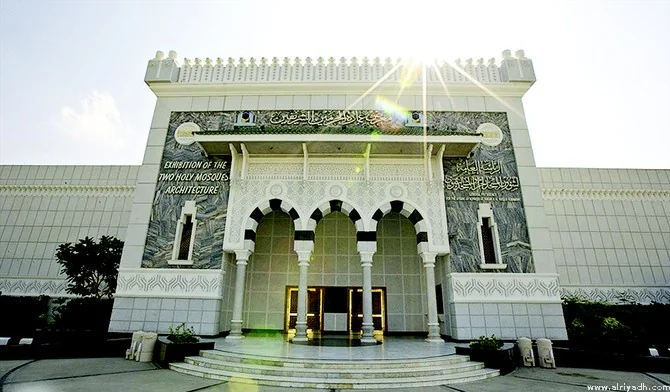
Includes a collection of Kaaba doors and rare Qurans – Museum of the Architecture of the Two Holy Mosques: a unique cultural and civilizational landmark
The Museum of the Architecture of the Two Holy Mosques is unique in the world, because it has the specificity of displaying the acquisitions of the Two Holy Mosques. Since its establishment, it has become one of the most prominent civilizational and cultural landmarks in the Holy Capital, Makkah. it was opened by His Royal Highness Prince Abdul Majeed bin Abdulaziz – may d have mercy on him – on 25 Shawwal 1420 AH.
The Museum of the Two Holy Mosques, which is located next to the factory of the Kaaba Kiswa in Umm al-Joud in Makkah, tells the history of many centuries and generations, and the story of the purest spots on earth and its holiest sanctuaries "The Two Holy Mosques" which includes the Holy Kaaba, the Qibla of Muslims and the focus of their hearts.
The expansions that took place over years in the Two Holy Mosques allowed the General Presidency for the Affairs of the Grand Mosque and the Prophet's Mosque to collect some acquisitions, architectural elements and written inscriptions from the Two Holy Mosques. The Presidency saw that it was appropriate to display some of these acquisitions in a special exhibition for them. Indeed, the necessary studies, restoration and selection of artifacts and written inscriptions were carried out by a specialized team of technicians. This helped in completing this cultural and civilizational project, which has become one of the most prominent civilizational and cultural landmarks in Makkah. Many visitors from inside and outside the Kingdom are keen to visit it and view its contents.
Education and expansion efforts:
The Two Holy Mosques have enjoyed the care and attention of Muslims throughout the ages. Since the founding of the Kingdom of Saudi Arabia, the Two Holy Mosques have witnessed, during the era of the Kingdom's kings from the founding until the era of the Custodian of the Two Holy Mosques King Salman bin Abdulaziz – may d protect him – attention and care that they have not witnessed in successive eras of history. Based on the keenness of the rulers in this blessed country to highlight those efforts and the desire to educate Muslim generations and introduce them to their glorious Islamic history, this museum was established on an area of 1200m. Its external design was taken into account to be consistent with the unique Islamic style and the distinguished architectural style of the Grand Mosque.
The museum consists of seven halls that include two models of the Two Holy Mosques and a number of different acquisitions including manuscripts, written inscriptions and precious artifacts, architectural models and rare photographs.
As for the sections that the museum includes, they are the exhibition and a number of sections, namely the reception hall, the Grand Mosque hall, the Holy Kaaba hall, the photographs hall, the manuscripts hall, the Prophet's Mosque hall, and the Zamzam hall, which includes the frame of the Zamzam well made in the early fourteenth century AH. The museum also contains rare acquisitions, the most important of which are: the columns of the Great Kaaba with its wooden base and crown dating back to the era of Abdullah bin al-Zubayr in the year 65 AH, a stone base on which the columns were standing, a copper crescent dating back to the year 1299 AH, the crescent of the main minaret in the Prophet's Mosque at the beginning of the fourteenth century AH, and a copper fence that was used on one of the windows of the mosque.
Multiple halls:
The museum includes six halls, namely the Grand Mosque hall and contains the staircase of the Holy Kaaba made of teak wood dated in the year 1240 AH and the cabin that used to cover the Maqam Ibrahim, peace be upon him, before it was replaced in the era of the Custodian of the Two Holy Mosques and a number of minaret crescents whose history dates back to the year 1299 AH.
The Holy Kaaba hall contains the Kaaba gutter made of wood, plated from the outside with ld, and lined from the inside with lead dating back to the year 1273 AH, and the lock and key of the Holy Kaaba from the date of 1309 AH, and the door of the Holy Kaaba which King Abdulaziz Al Saud – may d have mercy on him – ordered to be made in the year 1363 AH.
As for the Prophet's Mosque hall, it contains a door from the main doors of the Prophet's Mosque dating back to the early fourteenth century, and an old clock from the clocks that date back to the year 1277 AH.
While the photographs hall contains collections of rare photos of Makkah and Madinah, the manuscripts hall includes a group of rare Qurans and photocopied manuscripts from the libraries of the Two Holy Mosques. There is also a photocopied version of the Ottoman Quran which was written in the era of Caliph Othman bin Affan, may d be pleased with him.
The Zamzam hall includes the neck of the Zamzam well with its ring and cover and a pulley for raising Zamzam water dating back to the late fourteenth century AH and a bucket made of copper dated in the year 1299 AH. In addition, the museum includes a group of historical pieces displayed from the doors of the Kaaba, a door for the Grand Mosque, a door for the Prophet's Mosque, and a copper column that was used around the Mataf in the first Saudi expansion of the Grand Mosque in Makkah and other acquisitions. Alongside that come the artifacts that embody aspects of the history of the Two Holy Mosques. The museum is witnessing an influx from all parts of the Islamic world.