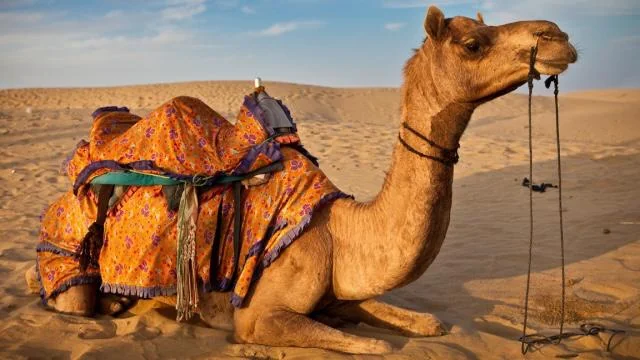
Camels: An authentic symbol for the residents of the Arabian Peninsula – Camels are a parallel life through the ages to the life of the Arab human
Camels have a dense presence in Arab heritage and in life in the Arabian Peninsula in general. They are considered an authentic symbol of life in the desert, and they have an influential cultural, social and economic connection in the history and life of the Arab person throughout the ages. With them he traveled, with them he lived, with them he awarded prizes in ancient races, with rewards of a hundred camels, with them he traded, with them he was described as generous, and about them he wrote poems and collections.
Arabs linked their first creative art (poetry) to a lasting saying when they said: "Arabs will not leave poetry until camels leave nostalgia" as a symbol of their permanent existence together in Arab life.
Relationship and monologue:
Camels are considered one of the animals most attached to their owner, especially in the Arabian Peninsula, where stories of love, affection and loyalty arose between them. Many stories have been reported that indicate and confirm this. Camels are constantly attached to their owner and very affectionate towards him, especially if he treats them with love and mercy. You see them memorizing his voice, knowing his monologues, enjoying his chants and responding to his requests. You see them approaching him a lot, smelling him and rubbing their head against his body in an expression of their love for him. If they miss him for several days and see him from a distance, they run joyfully at his arrival, and release their nostalgic sound joyfully at his arrival, and even wipe their head on him as an expression of their love for him.
In contrast to the affectionate relationship that binds man to camels, there is, in return, hatred and revenge from them when they are subjected to assault or insult by someone, to the extent that they maintain love and affection for those who treat them well, as they do not forget those who punished them or assaulted them, even if years have passed since this incident, they must take revenge on those who did that to them. The Arabs used to use them as an example in the past, saying: "More spiteful than a camel," as a metaphor for a person who holds a grudge against those who mistreated him as if it were a grudge like the grudge of a camel that never forgets.
Colors and names:
When talking about camels, we must touch upon their many names, which include "Hajin", "Ba'arin". As for their colors, they are many, including "Al-Majahim", which are the best and most abundant in milk, and are characterized by high ears, a long and wide tail, a wider and larger body, and larger footprints. Among its types are also "Al-Maghatir" with its beautiful white color, and it is characterized by its drooping ears, short tail, and its quick response to the shepherd, so it is easy to "train". Among them are "Al-Safr", "Al-Sha'l", "Al-Wadh" and "Al-Mulh", and each color of these colors has its fans and lovers, so you find each group of camels of one color with its owner. As for the naming of their groups, it is done according to their numbers. For example, if their number is about twenty or more, they are called "Dhaud", and if they are less than twenty, they are called "Nuuq" or "Manayih", and if they are more than a hundred, they are called "Khabit". As for naming the "Ba'ir", it is according to its age, as it is called in its youth and at birth "Hiwar", then if it grows up it is called "Hashi" or "Qa'ood", and if it grows more it is called "Ba'ir", while the female is called "Bakra", and if she grows old she is called "Fatir".
Various tasks:
Among the most famous tasks of camels are riding them and carrying loads on them during travel, as they cross the wilderness and deserts for several days without the need to restock water. No wonder if they were called the "Ship of the Desert". They are also among the best mounts for women, where the "Howdah" is placed on their back, which is spacious enough for a woman and allows her to move freely without the need to use the veil, due to the size of the "Howdah" and the covering of all its sides with cloth that prevents seeing who was inside the "Howdah", and allows air and light to pass through. Among the tasks that camels are also characterized by is their use to carry heavy objects such as firewood, tents and ods during travel, which no other animal can do. As for agriculture, it has another matter, as they are among the best animals used in extracting water from wells in farms, through watering by "Sawani", where they rotate in the "Manhah" next to the well back and forth without getting tired or bored, and they endure and are patient with this hard work that may take all their day. Perhaps among their most important benefits is drinking their milk and eating their delicious meat and benefiting from their fur and wool.
Symbolism of camels:
Camels were mentioned in the Holy Quran and the Sunnah of the Prophet, as evidence of their status. The Almighty said (Do they not look at the camels, how they were created?), and in this noble verse, d Almighty singled out the camels from among His living creatures, and made looking at how they were created prior to contemplating how the heavens were raised, the mountains were set up and the earth was flattened, and calls for looking and contemplating these creatures to be an entry point to pure faith in the power of the Creator and His wonderful work.
The Arabs spoke extensively about camels in their books of prose and poetry, until their characteristics became a proverb in literary texts. Among the most famous proverbs and wisdom among the Arabs in which camels were mentioned: "I have neither a female camel nor a male camel in it" and it is said to those who are asked to participate in a matter that does not concern him, and the Arabs said "Lighter in load than a camel" and it is said to the strong who is not affected by weights, and it was said "They came on the bakra of their father" an example for those who come all together and none of them stayed behind,
The Arabs also said "Tie it and trust" and it is used in taking reasons and precautions to move forward in what he wants then relying on d, in addition to their saying "This is not how camels are brought to water" and it is said to those who did something and did not do it well.
In a past time, camels were among the most expensive things a person owned at all, as they were the best aid in adapting to the hard and harsh living conditions. On them, he reaches his needs by traveling from place to place in the roughest and harshest roads, such as crossing the desert wastes that no riding animal can cross, as camels endure the abundance of sand and its high heat, and are patient with the scarcity of water and fodder, and can walk for days without the need to restock water and grass. They can also carry heavy equipment such as hair houses from one place to another, which is the habit of nomadic Bedouins in search of grass and water. As for their milk, it has a special taste, as it is an integrated food that gives the body high energy. Among the things that made the people of this country love these camels is their intelligence and experience in pastures, as they watch for lightning at the time of rain, even if it was hundreds of kilometers away from them. They are also among the rarest animals in their love for their first homeland that they can never forget, as they will inevitably return to it no matter how long the time of their separation from it lasts. The camel leaves the herd and returns to its homeland and the pastures of its youth, and knows the well from which it drank even once, so it will return to it without missing the road even after years.
Today's generation has taken camels for decoration and boasting, and they no longer serve their owner, but the verse has been reversed and he has become the one who serves them and spends most of his time, effort and money for the sake of taking care of them, so a pride arose from that which resulted in entering into competitions between their owners for the sake of acquiring the distinguished ones in shape and form, and they began to be sold at the highest prices and the price of some of them exceeded the prices of luxury and extravagant cars, and perhaps sometimes yachts and small planes. Camel races have also spread in the Kingdom, the Gulf and some Arab countries, and various festivals were held for camels.
This matter makes one wonder what are the features that make the prices of some camel breeds rise unimaginably? It makes owners compete in exaggerating them, and trying to obtain the best of them. The average person finds them similar, but for some of those interested, there are signs by which they infer their quality.