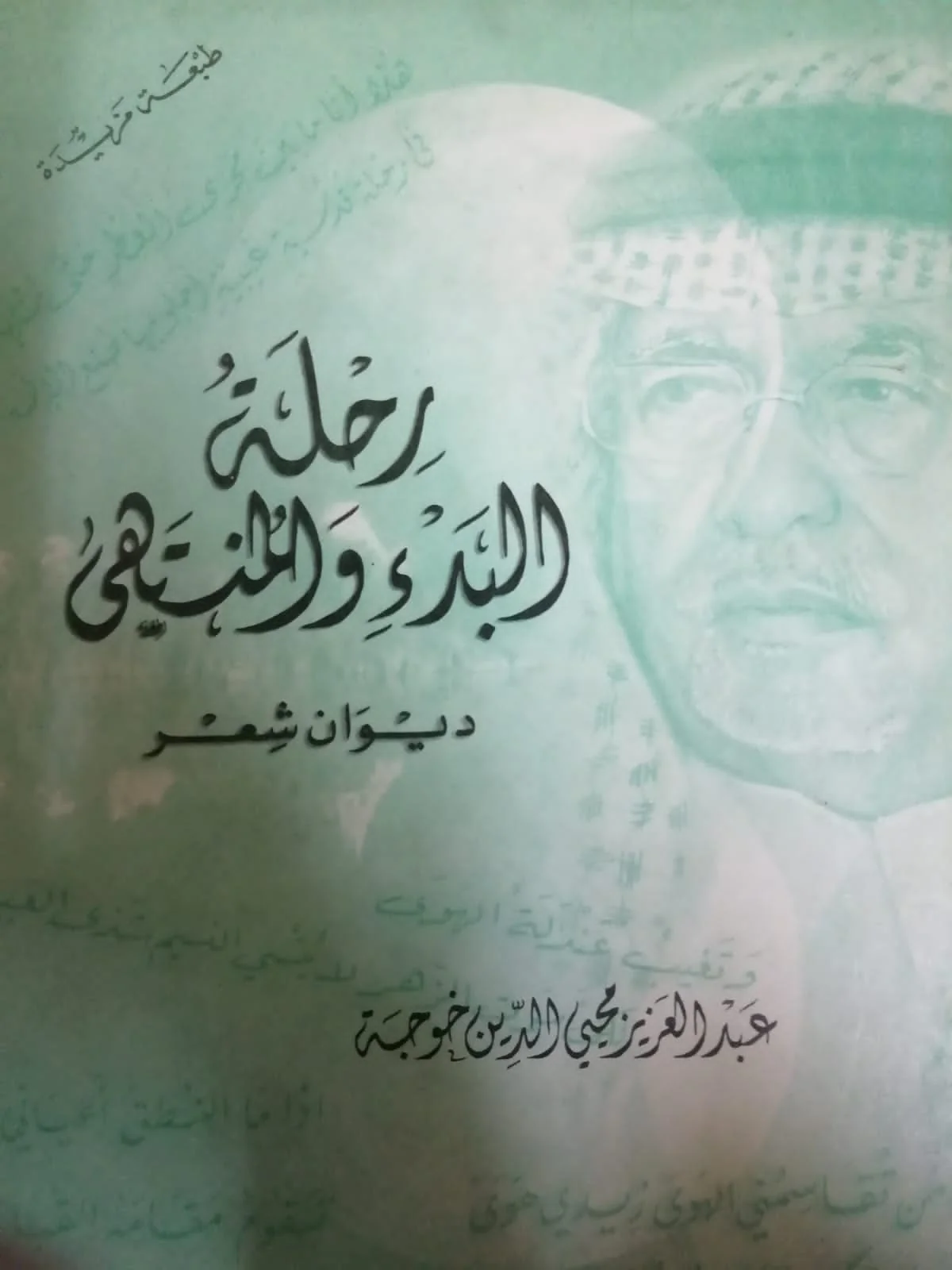
Spiritual reflections on the poetry of Abdulaziz Khoja and the journey of the beginning and the end
Abdullah Al-Samti
Dr. Abdulaziz Khoja titles a comprehensive diwan of his: "Journey of the Beginning and the End," which is the diwan in which we write our reader critical vision as a model in the diversity of poems, and the multiplicity of their indications, contents and artistic visions.
The title combines – implicitly – an expressive temporal distance, between the beginning and the end. The beginning needs a starting place, or rather a starting point, so there is a spatial meaning in the word itself, while this meaning also connects us to the end point.
Starting from the beginning to the end requires a measure of movement, vitality, travel and wandering across the distance, whether long or short. It is important that there is some transition; this transition is what motivates the existence of the temporal signifier in the title, which is a journey undertaken by the poetic self, whether it is a realistic journey in which geography contributes with spatial mechanisms, or a metaphorical journey in which the soul contributes with its contemplations and visions.
Thus, the title leads us to blended visions, in which indications of: self, time, place, travel and wandering are mixed. It is a mixture that remains under the question of the reader that motivates the approach to the various poems of the diwan, in order to reach with the poet the al of the end.
The pleasure of reading here is that it is shaded by this blended total indication, and under these shadows there is what leads to interpretations and explanations, and to enhancing the reader's awareness with a cognitive depth that aspires to discovery, translucency and adventure.
We will then ask multiple questions, harmoniously intertwined, or discordant and opposite, but they flow in the final analysis into the mechanisms of reading pleasure that fulfills important, adjacent and multiple indications.
Is it one journey undertaken by the self, or are they two journeys: a journey of beginning, and a journey of end?
We may give many indications to the title, because the poetic journey differs from the primary concept of the word. The journey of poetry is a self-discovery within, in the soul first, and then followed by other geographical, cosmic or historical journeys.
From here we will take the title via its poetic load, not its realistic load, and here many indications will explode before us, manifested in the poems included in the diwan.
The poet Dr. Abdulaziz Khoja begins this diwan with a heavenly journey of faith, in which he mentions this beginning and this end, which leads us immediately to consider this journey a spiritual self-journey, because the soul is what emerges here and contemplates the existents of the universe and the signs of d. It is possible for us here to quote the beginning in full so that the verses enlighten the reader's awareness, and it is entitled: "Glory to Him Who Created":
Glory to Him Who created hearts to comfort us with a sigh
And to melt from passion on an Aleph and a Lām, then a Lām, then a sigh
Glory to my Lord in His highness and in His radiance
He took my heart by night from its earth to its extent to its visions
And melted it with passion, so this is its end to its end
Glory to Him as a light wrapped in a veil so you see Him not
And as guidance whose revelation all lips repeat
But I am a longing that remains traveling
Its night journey never ends / Diwan p. 35
Longing for d is the journey of the beginning, the end and the conclusion. This is how this opening poem of the diwan guides us. Here the atmosphere is without limits, the vision is cosmic, in which the vision is blended. The words relate to the Creator, the Creator of hearts that practice their passion by traveling by night with their longings to the many signs of d that comfort with the sigh of passion and radiance.
Three verses in the poem focus on the visionary journey:
Glory to my Lord in His highness and in His radiance
He took my heart by night from its earth to its extent to its visions
And melted it with passion, so this is its end to its end
There is the night journey of my heart from the earth, from the beginning of creation, then the extent, then the visions. The poet has graded and arranged them with a significant creative act, where the beginning of creation is from soil, then life and its realistic practice, the search for the extents of d's creations in the universe, then the visions that do not end. Here we glimpse that the journey of the beginning and the end has no end, because it relates to the vision, and to the search in the divine signs of the universe, which is confirmed by the last verse in the poem:
But I am a longing that remains traveling
Its night journey never ends
There is a longing that does not end or cut off, because the signs of d have no end, and because d cannot be perceived by the eye through sight, but His signs can be perceived by the eye of insight through vision. The poet here deepens the indication of passion, vision, remembrance and longing, as if he is touching the Sufi horizon in tracking indications and their illuminations. The poet sets off and arrives through a journey of faith first that shades the far horizons of the diwan's poems.
Spiritual visions glow intensely in the poetry of Dr. Abdulaziz Khoja. He is a contemplative spiritual poet of the first order, in whom poetic visions blend, transforming the sensory into spiritual, and transforming things into their first roots with which they were created, which are roots that necessarily return to the first creation, and the bed and essence of the first creation is: the spiritual.
Therefore, the poet transforms everything that is material sensory into the essence of the soul, and expresses with his poetic verses and lines this transformation that makes the thing have two indicative dimensions in the poem. The first dimension: material so that it moves sensorially, according to its form and presence, and spiritual, where it manifests further and more densely as if it is invisible. Here the spiritual retains its materiality to be known, but it is colored by various gems of the soul that move in all things and may wear them and personify them poetically.
Reading a group of poetic models of Dr. Abdulaziz Khoja will stand us clearly on this spiritual horizon that emerges from his poems,
where spiritual icons manifest in Abdulaziz Khoja's poetry successively, through the journey of the beginning and the end. In addition to the introductory poem that we presented previously, with its spiritual atmosphere, comes the poem that establishes the beginning of the journey entitled: "The First Date" (pp. 39-40), which is a love poem, summarizing the first beginnings of love, and presenting in romantic contexts a set of images and scenes that express this love. A heart that is filled first with love is a heart joyful with life, and joyful with beauty, lying in wait for it, following its presence, and ing to it poetically in order to interrogate it and express it.
From here, the first love poem in the diwan, or let us say: the atmosphere of love that the poet spreads at the beginning of his diwan, makes us decide from the beginning: that entering the world of love is an entry into the world of the soul, because what is emotional sentimental penetrates beyond things, beyond matter, and es to the soul to explode its romantic feelings and energies, and reflect on the poet's vision of life and existence.