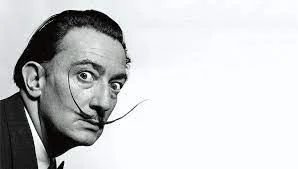
Salvador Dalí: Rebellious Colors and Crazy Fingers
Al-Anoud Mohammed
- As a result of his steady madness he was expelled from the college in 1926 so he went to Paris to search for a wider space that accommodates his wild imagination, and his first visit there was to the studio of (Picasso) .
- In Paris, Dalí increased in boldness and ambiguity, and was not hit by the arrows of criticism, and he said about that :" It is no wonder that the audience does not understand my work, for I do not understand it either "
- Dalí's early artistic beginnings carried the features of the Cubist school, and in his sudden transformations there are realistic lines manifested in his sad colors, and in black and white.
The miracle child of Catalonia born in May 1904 to a wealthy family, carrying the name of his brother (Salvador) who died three years before his birth. In his early childhood, restless questions exploded in the young boy's head as an objection to a faded name, and in search of distinct features for another being who was intended to be him.
The small Catalonian town of (Figueres) rejoiced in its amazing child, the family endured their arrogant son's violence, and the young boy enjoyed his distinctiveness, the suffering of his family, and his early madness, and he persisted in his rebellion, pride, and crazy imaginations.
Salvador Dalí played with death in his wakefulness and imagination, and curiosity pushed him into crazy artistic adventures. He resorted to changing the nature of beings and objects and harnessing them for roles that were not suitable for them, or were not part of their nature, and he disclosed the secrets of his thoughts on paper without concern. He painted his first paintings before the age of ten, and their neighbor (Ramon Pichot) discovered his undeniable talent and bet on his genius, encouraging him to paint, advising his family to care for him. Dalí held his first exhibition when he was fourteen years old, and afterward joined the (San Fernando) Academy of Fine Arts in Madrid in 1921. There he met his two legendary poet friends (Lorca) and filmmaker (Buñuel). As a result of his increasing madness, he was expelled from the college in 1926 and went to Paris to search for a wider space that would accommodate his wild imagination. His first visit there was to (Picasso's) studio.
In Paris, Dalí increased in boldness and ambiguity, and the arrows of criticism did not hit him. He broke the stick of obedience against all forms of art, saying: "It is no wonder that the audience does not understand my work, for I do not understand it either." He continued to persist in rebelling against the familiar, presenting a virtual reality to life and shocking his audience with a provocative grotesqueness that reflected a close relationship between his individual violent behavior, his repellent arrogance, and his creative artistic madness that caused a revolution in art theory. At that time, he occupied the artists themselves, as well as intellectuals, psychologists, and sociologists. He divided them into two teams: an admirer who felt wonder at his frankness in expression, and another who stumbled between suspicion and disgust at his evil visions. He settled the matter and their anxiety when the (Surrealists) disowned him and (Breton), the founder of the Surrealist group, expelled him from their school in 1939 after he also rebelled against their principles and became a slave to matter - according to their claim. He let out his famous cry (I am not a surrealist to be expelled, Surrealism is me).
Dalí's early artistic beginnings bore the features of the Cubist school, and in his sudden transformations, realistic lines appeared in his sad colors, and in black and white. As for the dream barriers that appear in his paintings, their source is his study of (Metaphysics) in Italy, and his intense infatuation with its principles and evidence. His philosophical readings clearly affected his hopes. He was influenced by the philosophy of (Nietzsche, Kant, Voltaire, and Spinoza). He also loved (Descartes) and took his upturned mustache that distinguished him and gave him added fame. Dalí showed special interest in (Freud's) philosophy and the theory of the unconscious that led him to absolute surrealism. Despite the controversy Dalí's art raised, he remained on the rise and glow throughout his life.
Dalí painted a lot and presented sculptures, models, and designs. Among his most famous works: (The Persistence of Memory 1931, Metamorphosis of Narcissus 1937, The Madonna of Port Lligat with Gala's face, and The Songs of Maldoror) and his last painting (The Swallow's Tail) 1983.
His strange sculpture (Rainy Taxi) enjoyed wide fame in Paris.
Dalí also wrote the screenplay for two films, the first in 1928 and the second (The lden Age) in 1930, which belonged to the cinema of the absurd where they rely on hallucinations and vague and strange visions. His only book (Diary of a Genius) was published in 1964 and is an autobiography. On the return trip to his town (Figueres), he was righteous, calm, and loyal, establishing a museum specific to him, and gifting his fortune and paintings to his country's vernment. Salvador Dalí married the Russian (Elena Ivanovna Diakonova) nicknamed (Gala) in Paris, who inspired many of his still paintings. Gala died several years before him, so he resorted to isolation voluntarily, distanced himself from friends, and lost his desire for painting. Depression haunted him for a long time before his death in January 1989.