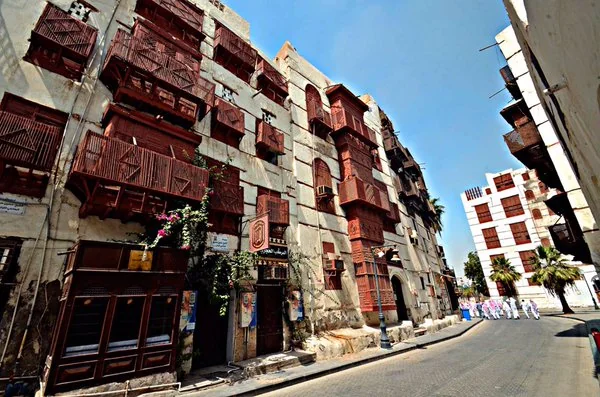
Formed the first basis of the Jeddah social fabric – 536 houses and families in (Jeddah) behind the old wall: arts, trade, science and knowledge
Many lovers of the city of Jeddah like to call it: "Jeddah: Mother of prosperity and adversity" for it gathers the prosperity provided here in the expression, and the adversity that may express the days of hardship sometimes, or express from a second point of view the strength and resilience and steadfastness. for Jeddah was and still is the gateway of entry to Makkah, and the Holy Mosque, and in the book: "The Best Divisions in the Knowledge of the Regions" which was authored by the traveler Mohammed bin Ahmed Al-Maqdisi known as Al-Maqdisi Al-Bashari (947-990 AD), Jeddah was: "The treasury of Makkah, and the source of Yemen and Egypt" and it was the gateway of entry for multiple civilizations, and it was throughout its history "a city of many blessings prosperous in trade with high urbanism" according to the description of the traveler Nasser Khosrow (1004-1088 AD).
The historical city of Jeddah witnessed a unified social foundation despite the many houses and families that inhabited it from the residents of the city and the newcomers coming for the Hajj of the house of Allah, for more than 16 thousand people was the number of the residents of the old city of Jeddah, who lived behind its walls, and as it was for Riyadh an old wall, and for some Arab and universal cities its walls like the old wall of Cairo, and the wall of Jerusalem, and the wall of Acre, and Dubrovnik in Croatia, and York in the north of England, and Harar in Ethiopia, and Taroudant in Morocco, and Toledo in Spain, and Pingyao and Xi'an in China, protecting it from external assaults, Jeddah also had a wall that protected it from the raids and assaults.
And Jeddah was composed from a number of houses and families, monitored by the researcher Mohammed Yusuf Tarabulsi in (536) houses and families, they are the ones who formed the first foundation for the Jeddah social fabric, and these families worked in trade and arts and sciences and various knowledge, and because Jeddah is close to the two holy mosques it was the focus of the hearts of those coming for Hajj and Umrah, and some of them used to settle in Jeddah and not return especially from the Arab countries near the Kingdom.
And the wall of Jeddah was surrounding it since the tenth century Hijri (the sixteenth century AD) until the middle of the fourteenth century Hijri, the twentieth century AD, and the wall is located in the historical Jeddah area and the wall was built by an order from Qansuh al-Ghawri the last of the Burji Mamluk sultans in Egypt, in the year 907 AH corresponding to 1509 AD. and Hussein Kurdi started the mission where he recruited the people their elders and their youngsters for the building of the wall,
And that for protecting the city from the Portuguese colonialism where the shores of the Red Sea were fortified and supplied with fortresses and towers and cannons to repel the ships and the attacks of the Portuguese.
And Jeddah remained surrounded by this wall until the year 1366 AH corresponding to 1947 AD.
Eight doors:
The wall includes eight doors which are: Bab Makkah, Bab Sharif, Bab Al-Nafiaa, and the doors: Al-Sabah, Al-Magharibah, Sareef, Al-Madinah, Jadeed. , and the wall was demolished in the year 1947 AD as it entered in urban areas, and but some of its gates remained.
The city of Jeddah inside its wall was divided into several neighborhoods and the old citizens of the city called them Harah and those neighborhoods acquired their names according to their geographic location inside the city or its fame with the events that passed through it
Among the most famous houses in the historical city of Jeddah: Beit Nassif, Beit Al-Sharbatly, Beit Faqih, Beit Al-Ashqar, Al-Ahdal, Al-Aseel, Al-Isfahani, Abu Al-Shamat, Abu Al-Ula, Abu Al-Jadayel, Abu Zinada, Al-Sharqawi, Al-Dumyati, Ba-Junayd, Ba-Khashwin, Ba-Jabir, Ba-Ghaffar, Bin Laden, Bin Zagr, Jamil and Jamjoum, Al-Hassoun, Hafni, Ba-Ashin, Al-Daghistani, Al-Rawas, Al-Rashidi, Zare', Al-Saqqaf, Al-Sannari, Al-Shabakshee, Al-Shanqiti, Al-Kinani and Al-Kadawani, Al-Magharbal, Al-Madani, and other known houses.
Among the most famous and oldest existing buildings until now Dar Al-Nassif and Dar Al-Jamjoum in Harat Al-Yaman and Dar Al-Ba-Ashin and Al-Sheikh and Al-Qabel and Dar Qumsani and the Shafi'i mosque in Harat Al-Mazloum and Dar Al-Banaja and Al-Zahid in Harat Al-Sham and Dar Al-Nimr
And Harat Al-Bahr and the height of some of these buildings reached more than 30 meters, as some of them remained for its durability and way of building remaining in a od state after the passing of dozens of years, and these houses were distinguished by the presence of wind-catchers on all rooms in the house and also the usage of Roshan windows.
Universal heritage site:
Historical Jeddah is known as: "Jeddah Al-Balad" and it is located in the center of the city of Jeddah, and its history dates back to pre-Islamic eras, and the turning point in its history was in the era of the Rightly Guided Caliph Othman bin Affan, where he took it in the year 26 AH corresponding to 647 AD as a port for Makkah, and historical Jeddah includes a group of landmarks and archaeological buildings such as: the ruins of Jeddah wall and its historical neighborhoods: Harat Mazloum, and Harat Al-Sham, and Harat Al-Yaman, and Harat Al-Bahr, as there is in it a number of historical mosques most prominently: Othman bin Affan mosque, and the Shafi'i mosque, and the Pasha mosque and Akkash mosque and the Architect mosque, and Al-Hanafi mosque besides the historical markets including: Al-Alawi market and Qabel market, and Bedouin market, and Al-Nada market, and Al-Khaskiya, and Al-Hababa, and Al-Jame', and among the most important khans of historical Jeddah: Khan Al-Hunood, and Al-Qasba, and Khan Al-Dallaleen and Khan Al-Attareen.
And in the month of June 2014 historical Jeddah was listed among the universal heritage sites, and in the year 2018 King Salman bin Abdulaziz – may d protect him – ordered the establishment of an administration with the name: Historical Jeddah Project Administration related to the Ministry of Culture with allocating an independent budget for it, and that based on supporting a restoration project directed by HRH the Crown Prince Mohammed bin Salman for restoring the buildings prone to fall in historical Jeddah.
Signals:
(Jeddah Book .. Story of a city – for Mohammed Yusuf Mohammed Hassan Tarabulsi – first edition 1427 AH, 2006 AD)
https://arb.majalla.com/2017/05/article55259247/
https://ar.wikipedia.org