Miniatures from Expressionism to Abstraction
Mervat Mohamed Al-Salem
Since the beginning of creation, man has not stopped searching for what he can express of his emotions and components, communicating with those of his species like other creatures and unleashing his feelings, obsessions and desires on the walls of caves and on polished rocks. The fruit of his arduous attempts was a language ranging between sound and image, sign and suggestion. The collection of experts, scientists and researchers in archeology and ethnology was a diverse set of numbers, drawings, letters and icons from many eras, telling stories and wars, narrating scenes and events, and describing the details of life in ancient times.
With the expansion of man's awareness and the development of his ideas as a result of his contacts and influence by peoples and groups outside his geographical surroundings, and after training, experimentation and social familiarity, and because of natural need, human expression reached advanced stages of sound, sign and depiction, until the language was formed with its primitive alphabet after a difficult labor. Although it remained a means of understanding in the narrow surroundings of the group and the tribe, and between small adjacent human gatherings, it was the nucleus of the first letters and the beginning of speech until drawings and images appeared in more accurate and clear forms after the completion of the alphabet, and the spread of writing and works in advanced ages. This art reached its perfection in the Middle Ages in the Middle and Far East, and moved to Western countries at a later time. It was drawn at that time on skins, metals, stones, bones and ivory, then on paper and cloth in later decades. The scribes then used explanatory, decorative and expressive drawings to explain the idea, so the purpose succeeded at a later time, and its results appeared in the civilizational interaction between peoples. Translations spread – especially – books of science, astronomy, medicine and geography, and the people of the West benefited from the East and the societies of the South from the North.
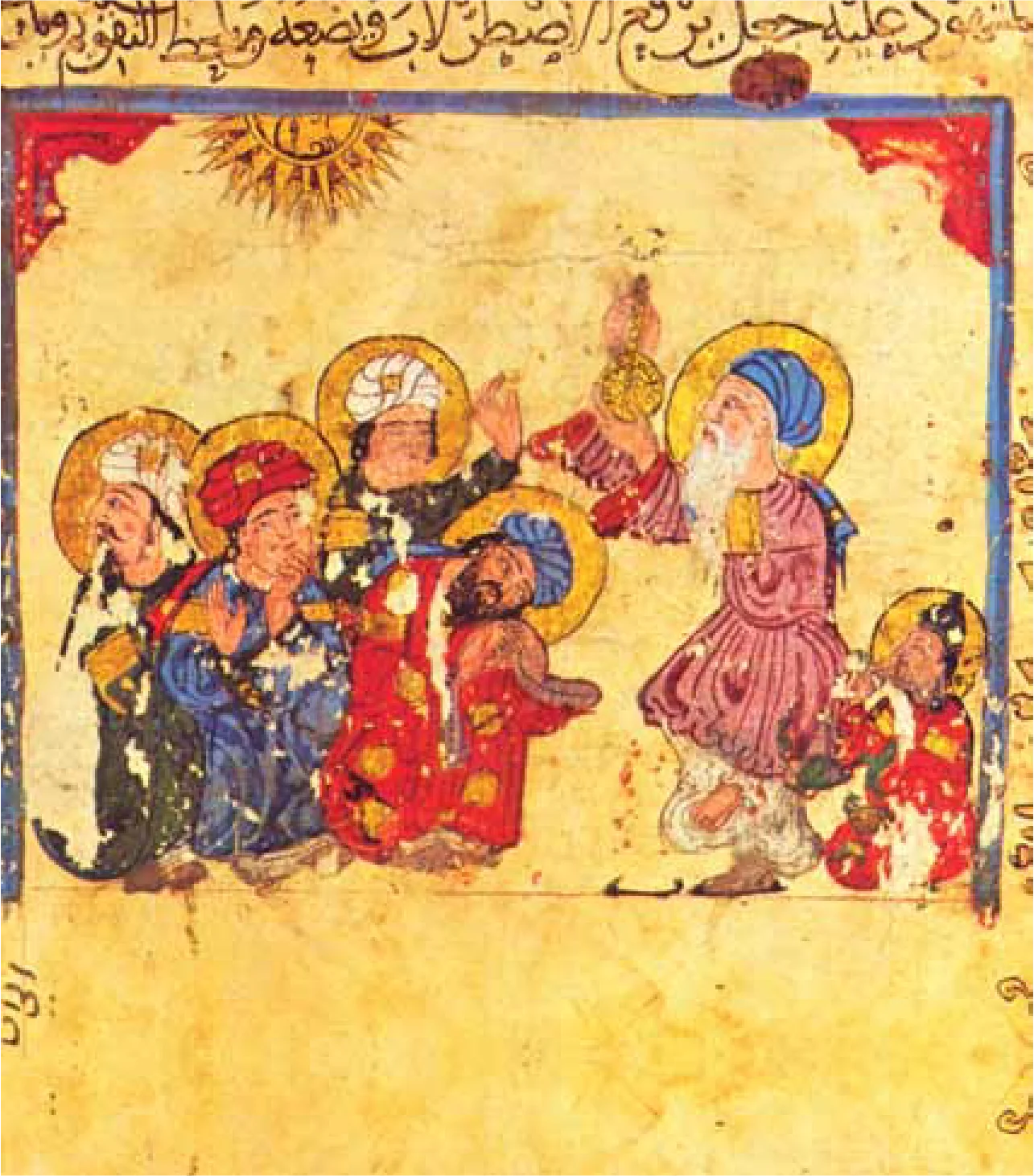
Hence, the miniature was defined as the formal textual embellishment of innovative stories narrated by drawings inspired by a visible reality, or a wide imagination that supports ideas and philosophies with embodiment and abstraction with bright colors that catch the reader's eye and move his imagination and feelings, and help him to understand. The beginning of its Arab appearance was in Ibn al-Muqaffa's translation of the book "Kalila and Dimna" from the ancient Indian language. Its author included live non-human images and drawings for explanation, indication and allusion, for everything he refrained from saying explicitly. Different schools followed in this color, and took multiple paths in this artistic form. The oldest of them were the Chinese school and the Indian school, and the most prominent in what they provided to the human heritage during the ninth century AD was the Persian school, followed by the Turkish school, and the Islamic school flourished by the beginning of the twelfth century AD. It was characterized by the accuracy of drawing and coloring, and the diversity of images, calligraphies, decorated margins and faces, and acquired a high aesthetic at the hands of Ibn al-Bawwab, Ibn Muqla and Yaqut al-Musta'simi. Its peak was in the Abbasid era because of the many translations that were completed at that time, such as the Maqamat of Al-Hariri, Al-Aghani of Al-Asfahani, the Fixed Stars of Al-Sufi, the Antidote of Galen, and the Veterinary Science of Ahmad bin Al-Hassan, and many others.
As for the most famous miniatures preserved by the Arab artistic memory, they are what was completed in the gilded and decorated Abbasid school way with precise drawings, derived from letters, and known as Hurufiyya. The influence of the Persian miniature seems clear on the artists of that school in terms of technique and content based on the narrative, legend, astronomy, philosophy and wisdom.
In this historical context, Dr. Iyad Hussein Abdullah says in his subject about "the semiotics of Islamic miniature and civilizational interactions between it and the rest of Islamic arts" (Multiple forms of Arabic calligraphies appeared over time periods that lasted several centuries, each of which performed a different function. These forms acquired aesthetic that had their traditions, controls and special aesthetic logic, which clearly express Arabic Islamic culture. This diversity and multiplicity was a source of richness in the of beauty, as is the case in the fields of thought, philosophy, literature, poetry and sciences that flourished in the fourth century AH. There is no doubt that Arabic calligraphy with its special aesthetic logic is a collective and not an individual art. Its various artistic forms remained rich in their abstract energies to the extent that they continuously expressed the pure spiritual data of civilization, by their continuous appearance as wall paintings on the walls of the mosque, or as a covering of tile (Qashani) for minarets and domes, or as a written text of the Holy Quran or within the forms of manuscripts that documented multiple forms of knowledge.
Arab and Islamic miniatures – offspring of the manuscripts that conveyed that knowledge to us – constitute one of the artistic, cultural and social manifestations that largely reflected the culture of those societies.
This special color of the art of depiction appeared, known today as: miniatures, and were formerly called: embellishments (Tazawiq). The Muslim artist developed this art which inherited its origins from civilizations prior to Islam, especially the Indian, Persian and Eastern civilizations. This art reached achieving a unique artistic painting in subject, form and treatment, even to the point of dazzle and astonishment in many cases, due to the many crowds and elements drawn with high precision, with bright colors and different movements deeply expressive of its subjects taken from reality at times and from stories and folk legends at other times .
Although some considered miniatures just embellishing models and called them embellishments at times, the truth of the matter did not carry a decorative function despite including many elements that suggest that. The first Arabic book in which miniatures appeared was the book (Kalila and Dimna), which is in its origin an Indian book translated by Ibn al-Muqaffa into the Arabic language.
Dr. Iyad determines the nature of the miniature and its conditions precisely and limits it to the forms and specifications that include a mixture of elements and vocabulary, such as texts in diverse Arabic calligraphies, with multiple measures and colors, in addition to plant, geometric and animal decorations of different styles, methods and directions, as well as drawings with multiple realistic forms that tend to exaggeration many times. The most important thing that distinguishes the relationship existing between these elements is the narrative or storytelling scene, which takes multiple forms ranging from heroism or hunting scenes or narrating events, facts and other topics. We also notice a greater degree of regularity in the distribution of forms and vocabulary according to their importance, the multi-level and multi-directional geometric distribution according to a mathematical system and the color harmony which often tends towards a type of amazing exaggeration. The process of executing the smallest details with high skill is not hidden, nor is the regular sequence in narrating the event within a very limited space.
The dominance of abstraction seems clear on the Arab miniature which relies on geometric formation and decorations to satisfy visual taste. The maker of miniatures may not need a high culture to achieve the condition of creativity in his paintings, and the maximum he needs is a deep understanding of the text he is working on. If some borderline paintings went out of context, it is due to the influence of those working on them by Western artistic techniques, and the recourse to experimental symbolic connotations with maintaining the historical heritage framework of the image and the gradual departure from the expressive realism that distinguishes it from the artistic painting or the image as an output that satisfies the visual taste of all social levels.