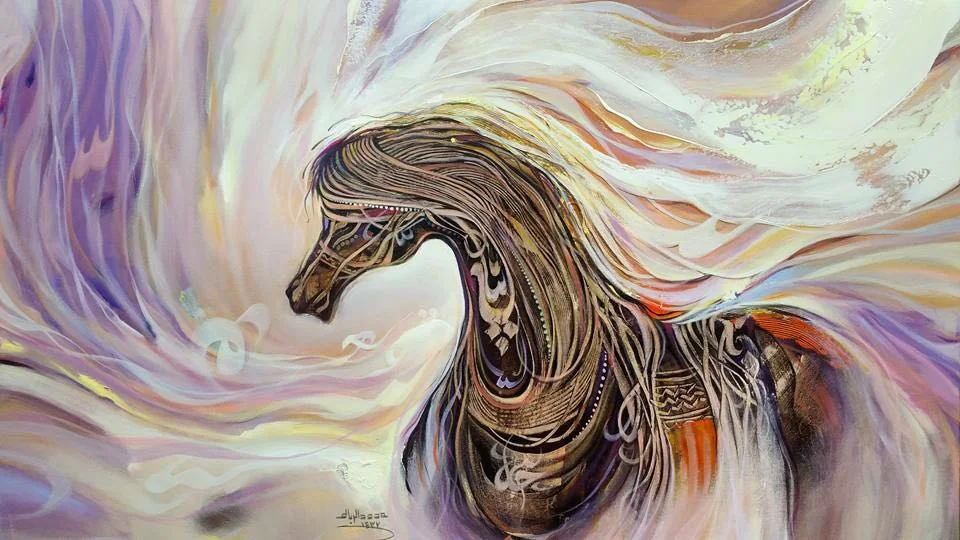
The Arab Plastic Artist and the Aesthetics of the Arabic Language
Radi uda (*)
Poets and writers were able through the language of Dad (Arabic) to possess the ticket of passage to the world. Was the Arab plastic artist able through the Arabic language, literal formation, sculpture, and ceramics to spread his artistic works and place his name on the map of creativity around the world?
How was the effect of circulating and participating the Arab artist with those Arabic letters? And activating them in the contemporary plastic experience through procedures and events that emanate from the spirit of creativity and looking forward to the future so that we can revive the presence of the Arabic language with a contemporary vision that makes it match cognitive updates? And it becomes one of the authentic tools for intellectual development after the separation of people and society at all its levels and limiting its bet on using foreign languages, letters, and symbols excessively so that it is what we can call the elite capable of diversity and bringing every visual pleasure by maintaining the authentic of the language of Dad. It is a difficult bet for the artist and his artistic production – through an experience that does not exceed a hundred years by little – as if it were on the margin of change and creativity, and after that an absence for the real and pure role of the arts in their various forms and genres in contemporary life. Therefore, the experience of the artist Nja Mahdaoui was one of the greatest indicators of success with support and publicity. Arab and Muslim creators have presented stunning arts to the world other than Arabesque, and have contributed to creating contemporary artistic .
The Arab plastic artist has inspired from the aesthetics of the linguistic text and the creative form of the letter many paintings and figures capable of competition, which have created a prominent place for themselves in the movement of developing aesthetic forms and adopting them in all fields from fashion and decoration tools to interior design and beautifying squares and airports.
The artists had their opinion on the relationship between the plastic letter, the Arabic language, and addressing the Western taste with this Arab art. What did the plastic artists say?
The Saudi artist and critic Abdulrahman Al-Sulaiman is not very optimistic about the West's view of Arab art in general, even if some works of Arabic Hurufiyya please him sometimes. From his opinion:
The West sees us with superiority, and as imitators of it. Therefore, our works cannot arouse it and adopt, sponsor, or present them to the world in any form. It may like some Arab works but its judgments are always preconceived.
The Saudi artist Muhammad Al-Rabat identifies the importance of adding Arabic calligraphy to the painting with its and beauty, and its connotations and the meaning of its existence in the artistic composition. Contemporary arts have recognized the role of Arabic calligraphy in imparting aesthetics to its structure and artists adopt it due to its infinite openness and symbolism, which imparts an Arab-Islamic character with new aesthetic and symbolic dimensions to the plastic painting that increase its elegance. We have proofs of that in the works of the international artist Wajih Nahla, the Syrian artist Muhammad Ghannoum, the Emirati artist Abdul Qader Al Rais and others from the Iraqi, Arab and Islamic world artists whose works have spread all over the world and who have a special imprint that differs from other arts.
The Egyptian artist Muhammad Halil sees that the Arabic letter was and still is a source of attraction for interior and fashion designers in the West. The Arab artist possesses a store, a heritage, and an awareness of the importance of the Arabic letter with its types and formations and appreciates that, even if he tends towards modernity in his works.
The Saudi artist Mufreh Asiri confirms that Arab and Muslim creators have presented stunning works to the world in Islamic arts that are renewed with the renewal of eras and times and by the difference of backgrounds. They have contributed to creating contemporary artistic .
These people were inspired by the Arabic letters and decoration in their plastic works and reached advanced positions in contemporary formation. We mention them as an example, not limited to: Al-Saleem, Al-Radwi, Jamil Hamoudi, Fateh Al-Moudarres, Dia Al-Azzawi, and Farid Belkahia. And artists whose names I do not recall from Sudan, Egypt, and Syria who presented stunning arts to the world that cannot be denied.
Thus, the experience of the Arab plastic artist was not less in any case than his brother the man of letters, the athlete, and the musician. Those honorable Arab models in sciences, arts, and letters that made a dazzling and brilliant name among the stars of the world we found their equivalent from the names of Arab plastic artists in this survey. If this indicates anything, it indicates the enthusiasm and diligence of the artist with the love and appreciation he possesses for the Arabic language and the Arabic letter, which pushed him with great activity, determination, and care that this letter reaches the horizons of the world and has a presence in all museums and exhibitions, as happened before with the art of Arabesque.