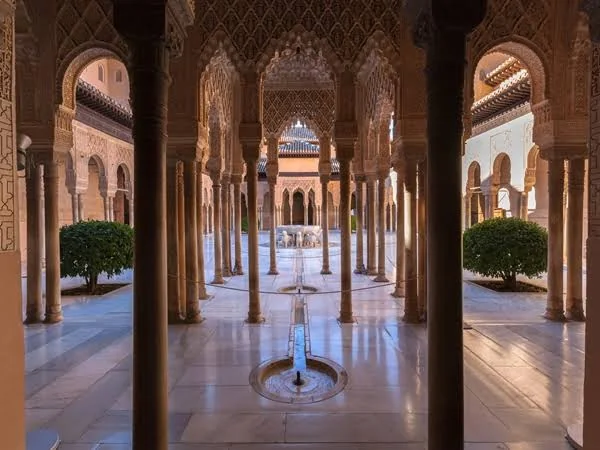
Built in the fourth century AH and its construction took 150 years .. The Alhambra Palace is an Andalusian architectural gem and one of the most prominent tourist attractions in Spain
When the Andalusian leader Boabdil (Abdullah al-Saghir), the last vernor of Granada which he handed over to King Ferdinand II and Isabella I by signing an agreement with them in 1491 providing for the surrender of the city, the demobilization of the army and the confiscation of weapons, wept, his mother initiated by reciting a verse that says:
Weep like women for a lost kingdom
You did not maintain like men
It was an eternal poetic stab that immortalized this moment in which Andalusia fell to the Spaniards after eight centuries of Islamic presence, where the Muslims left Andalusia, but they left behind monuments, arts, forts and palaces, the most prominent of which is the Alhambra Palace full of inscriptions, decorations, buildings, artifacts and the extended lake, which is registered in UNESCO within the list of World Heritage.
Architectural Edifice:
The Alhambra Palace is an archaeological palace and fort and one of the most important edifices of Islamic architecture lost in Andalusia. It was built by the founder of the Nasrid dynasty "Al-Ghalib billah" Abu Abdullah Muhammad I Muhammad bin Yusuf bin Muhammad bin Ahmad bin Nasr bin al-Ahmar [6] between 1238-1273 in the Kingdom of Granada during the second half of the tenth century AD. It is now considered one of the most important tourist landmarks in Spain and is located 267 miles (430 kilometers) south of Madrid. The beginning of the construction of the Alhambra Palace dates back to the fourth century AH, corresponding to the tenth century AD, and some of its parts date back to the seventh century AH corresponding to the thirteenth century AD. Its construction took more than 150 years.
It is said that it was named Alhambra (The Red) in reference to the Nasrid dynasty (Banu al-Ahmar) who built it, and another saying is that it was due to the use of red bricks in its construction, while the third opinion es back to the fact that the construction was at night by torchlight which reflected a red light on the walls.
The Alhambra Palace consists of four parts: the military Alcazaba fortress (the oldest part), the Nasrid Palace (the latest burst of Moorish architecture), the Summer Palace of Generalife, and the Renaissance Palace of Charles V. In fact, the Alhambra is a small city with four gates, 23 towers, seven palaces, servant quarters, workshops, baths, educational institutions (madrasas) and mosques.
Among the clear characteristics of Islamic architecture in the palace buildings; the use of delicate decorative elements in geometric arrangements like carpet patterns, the writing of Quranic verses and supplications, and even some praises and descriptions from the poems of poets like Ibn Zamrak, surrounded by colored stucco decorations covering the walls, and colored tilework (zellige) with geometric patterns covering the lower parts of the walls.
Decorations and Colors:
The most important characteristic of the Alhambra is the Islamic architecture features which include Quranic verses, poetic lines, supplications, the use of decorative elements and colored tilework, and it was chosen in 2007 as one of the twelve treasures of Spain.
In all the walls of the Alhambra you will find the Nasrid motto: No Victor but d. The story of the motto es back to the time the Arab leader Abu Abdullah Muhammad I entered Granada, and the people welcomed him, he replied saying No victor today but d, to turn into the Nasrid motto in all parts of the Alhambra.
The palace stands on a set of Islamic architectural styles, with the writing of Quranic verses and poetic lines in wonderful fonts, and it includes as usual ancient mosques and old palaces a large number of columns that are decorated from below and above, to contain geometric visions in which the theme of circularity plays a fundamental role in framing the Islamic architectural style.
Columns consist of either single or double columns, scattered across the palace lobby, where high altitudes end in wonderful decorated domes, as the fountains are surrounded by sculptures in the shape of lions, while the large lake in the palace extends longitudinally surrounded by diverse plants and flowers, and the palace floor is multi-patterned dominated by shiny marble tiles.
Architectural corners:
The palace consists of a set of corners including: Court of the Myrtles, leading to Hall of the Blessing, Hall of the Ambassadors, Court of the Cypresses, Hall of the Two Sisters, Court of the Lions, Hall of the Kings, Lindaraja's Mirador, Peinador de la Reina, the Angle and the Garden, as it includes a number of towers and gates.
The walls of the Alhambra are crowded with Naskh and Kufic Arabic calligraphy, in which we read not only the phrase "And No Victor but d" (this phrase attributed to Zawi ben Ziri the founder of the Nasrid dynasty); but we can also read poems by three poets of the royal court of Granada who are Ibn al-Jayyab (1274-1349), and Ibn al-Khatib (1313-1375) and Ibn Zamrak (1333-1393), they were chamberlains to the king and his prime ministers. Ibn Zamrak - among them - is considered the most brilliant poet of the Alhambra.
The architectural art of the Nasrid state represents the completion stage of the era of prosperity that the Umayyads started in Cordoba in the eighth century. Although this architectural art does not reflect any influence by the Cordovan architectural art represented in the Mosque of Cordoba which preceded the era of the Alhambra by a long history, it was able to provide special touches in Andalusian architecture like horseshoe arches with alfiz (a wide rectangular frame surrounding arches), and spandrels (a triangular space from arches) in addition to special elements like column capitals in the Alhambra.
The greatest interest of architects in creating the Alhambra was to cover all spaces, no matter how small, with decorations. So all the decorative elements seemed tiny. You find that the majority of the internal arches are nothing but forms of decoration and do not contribute to supporting anything from the building, as the walls are covered with ceramics and stucco, and the decoration is beautiful in appearance. The carvings that cover these walls were frames of wood worked in beautiful shapes.