Walls, palaces, wells, inscriptions and drawings – Tayma vernorate: a culture open to folk, poetic, visual and civilizational heritage
it is a city full of all the requirements of the cultural and tourist field, and the first thing that distinguishes it is that it includes an external wall that is one of the longest historical walls in the Arabian Peninsula, and the most fortified, as its length is more than 10 km and its height in some remaining parts is more than 10m, and the width of its wall is between a meter and two meters. The wall was built in some of its parts with stones and in other parts from brick and mud. The period of construction of the wall dates back to the sixth century before Christ. This is the Tayma vernorate, which is indicated first by its wall, which is an ancient archaeological wall without doubt, it is possible to invest it culturally and touristically to a large extent, and reshape it, paint it and put some inscriptions and drawings on it that express the culture of the Kingdom.
Tayma includes a number of ancient palaces rooted deep in history, including: Al-Hamra Palace, which is a building with three sections, the first: a temple, and the others for housing. Among the most important contents in the palace: an obelisk carrying an Aramaic text, and a manual cubic stone, and the history of the palace dates back to the sixth century BC.
Among the historical palaces as well: Al-Ridha Palace, Al-Bajidi, Al-Amara Palace, Al-Talq Palace, and the palace of the poet Al-Samawal or what is called: "Al-Ablaq Al-Fard" which is one of the building landmarks that gained wide fame, and heritage sources spoke extensively about it and dealt with its descriptions, and talking about its owner: Al-Samawal ibn Adia al-Azdi al-Qahtani, and in that Al-Samawal says:
Adia built for me a fortified fortress
And water whenever I wanted I quenched my thirst
This palace derived its fame because of its fortification and its unique architectural form that was singular among other palaces of the Arabian Peninsula, as it was known by several names but the most famous is Al-Ablaq Al-Fard, and Al-Ablaq means: the building constructed of white and red stone.
Al-Zabba', Queen of Palmyra, in the third century AD, praised this fortress after she failed to subject Duma al-Jandal and Tayma because of their fortification, and she said her famous saying: "Marid rebelled and Al-Ablaq became invincible." .
Among the archaeological sites in Tayma: "Qurayyah site" which is an archaeological site whose area exceeds 300 hectares and contains many urban landmarks constructed of stones, including: palaces, civil buildings, agricultural facilities such as wells, irrigation channels and various facilities, and the site contains tombs from the Aramaic period, in addition to that this area was fortified with two walls, an internal and an external one, topped by observation towers concentrated in the southern and western sides.
The most famous tourist well:
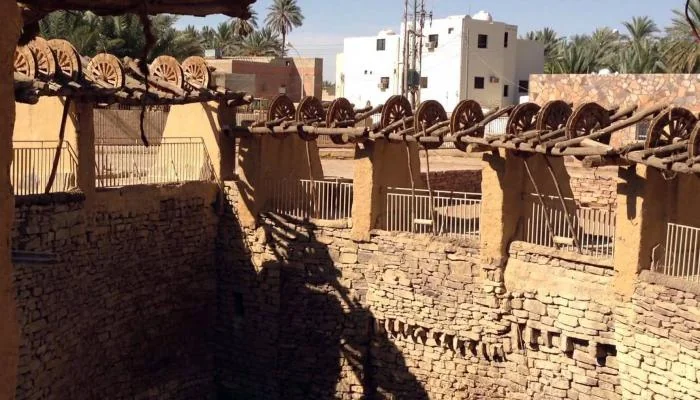
One of the most famous wells known to the ancient world, its history dates back to the middle of the sixth century of the first millennium BC, it is the "Haddaj Well" which was the first source of water in Tayma, but it was completely vanished because of a flood that swept the city in the era of King Al-Samawal ibn Adia al-Ghassani in the fifth century AD, and it was also sabotaged in the seventh century AH after it was subjected to another flood, and remained completely buried until it was re-excavated about 400 years a, to return to work and continue to supply the town with water by means of Sawani, then the well was neglected for a period and it was restored and qualified years a to be an important tourist landmark that has its cultural and economic role.
Writings, inscriptions and arts:
Tayma is rich in many ancient writings and inscriptions and rock drawings, and including ancient Thamudic, Aramaic, Nabataean, Kufic and Islamic inscriptions. The rock drawings include human, animal and plant forms and what simulates nature. Among its most important sites: Mount Ghunaim, Wadhha, the Western and Eastern Khabou, Mushamrakha, Safat al-Marida, Umm Saraf, Mahajjat Tayma, Ghiran al-Mujaddar and others. Due to what Tayma contains of artifacts, the Museum of Antiquities and Folk Heritage was opened, which was opened on 6/7/1413 AH.
Tayma is famous for the presence of a large number of traditional tools such as: Al-Mahala, Al-Daraj, Al-Minkhala, Al-Zabil, Al-Qirbah, Al-Najr, and a number of traditional crafts and popular professions such as: carpentry, blacksmithing, harvesting, Takseef, and Diayas, and other popular professions besides popular games such as: Al-Bayita, Adhim Lah, Al-Tokha, Al-Ghumayya and Al-Miqla', and among the popular arts: Al-Ardah, Al-Samiri, and Al-Hajini.
Tayma, which is located to the southeast of Tabuk at a distance of 264 km, is one of the most important vernorates rich in its antiquities and historical and natural landmarks, and if it is beautified and placed on the tourist map it will be one of the most important tourist landmarks in the Kingdom due to its history and its archaeological contents and its deep far civilizational depth.