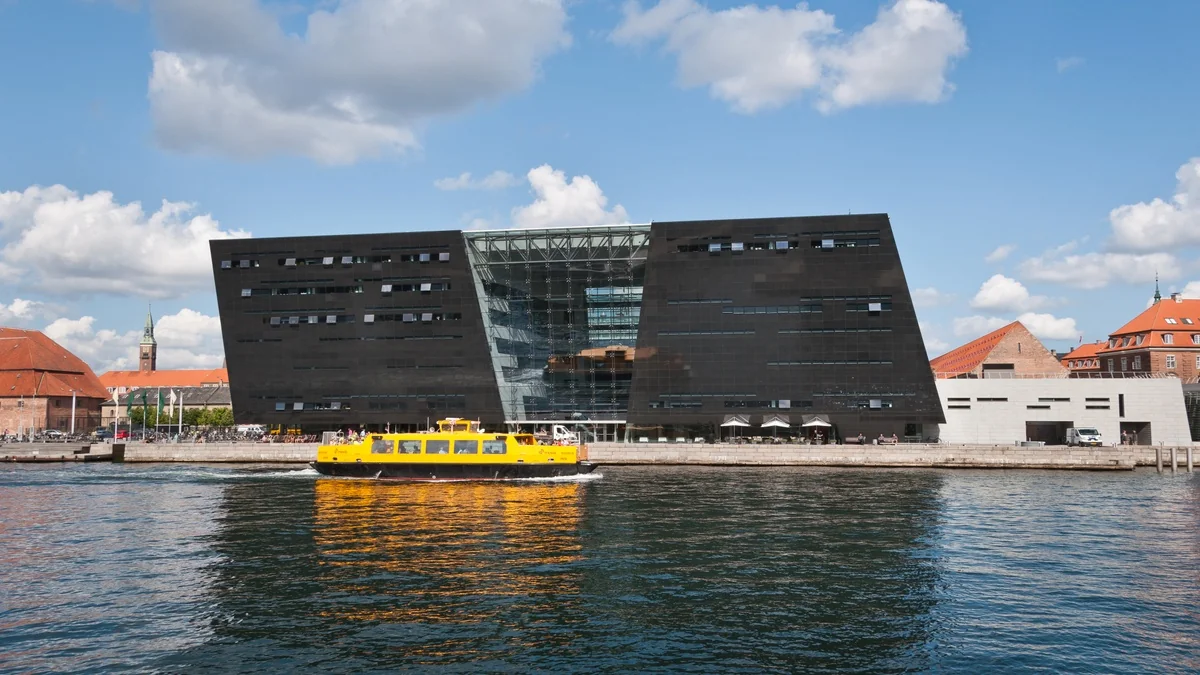
It contains many rare Arabic manuscripts.. The Royal Library in Copenhagen.. the largest library in Northern Europe
Written by / Hosni Abdel Hafez
The Royal Library in the Danish capital, Copenhagen, is the largest national public library in the Nordic countries and one of the most important and largest libraries in the world. It is full of thousands of documents and manuscripts in various languages, numbering (except for the oriental ones) about forty thousand manuscripts and documents. As for the oriental section, it includes oriental books and manuscripts reaching a total of about thirty thousand, including nearly four thousand manuscripts, most of which are in Sanskrit, Arabic, Monlian and Tibetan languages.. Three of the most prominent Danish orientalists had compiled a catalog of three volumes, containing data, comments and explanations for a large number of rare Arabic and oriental manuscripts, and the first editions of this catalog appeared between 1846 and 1875 AD. So what about the Royal Library in Copenhagen...?
What are the most famous and important Arabic manuscripts in it..?
Historical Overview
The first beginnings of forming the manuscript collections contained in the library date back to the reign of King Christian III (1345 - 1359 AD), who was known for his passion for reading and collecting manuscripts. This collection was inherited by his grandson King Christian V, and most of it revolved around theology and German literature. These manuscripts were added to the collection formed by King Frederick III (1648 - 1670 AD), to form together a small library, which is the first building block on which the current Royal Library was based. As for the first oriental manuscripts, they came from the Danish traveler Carsten Niebuhr, who collected them during a trip to the East that lasted from 1761 to 1767 AD. After that, more collections followed that were in the possession of people famous for acquiring manuscripts, including the Kratzenstein collection, the Otoloot collection, the Suhm collection, and the Moldenhawer collection. As is the case with most oriental manuscript collections in large European libraries, Arabic, Persian, and Hebrew manuscripts were the most prominent collections in the library. To them was added a large collection brought back by the Danish historian and orientalist Rasmus Rask from a long oriental journey during which he roamed many countries of the Near and Middle East.. The deposit of more oriental manuscripts continued in the Royal Library in Copenhagen in the nineteenth century and the first half of the twentieth century.
The library building is currently located near the city port, in an area known as Slotsholmen. Its construction dates back to 1906 by Hans Jørgen Holm. There are three other buildings belonging to the mother library, one of which is located in the heart of the city, in an area called thersgade, which specializes in social sciences and law, the second in the Amager area, for the humanities, and the third in the Nørre Allé area, which specializes in natural and health sciences. The library buildings have witnessed more development and renovation during the past decades.. In 1999, near its old building, a new building called (The Black Diamond) was opened, as its outer shell is made of glass and black granite extracted from Zimbabwe and polished in Italy, the weight of each piece of which reaches about 75 kg, while its total area exceeds 2,500 square meters. The building was designed by two famous architects, Schmidt, Hammer & Lassen, and includes a large hall, topped by eight floors, and connects with the mother library (the old building) through three bridges, two small ones for internal movement, and the third large one for movement between the inside and outside together. Its entrance is topped by a huge painting by a Danish painter named Kirkeby.. Due to its historical importance, the old building of the library has been listed in the UNESCO records of World Human Heritage.
Among its most famous and important holdings is what is known as the Arnamagnæan collection of manuscripts, which includes correspondence between Hans Christian Andersen and Søren Kierkegaard, the Dalby Book, which is a Latin Bible on parchment, a collection of national historical chronicles of Denmark, and rare maps of the polar regions.. Since its establishment, a large number of scholars have succeeded in presidency of the library, the first of whom was Mebon Marcus, and among the most famous were Gravenfeld Berier, Daniel Moldenhawer, Schlegel, John Erichsen, and Bruun Wang.
Organizationally, there are five main departments in the library:
(1), The Danish Department.
(2) The Foreign Department.
(3) The Maps Department.
(4) The Music Department.
(5) The Manuscript Department.
The library contains six reading rooms, each with about 500 seats, and there is a large hall known as (The Queen's Hall), which accommodates more than 600 people, and is used for a variety of purposes related to culture and the arts.
Multiplicity of Tasks and Functions
The Royal Library in Copenhagen is a public library that opens its doors to the public and provides more services that benefit the average reader and the academic researcher. In points, the most prominent tasks and functions performed by the library can be identified as follows:
• Acting as a legal deposit library.
• Acting as the central entity for collecting national intellectual production.
• Collecting foreign intellectual production.
• Issuing the national bibliography.
• Collecting, preserving, and organizing manuscripts.
• Providing opportunities for other libraries and private information-providing entities to benefit from the national library catalog.
• Participating in planning library services within the country.
• Acting as a central publication exchange center within and outside the country.
• Issuing a unified national catalog.
• Planning and coordinating interlibrary loan operations.
• Providing library services to vernment agencies.
• Providing specialized training areas.
• Providing indexing services for national periodicals and newspapers.
• Contributing to the formulation of national standards for the information circulation system.
• Acting as the central agency responsible for communication and exchange of information with international data banks.
• Providing reading systems for the disabled.
• Acting as the national research library for humanities, religious and social sciences.
• Performing the main role played by the University Library in Copenhagen.
Catalog of Oriental Manuscripts
In three volumes, the first catalog of oriental manuscripts appeared at the hands of Westergaard, Olshausen, and August Ferdinand Mehren, who were leading Danish orientalists. These three volumes were printed during the period from 1846 to 1857 AD. The second volume was devoted to about 309 Arabic manuscripts, some of which we will mention later, with comments and explanations by the orientalist Mehren. Their classification in the catalog, according to their subjects and sequence, and the number of manuscripts for each subject, was as follows:
Religions (from 1 to 80)
Mathematics, Astronomy and Geometry (from 81 to 91),.
Geography and Natural History (from 92 to 104).
Animal History (from 105 to 107).
Medicine (from 108 to 115).
General History (from 116 to 164).
Genealogy (from 165 to 167).
Biographies and Literary History (from 168 to 172).
Politics (173).
Grammar (from 174 to 195).
Dictionaries (from 196 to 199).
Rhetoric (from 200 to 209).
Collections (from 210 to 223).
Stories, Maqamat and Letters (from 224 to 236).
Poetry (from 237 to 286).
Family Life and Social Relations (from 287 to 292).
Other Subjects (from 293 to 309).
From the Rare Arabic Manuscripts
This is a group of precious Arabic manuscripts acquired by the Royal Library in Copenhagen:
Akhbar al-Duwal wa Athar al-Uwal: by Abu al-Abbas Ahmad ibn Yusuf al-Dimashqi. The number of leaves of this manuscript is 300, and its number in the Arabic manuscript catalog is 128.
Al-Aghani: by Abu al-Faraj al-Isfahani, consisting of 240 leaves, numbered 169.
Al-Ibil: by al-Asma'i, consisting of 40 leaves, numbered 107.
Al-I'jaz wa al-Ijaz: by Abu Mansur al-Tha'alibi, consisting of 37 leaves, existing within a manuscript collection numbered 207.
Al-Ishtiqaq: by Abu Durayd, consisting of 513 leaves, numbered 165.
Al-Ashriba: by Ibn Qutayba, consisting of 52 leaves, in a manuscript collection numbered 298.
Azhar al-Rawdatayn fi Akhbar al-Dawlatayn: by Abu Shama. This manuscript is in two parts and a tail. The first is in 218 leaves, and the second is in 273 leaves, while the tail is in 187 leaves.. This manuscript carries numbers 155 and 156 in the catalog of Arabic manuscripts.
Al-Iftitah fi Sharh al-Misbah: by Hasan ibn Ala' al-Din al-Aswad, consisting of 85 leaves, in a manuscript collection carrying number 177.
Al-Barq al-Yamani wa al-Fath al-Uthmani: by Qutb al-Din Muhammad ibn Ahmad al-Makki, consisting of 226 leaves, numbered 140.
Bada'i' al-Bada'ih: by Ibn Zafir al-Azdi, consisting of 231 leaves, numbered 169.
Bughyat al-Mustafid fi Akhbar Madinat Zabid: by Wajih al-Din Abd al-Rahman ibn Ali ibn Abbas, known as Ibn al-Dayba' al-Yamani, consisting of 89 leaves, numbered 141.
Tarikh al-Islam: by Shams al-Din al-Dhahabi, consisting of 662 leaves, numbered 113.
Tuhfat al-Albab wa Nukhbat al-A'jab: by Abu Abd Allah ibn Abd al-Rahman al-Andalusi al-Gharnati, consisting of 300 leaves, numbered 92.
Tuhfat al-Arus wa Nuzhat al-Nufus: by Abu Abd Allah Muhammad Ahmad al-Baja'i, consisting of 176 leaves, numbered 288.
Thamarat al-Awraq: by Ibn Hijja al-Hamawi, consisting of 191 leaves, numbered 215.
Jawahir al-Buhur wa Waqa'i' al-Umur wa Aja'ib al-Duhur fi Akhbar al-Diyar al-Misriyya: by Ibrahim ibn Wasif Shah, consisting of 65 leaves, numbered 149.
Al-Durr al-Muntakhab fi Tarikh Madinat Halab: by Ali ibn Muhammad al-Jabrini, its number of leaves is 178, numbered 142.
Hayat al-Hayawan al-Kubra: by al-Damiri, in two parts. The first is in 402 leaves and the second is in 588 leaves. The first part carries number 105, while the second part carries number 106.
Kharidat al-Aja'ib wa Faridat al-Ghara'ib: by Ibn al-Wardi, consisting of 213 leaves, numbered 93.
Zad al-Musafir fi 'Ilaj al-Adwa' allati Ta'rud fi al-Jasad: by Abu Ja'far Ahmad ibn Ibrahim al-Jazzar, consisting of 368 leaves, numbered 109.
Rayhan al-Albab wa Ray'an al-Shabab fi Maratib al-Adab: by Abu al-Qasim Muhammad ibn Ibrahim al-Mawa'ini, consisting of 268 leaves, numbered 211.
Lubab al-Lubab fi Tahrir al-Ansab: by Jalal al-Din al-Suyuti, consisting of 178 leaves, in a manuscript collection numbered 167.
Mabariq al-Azhar fi Sharh Mashariq al-Anwar fi Sihah al-Akhbar: by Abd al-Latif ibn Abd al-Aziz, known as Ibn Malik, consisting of 311 leaves, numbered 51.
Al-Ma'arif fi Akhbar al-Arab wa Ansabihim: by Ibn Qutayba, consisting of 419 leaves, numbered 116.
Mu'jam al-Buldan: by Yaqut al-Hamawi, consisting of 378 leaves, numbered 100.
Minhaj al-Bayan: by Yahya ibn Jazla, consisting of 340 leaves, numbered 113.
Nukhbat al-Dahr fi 'Aja'ib al-Barr wa al-Bahr: by Shams al-Din Muhammad ibn Abi Abd Allah Muhammad ibn Abi Talib al-Ansari al-Dimashqi, known as Sheikh al-Rabwa, consisting of 158 leaves, numbered 96.
Ma'ahid al-Tansis 'ala Shawahid al-Talkhis: by Abd al-Rahman al-Abbasi, consisting of 228 leaves, numbered 202 in the Arabic manuscript catalog..