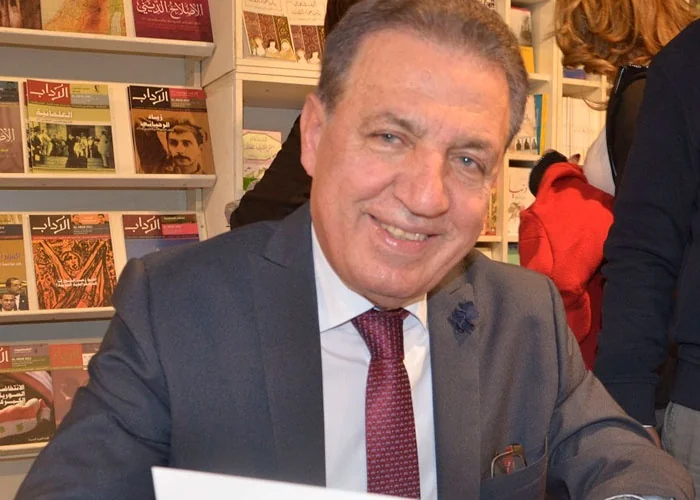
Ahwal Al-Ma'rifa publishes the full statement of the 2021 Booker
Statement announcing the shortlist for the International Prize for Arabic Fiction (2021 session)
(Chawki Bazih \ Chairman of the Jury)
If poetry, according to some critics, is what remains of the verse text after converting it to prose, or it is what remains of the language after clearing it of excesses, then the novel from some angles is what remains of history after clearing the truth from the custody of falsifiers, impersonators, and writers of official reports. It is not a kind of coincidence that the novel occupies, accordingly, that advanced position that it has reached during the past decades of time, but rather the matter is related to the ability of this literary genre to meet the human need to discover their features in the mirrors of the narrative imagination, or to search for suitable exits for their troubled relationship with reality, through virtual parallel lives, they can identify with them in moments of happiness and victory, and they can on the contrary disavow them in moments of disappointment, destruction and the blockage of the horizon.
While the novel, armed with the lightness of prose, can track more than any other art, the neglected destinies of societies and individuals, or the for,tten biographies of obscure places, and of marginalized people who find no one to give them a mention, it seems closer to being the black boxes, which must be resorted to, to reveal what Amin Maalouf described as the imbalance of the world, and to unveil its defects and faults.
Although the required specifications for this statement do not leave me the luxury of ,ing deep into revealing the detailed features of the nominated novels, this should not distract us, my fellow jurors and I, from pointing out that the novels submitted this year, although they were fewer than their predecessors in terms of quantity, stand at the qualitative level, side by side with the best works known by this award since its inception. The reason for this is not only due to the fact that a new generation of novelists is advancing to the arena of creativity equipped with more than just abstract talent, to boldly explore all the requirements of narrative writing and its experimental tests, but because these works were written in the rare moment of engagement between the growing noise of the cracks of the troubled Arab reality, and between the forced isolation imposed by the Covid-19 pandemic on all humans, and on the creative ones among them in a special way, where narrative writing could bear fruit, under the double shelter of silence and darkness.
The most prominent thing revealed by the deep examination of the six novels that reached the shortlist is the regression of the authors' closed e,s, in exchange for their attachment to their dynastic roots, their mother earth, and their collective memory. The themes addressed by the selected works may not be completely new to the specialized reader, as the Arab present is a carbon copy of the past, and male dominance is in its full power, and women are almost absent, and reality is wounded by all forms of corruption, whose controllers do not hesitate to commit massacres, or trade in poisons, in order to achieve material gains and accumulate wealth, and the heroes are schizophrenic, killers and killed, and the place is shaky and lacks solidity, and the times are fragmented, and violence is distributed equally between the ruling authority and the forces of dark takfir. However, what gave these works their uniqueness is another matter, related to their stylistic richness, their ability to amaze and take the breath away, their masterfully crafted and interesting plot, and their clever language with a varying expressive nerve, both soft and intense, as well as their successful investment in myths and the collective imagination.
Nevertheless, it was not easy to reach the results reached by the committee, for the imperfect pun between freedom and confusion is not without significance, and the most difficult test of freedom is not represented by the mandatory paths of trips, but by the crossroads that stop us for a long time in the wind of opposing possibilities, where decisions taken have varying consequences. From among approximately thirty novels that were advancing steadily and with slight differences to the arena of competition, we had to, forced and with a considerable amount of struggle, arduous deliberations and in-depth discussions, and in commitment to the conditions and systems of the award, be satisfied with six works in the current stage from among the wonderful novels we read. However, I can confirm in my own name, and in the name of my four colleagues, that what we reached of results and conclusions, has been based from our point of view on artistic and creative considerations, that have no relation to anything related to the writer's country, age, gender or fame, or the publishing entity of his nominated work. The jury has therefore decided that the award's shortlist will include the six works that I will name according to the alphabetical order of their authors' names, and they are the following:
1– The Notebooks of the Bookseller, Jalal Barjas (Jordan) - Arab Institute for Research and Publishing
2 – Longing for the Woman Next Door, Habib Selmi (Tunisia), Dar al-Adab
3 – File 42 – Abdelmajid Sebbata (Morocco), Arab Cultural Center
4 – The Eye of Hammurabi - Abdelatif Ould Abdallah (Algeria) – Mim Publishing
5 – The Calamity of the Nobles' House – Amira Ghenim (Tunisia), Mesila for Publishing and Distribution
6 – The Bird Tattoo – Dunya Mikhail (Iraq) – Dar Al-Rafidain