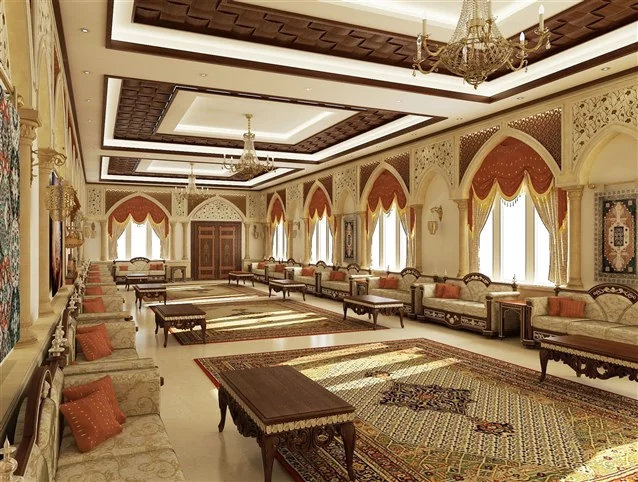
You sit and the guests talk .. Saudi home councils: traditions of hospitality and dialogues of tales, stories, and poetry
One of the prominent social phenomena in the Kingdom is the presence of a council (Majlis) in the Saudi home. It is not just a place to receive guests like the salon or the reception room found in apartments and houses, but rather a place that has its own traditions, rituals, and obvious social customs, and also has its own decorations, and its culture with its free conversational hierarchy, and its social formalities sometimes when the council turns into a council of knowledge or a forum managed in a specific cultural way, moving to what are called cultural salons.
But here we deal with the Majlis as a popular social phenomenon, which has been included among the customs of many countries in the UNESCO Representative List of the Intangible Cultural Heritage of Humanity, including Saudi Majlises, which were included in the list of intangible world heritage under the title: "The Majlis: A Cultural and Social Space" in partnership with the United Arab Emirates, the Sultanate of Oman, and Qatar in 2015.
Majlis Identity:
The Majlis is a gathering place for community members to discuss some local issues and matters in an open, non-methodical way, and to exchange news of public affairs, as well as family, personal news. It is therefore a place for social communication, and is also considered a place for performing social duties, such as receiving guests, offering condolences, or sometimes wedding parties, congratulating on a newborn, or students' success, and so on. It is a place for social meetings whether at the level of friendships and acquaintances, or at the family level.
The Majlis is a wide place with cushions and armrests, and sometimes there is a fire to prepare coffee. The elderly are very interested in this, and in Majlis meetings for their knowledge of lineages, tribal history, narrations, and various tales that are clothed in a color of evening conversation that the audience in the Majlis loves. Oral heritage, folk stories, proverbs, tales, or folk singing and poetry of both types, eloquent and Nabati, may be transmitted, and dialogue and reception skills stand out from the various attendees, old and young.