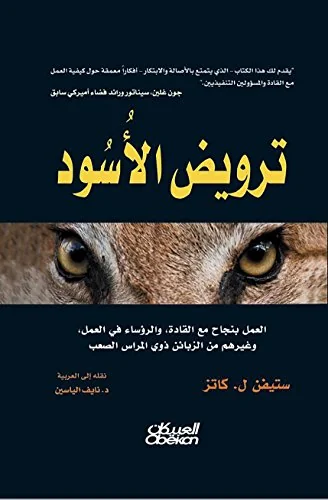
Through Pun, Metaphor, and Intertextuality, Stephen Katz Harmonizes Management and Circus in His Book: Taming Lions
Exposition: Suhail Najib
The book "Taming Lions" researches the science of management and the world of managers using a comparative approach, in which its author "Stephen Katz" excelled through the style of pun, metaphor, and intertextuality in presenting in-depth administrative visions and ideas, and how to work with leaders and executive officials to achieve success with them, and acquire superior practical skills for netiating with customers with difficult moods.
The book gained high satisfaction in the world of management, and certificates of accreditation from experts, senior managers, and executive officials at major international companies. Many decision-makers adopted it as a roadmap to be guided by in difficult situations, as the author presented safe solutions with shrewdness, and created a harmonious mixture of the art of management and the arts of the circus related to taming lions. He provided a summary of the experiences, expertise, wisdom, and administrative theories that he knew, pointed out the strengths of managers, their weaknesses, and alerted to their positive qualities such as strength, control, and working with consultation on important decisions to distribute responsibility, the importance of discovering capabilities, instilling confidence in the souls of subordinates, providing equal opportunities for those working under control, self-respect, personal integrity, approaching the cadres of workers and helping them, and activating administrative reward and punishment at the appropriate time and other elements that lead to the satisfaction of workers, and raising their productive capacity, devotion to the establishment, and loyalty to its management.
As for the negative qualities that the author sees in the inner workings of managers, such as vanity, dictatorship, bias, nervousness, unilateralism of decision, neglecting the conditions of workers, and ignoring their personal and human conditions, those are the qualities that hinder the progress of the productive wheel, put obstacles in the path of achievement and creativity, frustrate the determination of those with competencies, and discourage the resolve of those with capabilities.
To save what can be saved, the author presented successful solutions for dealing with such managers before the "ruin" of the establishment.
Paul Brown, one of the biggest specialized writers in the science of management and economics, described the book "Taming Lions" by saying: "This book is the best training guide on using your whip and chair effectively." As for the evaluation of the "Business Book Review" foundation for Katz's book: "The perspective presented by Stephen, in addition to the exciting metaphor he uses, is what makes this book a great work."
The author made his comparisons between lions and managers, based on the instinct of survival and control, the practice of power, the lust for exclusion and uniqueness in the place. He did not forget to provide advice to subordinates on how to deal with their human lions, avoid their punishment and harm, and draw their attention to the risks at the appropriate time. Stephen also mentioned in his comparative study many proofs and examples through which he confirms that he did not find any differences in the leadership of those around them in the circle between the two creatures, and from here he chose the twinning between them in his book due to the high degree of identical nature, practice, and control between the two.
Katz presented his interesting management theory in a book of three parts: branching into thirteen chapters under common titles that scholars know and management experts agree on, most notably:
- Lions cannot be gentle: Among what was mentioned in this chapter is that lions are capable of attacking anything except the problem, and they keep others in a state of anxiety to maintain their stability and confidence, and the certain thing in their character is their constant mystery. They have a lust for power instinctively, and they suggest to everyone control over the surrounding of their site.
- Entering the lion's skull: This theory is based on the defense instinct of the other party at work, because lions set their sights on the prey.. the enemy.. the neglected - first - and it is important to search for the lion's (four) senses to avoid them. Its senses are: control, its lair, its social status, and survival. It must be noted that lions enjoy a od visual and auditory memory, and this is a deep-rooted fact; they have eyes that do not make mistakes and a curiosity to know everything around them.
- The art of taming lions: In this chapter, the author breaks the (code) of the behavior of autocratic managers. To become one of them, you must approach the lion so that it approaches you. This is done when the subordinate gets rid of fear, hesitation, and repression, but he should be alert and cautious...