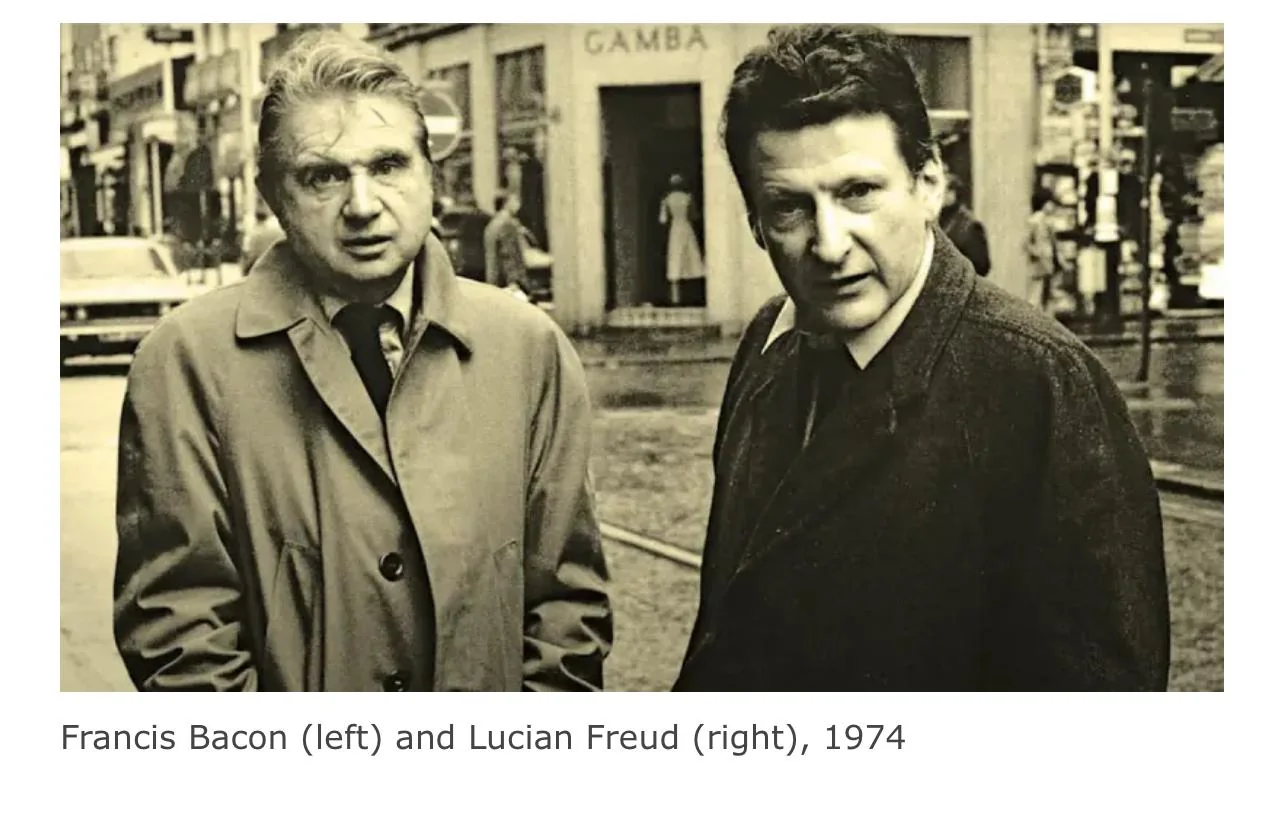
Lucian Freud and Francis Bacon: The famous friendship between rivals
Artists often develop strong relationships with each other, as we read in Collector magazine about the rivalry and friendship between Lucian Freud and Francis Bacon, two of the world''s most famous contemporary artists.
While many famous and influential artists had flourishing relationships with others in their field – Andy Warhol and Jean-Michel Basquiat or Edgar Degas and Édouard Manet come to mind – there were also intense rivalries, cruel competitions and countless insults shared between artists.
According to the report translated by Ahwal Al-Ma''rifa, in one case, this seemingly contradictory relationship occurred simultaneously between two of the most famous artists of all time: Lucian Freud and Francis Bacon.
Lucian Michael Freud was born in Berlin, Germany in the summer of 1922. Freud was the son of Ernst Freud, the Austrian Jewish architect, and the grandson of the world-famous neurologist, Sigmund Freud. His family emigrated to England in the early 1930s, and Lucian studied at the Central School of Arts in London and the East Anglian School of Painting and Drawing in Dedham.
After serving in the Merchant Navy during World War II, Lucian Freud began painting full-time. In his early days, Freud''s paintings had surrealist influences, but as his style matured, his art moved more towards realism.
For decades, Lucian Freud painted intense and evocative portraits of live models by asking friends, family members and even acquaintances sometimes to sit for him.
Francis Bacon was born to British parents in Dublin, Ireland in 1909. Bacon was a descendant and namesake of the famous philosopher, attorney general and Lord Chancellor of England, the other Francis Bacon, who lived in the mid-16th and early 17th centuries.
Before his death in 1626, Bacon was raised in both Ireland and England, where he was home-schooled rather than ing to school because of severe asthma. His childhood was turbulent at best, and his relationship with an abusive father was shaky; he came of age during the rise of the Irish nationalist movement. The abuse from his father worsened throughout Bacon''s life; he was even whipped by stable boys at his father''s command.
His paintings distort his subjects, often hauntingly, in a distinctive style influenced by Surrealism. In Bacon''s paintings, bold and vibrant colors twist together to create the familiar shadows and highlights of the human face. His paintings share strong emotions, whether in people''s faces or even in the details of the backgrounds. Bacon turned to the old masters for inspiration and believed strongly in supporting the beauty of the medium, saying his artwork was "worthy of either the National Gallery or the trash can, with nothing in between."
In the mid-1940s, Lucian Freud and Francis Bacon met and friendship began immediately. The two remained friends for decades, talking almost every day.
The two intensely examined each other''s work, and both tore the other to pieces and regularly exchanged harsh criticism. As Bacon explained: "Who can I tear to pieces, if not my friends? ... If they weren''t my friends, I couldn''t commit such violence with them." Freud continued to call Bacon''s paintings in the 1980s "terrible."
Years after their relationship ended, each artist sat to paint portraits of each other, Lucian Freud sitting for Bacon for the first time in 1951. The fact that they wanted to paint each other speaks to the nature of their relationship. Freud said in this regard, "I only paint the people close to me," a sentiment reflected in his other portraits, where his children were recurring subjects.
Esther, one of Freud''s daughters, spoke fondly of his painting her: "I felt my importance to him ... in those hours and hours I had a lot of his attention.. he would paint and tell me stories and sing me songs. He''d give me food and take me to dinner. It makes you feel wonderful. I felt very close to him."
Lucian Freud seems to have used the studio to connect with those in his life, but apart from the hours pumped into his children''s portraits, he was an entirely absent father. In 2013, David McAdam Freud, Lucian''s son, said he and his siblings barely saw their father during childhood.
Freud''s relationship with his children remained complex throughout his life. His son David visited Lucian on his deathbed while he was suffering from a terminal illness. Instead of using the limited time the two men had with each other to say odbye, it was used to paint a series of portraits. This time Lucian was the subject.
While some of Freud''s and Bacon''s works resemble each other, the two had very different ways of painting.
In another insistence, Lucian Freud took more than a year, a total of 16 months, to finish one painting. The model was posed throughout this long period except for four days, and each painting session took about five hours. In a series of paintings of his mother, Freud spent nearly 4,000 hours working.
Freud did not seem to mind spending so much time on one artwork, saying he "feels it is finished when he has the impression that he is working on a painting of someone else." Unfortunately, Freud''s portrait of Francis Bacon was stolen in the late 1980s and is still missing to this day, reducing all the work he spent on it.
While the painters share an outward disdain for each other''s styles, they clearly influenced each other''s art. Bacon regularly used a 14 x 12 inch portrait format, focusing only on the subject''s head, a medium Freud later used in portraits of two of his daughters made in the early 1980s.
In 1969, Bacon painted a triptych of Lucian Freud, but shortly after the artwork was finished, the friendship ended. Apparently, the disagreement was a result of Freud''s arrogance and Bacon''s intense dislike for him. However, despite the two being separated, the portrait remains very popular. In 2013, it sold at Christie''s for $142.4 million, breaking the record for the most expensive artwork sold at auction. The sale broke the previous record for Edvard Munch''s The Scream, sold at Sotheby''s, by more than $22 million.
In the painting, Freud sits on a wooden chair, a geometric cage, with additional wood framing his body. His face is depicted as a mask of color. Red and pink contrast with deep blue and gray tones. In each individual panel, the angle at which the audience sees Freud changes, becoming almost dizzying at times. A gray-brown color covers the lower half of the paintings, its horizon linking each panel to the other.
A bright yellow, like a pencil, covers the upper halves, creating a sharper contrast than the colors obscuring Freud''s face. Much like Bacon''s other portraits, it seems as if a psychological reflection of the subject has been painted rather than the subject himself.
Freud''s legs are crossed, a different angle of his feet and legs appearing in each of the panels. While the portrait may have expressed some of Francis Bacon''s personal feelings towards Freud, there is a sense in all of Bacon''s paintings that he is painting the "psychological state" more than he is painting his subject.
Although they seemed to hold a great deal of disdain for each other both personally and artistically, it is clear the artists had a strong bond. Freud hung one of Bacon''s early paintings on his bedroom wall for many years and said in this regard, "I''ve been looking at it for a long time, and it hasn''t tten worse. It really is extraordinary." Under the surface of insults and bickering, there seemed to be a deep admiration and respect for each other.
In 1992, at the age of 82, Francis Bacon died of a heart attack while on vacation in Spain. Lucian Freud met his end in 2011 in London, at the age of 88, due to a long struggle with illness combined with old age. While the strange relationship shared between these two artists may have ended decades a, their legacy as individual artists and what they were able to achieve together remains strong to this day.