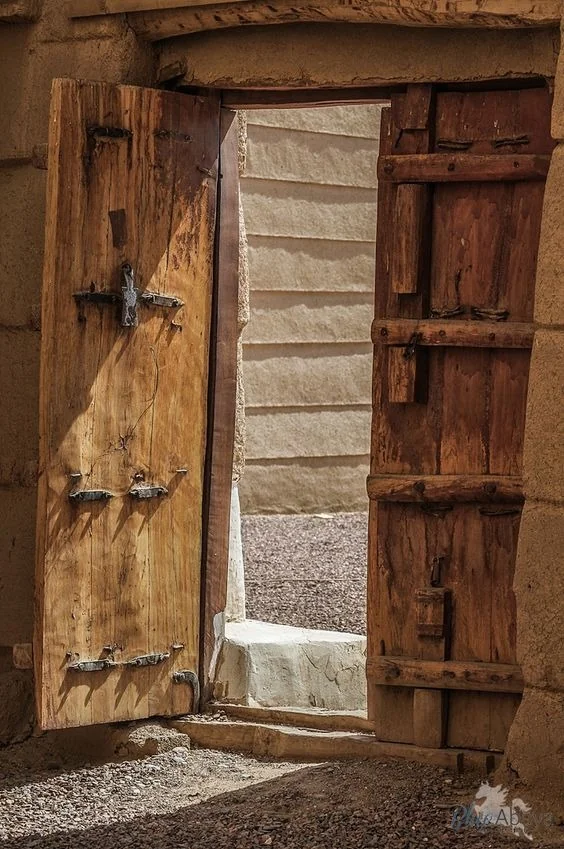
The first to receive guests and the last to bid them farewell – Doors in Saudi society write a history of development and a culture of formation
For doors in Saudi society, and in any society, its culture that starts from the material the doors are made from, to the form and size, to the jewelry and engraving and carving, to defining the forms of doors from classical or traditional or modern.
Doors were placed for protection first, for every house a door, and for every home or house a gate that protects it from strangers and from enemies as well, and the closed doors were not closed for the sake of isolation of its residents, but rather for the sake of protection for the doors give a great deal of safety, with the walls that surround the houses and homes when the houses and homes were primitive built with mud and palm trunks and straw, then it developed into the mud bricks, until they became villas and palaces and buildings and structures high and luxurious opening and closing its gates by remote control.
Wooden and iron beginnings:
The beginnings of door industry in the Kingdom, and in the Gulf generally, were wooden, and from palm trunks sometimes, and they might be studded with pieces from the small iron, and a wooden internal bolt is placed for it, wood was the main component for the doors.
And the old doors are two types: the first: and it is the oldest and made from palm trunks in the form of rectangular boards, then the carpenter adjusts it and cuts it, to take the form of the door, and the second is made from Athel wood and it is the common and most used in the past, and there is "Al-Jareed" door and "Al-Bahr" door and is characterized by intersections and engravings, and large doors called (Darwaza doors) which are used usually in the entrances of old walls, and for the old house doors with common names including: coffee door, and house door, and courtyard door.
Aesthetic connotations:
Doors are not just wooden or iron pieces for protecting the homes and houses, but they also have their connotations and their aesthetic tastes, for the external doors for houses – for example – are the first what receives the guests and the last what bids them farewell, and for this they leave the first and last impressions in the souls of the visitors, therefore the doors which many times make the people feel safety when closing have special connotations and aesthetic, which makes it open on an infinite diversity in spaces of fine art and language.
And far from its physical embodiment and its aesthetic composition, for the doors are several connotations, people kept them throughout history, for it is the separator between secret and public, between unknown and known, between specific and general, and for this it remained a spring for stories and comparisons and suggestions that are used daily in every spot of the earth.
For when looking in the history of art one must summon the sculpture "Doors of Hell" for the French artist "Auguste Rodin" which he inspired from the epic "The Divine Comedy" for the Italian writer "Dante" who lived in a period between the 13th and 14th centuries and from the collection "Flowers of Evil" poetic for the Frenchman Charles Baudelaire from the 19th century.
And Rodin worked on this epic sculpture nearly 20 years, for the account of the French state in year 1880 and famous sculptures branched from it among them "The Thinker"
Symbols and rituals:
The word door does not stop – linguistically – on these doors in houses, but it has the meaning of division as in books: the first door and the second door and the third and so on, and moved symbolically to the term: "The open door" as a method or way in style of managing tasks, and the doors were not just a fine and aesthetic idea, for the doors might be a symbol for a sentence carrying in its contents what the door really suggests, for in politics, and international relations some friendly phrases might be used that summarize bitter conflicts, when saying "opened the doors of dialogue" and "closed" is used for the signal on the difficulty of the situation and that the dialogues reached a dead end, and on that the separator which they consider metaphorically the door, still requires every party to stay in its place, and we find this in other phrases like doors of fire, and doors of heaven, and we are on the doors of winter, as it has popular proverbs and metaphors, like: "The door that comes from it the wind close it and rest" and in the Kingdom the sentence: "Hold the door" leaves its negative effect in those to whom it is directed by his dismissal or termination of his work.
And some studies were put in the current era, to explain the presence of some doors and their importance like the doors of old Damascus and which reach seven doors, and its relationship with planets, or doors of Al-Aqsa mosque, or archaeological doors of Palmyra, and other doors that still hold its status despite the passing of hundreds of years.
And the Saudi researcher Saeed Al-Wail points out in his book: "Traditional wooden doors and engravings in the architecture of the Eastern Region" to the possibility of distinguishing the various types for traditional doors as well as its size and extent of its durability through knowing the place of the door presence and its function, and the function of the building present like civil and religious and military buildings, and what these architectural divisions represent from difference in functions and als, for regarding the place of the door presence the form and design and durability of the external door differs from the doors of the internal facilities for the building, for the studded door was known with its quality as the most famous external types given its strength and cohesion, and regarding the doors of civil buildings which represent the doors of residential houses for all classes of society multiple types were known, among them traditional which were famous in old periods and the most important of them the studded and the cut, and Abu Sayer and Bu Khokha door, and the Baghdadi and Badouri door, and the size of every door and its area relates to the purpose made for it, as well as the empty space for the wall all together, except that there is a recognized average between the carpenters and builders for the size of the external door.
And the researcher Al-Wail confirms that the traditional door relates with its various types with a group of names in its parts including: the frame surrounding it, and it is mostly made from Athel wood, and for the frame a group of wooden fillings and decorative strips and friezes that suit this part. and the styles of doors and its forms differ in the south of the Kingdom where it was famous for formation and drawings in colors of costumes sometimes, from it in the center of the Kingdom or its north and east.
And from those parts in doors also (Khashm Al-Bab) and usually it is in the center extending from top to bottom, and takes an aesthetic tint full of engravings, and the names of Khashm vary according to the engraving that crowns it, including: graduated Khashm and Maskati, and Bu Jarou Khashm, and Bu Khawazereen Khashm; like this for the doors its forms and styles and sizes and its formation which forms a qualitative culture having its renewed presence throughout history.
Signals:
https://www.albayan.ae/five-senses/culture/2019-08-27-1.3634968
https://alarab.co.uk/
https://www.ogle.com/amp/s/www.alwatan.com.sa/ampArticle/164122