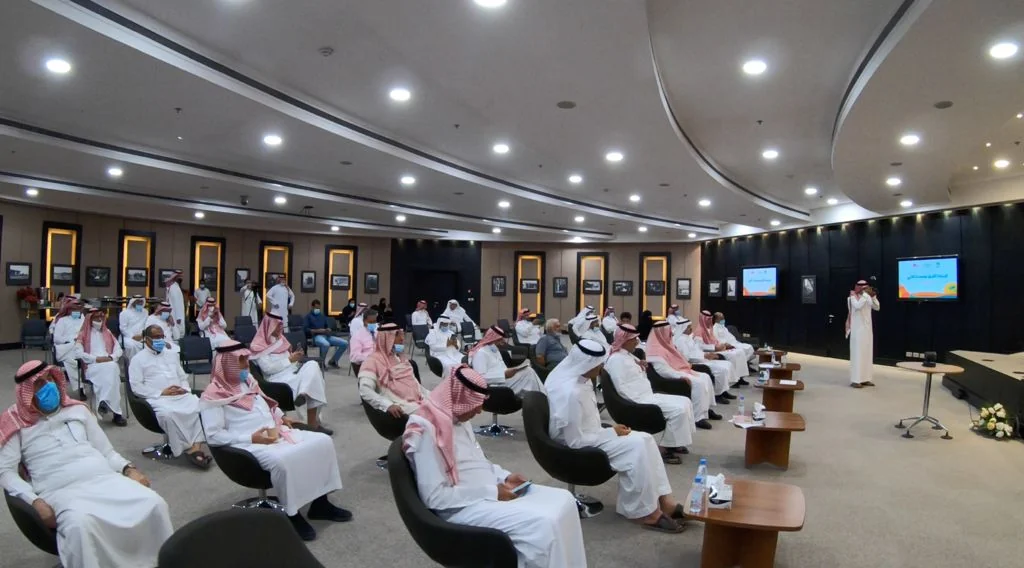
In the King Abdulaziz Library Seminar Celebrating the 91st National Day - Al-Mutawa, Al-Osaimi, and Al-Qahtani: Our National History Transformed from Unification Epics to Building and Development Efforts
Participants in the seminar: "Our Rich History and Our Proud Glory," organized by the King Abdulaziz Public Library in Riyadh yesterday evening, Monday, September 20, on the occasion of the Library's celebration of the 91st National Day, emphasized that King Abdulaziz Al Saud – may ,d rest his soul – made heroic efforts to unify the Kingdom of Saudi Arabia. This took two phases, the first of which began with the capture of Riyadh on the fifth of Shawwal 1319 AH and the second began after the announcement of the unification of the Kingdom under the name: The Kingdom of Saudi Arabia on September 23, 1932 AD, as this unification started with the epics of unification followed by building and development efforts.
The seminar, in which a number of prominent specialists in Saudi history and the history of the Arabian Peninsula participated, namely: Dr. Abdullah Al-Mutawa, Dr. Bandar Al-Osaimi, and Dr. Fatima Al-Qahtani, began with an introduction by Dr. Abdullah Al-Munaif, the seminar moderator, about the importance of reading and studying Saudi history from its various aspects, and introducing some of the works of Dr. Abdullah Al-Mutawa, who began his talk by saying that the celebration of the 91st National Day is a national occasion that motivates reading history, and that the establishment of the Saudi state extends to (276) years a, at the hands of Imam Muhammad bin Saud. Dr. Al-Mutawa pointed out that the Kingdom will celebrate its centenary National Day in eight years from now, and called for preparation for this day.
Dr. Al-Mutawa, who reviewed the stages of Saudi history and the steps for unifying the regions of the Kingdom, explained that nations choose a day with specific historical significance and call it Independence Day, National Day, or Evacuation Day, and so on, and the names vary, with some carrying a cultural character. He noted that the Saudi state was not completed overnight, and that it took several stages from the first and second Saudi states until the contemporary state, which took about (32) years to establish and unify, after which the building stage began.
In a paper titled: "King Salman bin Abdulaziz as a Historian for the Nation," Dr. Bandar Al-Osaimi spoke about the upbringing of King Salman and his love for and study of history, and his distinction – may ,d protect him – with knowledge of tribal lineages in the Kingdom. He read school curricula and looked at a large number of old magazines, including the Egyptian Al-Hilal magazine, which was among his earliest readings. He read extensively in the history of peoples and nations, and sought to establish a private library containing (60) thousand volumes in (18) thousand titles. He was interested in reading Islamic history.
Dr. Al-Osaimi added that King Salman's interest in history was an inspiration to HRH Prince Mohammed bin Salman, pushing him to care for heritage, antiquities, and Arab civilizations before and after Islam, as well as pushing him to launch Vision 2030 and its contents regarding interest in history and heritage, as well as his care – may ,d support him – for restoring historical cities and archaeological sites.
Dr. Al-Osaimi pointed out that the care for teaching history in Saudi universities was under the direction of the Custodian of the Two Holy Mosques King Salman bin Abdulaziz. He also cared – may ,d protect him – for national libraries and historical studies, and received an honorary doctorate from two universities. Many books have been written about his personal and scientific biography and his interest in history. King Salman is considered the first historian in our country, and his historical sources were through oral narration as he conveys some oral accounts about his father the founding King or about his advisors, as he possessed a lot of information about the nation's history. He loved reading and followed new publications and has – may ,d support him – a large number of historical books, manuscripts, and documents, with the number of documents in his library alone reaching one million documents. Also his chronicling of the city of Riyadh, which was a small town and has become today a major city among the largest cities in the world.
Dr. Al-Osaimi monitored the factors that formed the historical vision of King Salman as a historian, seeing them in three factors: his influence by the personality of his father King Abdulaziz Al Saud, his love for reading as reading formed an important cognitive resource, and the symbolism of the place between the ,vernance Palace and Al-Masmak, where King Salman was the Prince of Riyadh for 55 years. His conscience was linked to history, which is one of the most important factors, and he used to publish some comments and feedback in newspapers regarding the history of the Kingdom, as well as...