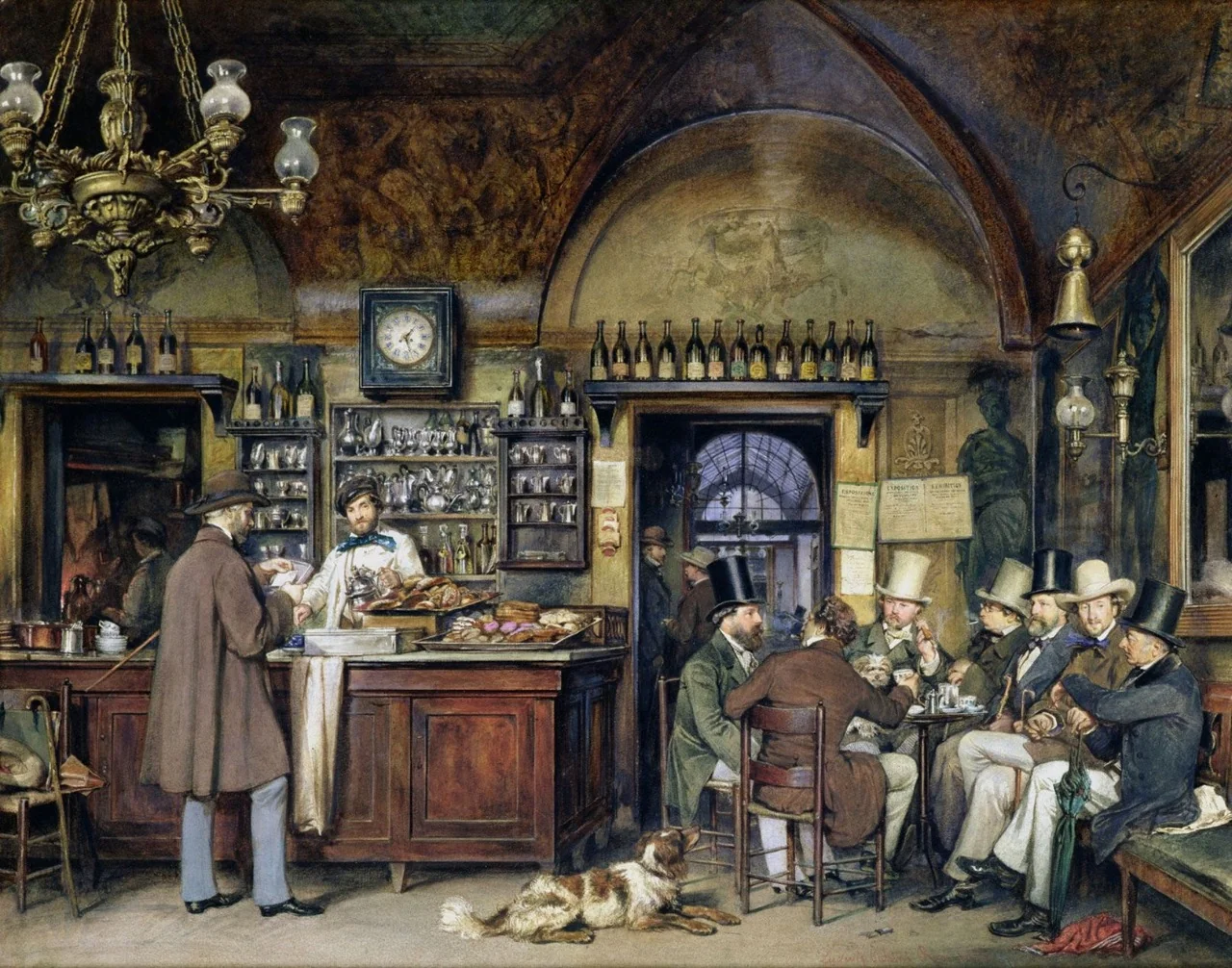
Transformed from a social phenomenon into a global cultural phenomenon: Cafes contribute to enlightenment and education, and literary, intellectual and scientific currents launch from them
The presence of intellectuals, literati, and writers gave cafes a great deal of historical and cultural importance, as cafes have manifested as a social phenomenon for more than a thousand years. Cafes have played and continue to play a tangible role in forming literary and cultural currents and groups; as many intellectuals around the world used to take them as an inspiring space for creativity, dialogues, and serious debates, where they transformed from just a place for people from various segments to meet, and a place for road crossers or strangers in cities, into a place that has its history and its distinct cultural dimensions.
Researcher Kamel Rahouma asks in his book "Cultural Cafes in the World: Cairo, Paris, Damanhour": "Why do people to cafes?", to reach the conclusion that they are one of the mechanisms of enlightenment and education.
What gave cafes their luster and historical presence is the transformation of some of them from a social phenomenon into a global cultural phenomenon, as they were frequented by intellectuals, artists, writers, musicians, authors and orientalists, which stamped them with cultural features manifested in the formation of literary and artistic currents, and in the transformation of some of them into something like open cultural salons frequented by everyone, especially with the presence of prominent cultural figures.
Cultural Forums
Cultural forums inside cafes constitute an old phenomenon that has not been interrupted throughout history, but they took forms that varied according to environments and times, but it does not exclude them from what cafes perform through the ages. Among the manifestations of this, in the modern era in Egypt: the salons of groups such as the "Apollo Group Salon" which was established before the publication of their magazine "Apollo" in 1931, and also the "Al-Muqtataf Salon" which belongs to the Lebanese "Al-Muqtataf Magazine" which moved to Cairo and the salon was established under the management of the scholar Ahmed Fahmy Abu Al-Khair. Also, in green Tunisia in the modern era, several literary and intellectual clubs were established, including: "William Morsi Club", "Khamis Al-Qabaili Forum", and "Al-Annabi Forum".
There are also other activities in cafes such as: music and singing, evening parties, especially the activities of Ramadan tents, religious chanting and poetic chanting, seminars and cultural meetings and poetic matches, plastic arts exhibitions, joking matches, and games of amusement, luck and betting: such as "dominoes", "dice or backgammon", "card games", "chess with its competitions", and "Al-Sija" in some areas that preserve their heritage through time.
Oriental Cafes
The various Arab countries were distinguished by the presence of cafes for intellectuals and writers. In Egypt, which was famous for its cultural cafes, there are cafes: Al-Fishawi, Al-Harafish, Qashtumur, Matania, Riche, Isavitch, Qashtumur, the Cultural الندوة Cafe, Layali Al-Hilmiyya, the Old Dar Al-Kutub Cafe in central Cairo, and Abdullah Cafe in Giza, whose most famous regulars included Muhammad Mandour, Abdelqader Al-Qat, Noman Ashour, Anwar Al-Ma'dawwi, Zakaria Al-Hijjawi, Abdelmohsen Taha Badr, Raja Al-Naqqash, and Mahmoud Al-Saadani.
And (Riche) was like a mother to many literary and intellectual projects; in it was born the idea of the "Egyptian Writer" magazine, whose presidency was assumed by Taha Hussein, and the "New Culture" magazine by Ramses Yunan, and Gallery 68 for the writers of the sixties. Since the beginning of 1963, Naguib Mahfouz used to hold a weekly seminar every Friday in this cafe, as he used to hold it for the new generation at that time such as Salah Jahin, Al-Abnudi, Ahmed Ramzi and Kamal Al-Mallakh.
Among the most famous cafes in Iraq is "Al-Khaffafin Cafe", which is the oldest of all, established more than 950 years a, according to the famous Baghdad historian Jalal Al-Hanafi. Among its regulars were many icons of thought and literature, including: Maarouf Al-Rusafi, Jamil Al-Zahawi, and Abboud Al-Karkhi. Also, "Al-Shabandar Cafe" on Al-Mutanabbi Street (1917), and "Al-Zahawi Cafe", which has overlooked one of Baghdad's most important squares, "Al-Maidan Square", for more than a hundred years, and was named after the great poet Jamil Sidqi Al-Zahawi. It is the cafe that witnessed the writing of his famous responses to the great writer Abbas Mahmoud Al-Aqqad. The great Indian poet Tare spoke of Al-Zahawi hosting him in the same cafe. Among its regulars were the poet Muhammad Mahdi Al-Jawahiri, the sociologist Ali Al-Wardi and Al-Rusafi, and it also witnessed the beginnings of the literary life of the great poet Badr Shakir Al-Sayyab.
In Syria, cafes: Havana, Brazil, and Al-Kamal. In Tunisia, cafes: (Under the Wall), New Era, and the Diwan, Morocco Cafe on France Street in the Tunisian capital, and Paris Cafe on Habib Bourguiba Street, which was established in the sixties.
In Algeria, the historical Al-Rumana Cafe and Al-Widad Cafe in the city of Oran in the city center on Ahmed bin Ahmed Street, in addition to other cafes such as: Malakoff and Al-Tlemisani in the Casbah, known in the past for the gatherings of poets, writers and artists.