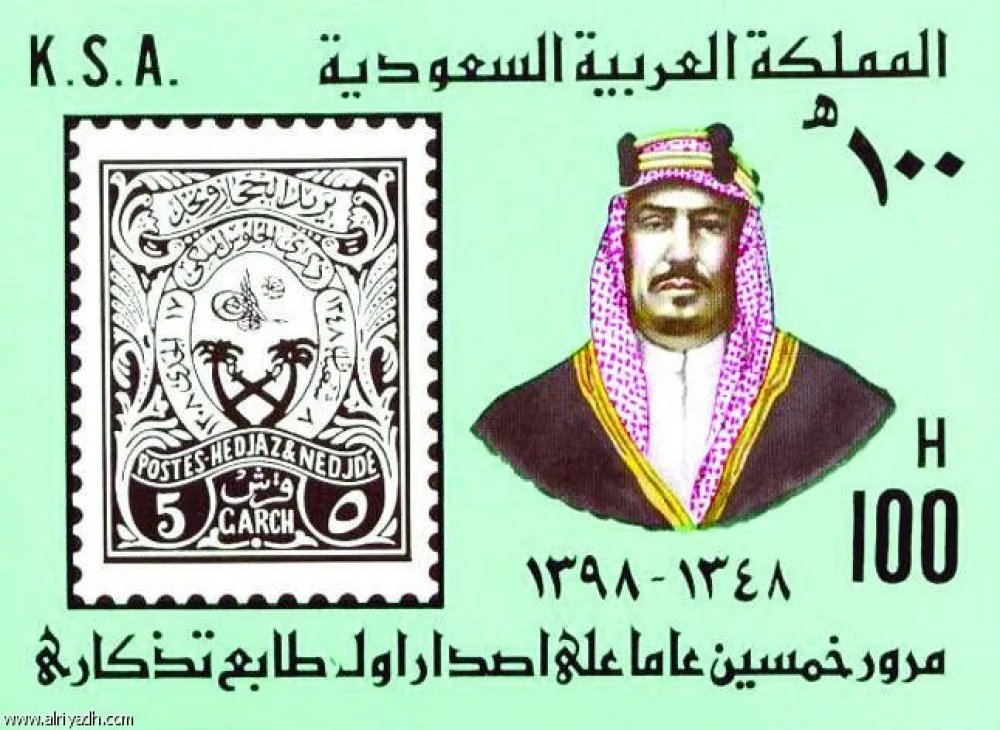
Including pictures of places, occasions and historical figures.. the Kingdom's postage stamps travel around the world and convey the aesthetics of the place
Despite its small size and its image that almost appears on the envelope sent from one place to another, it carries in a symbolic and indicative way the image of the state and expresses it in what represents it historically and culturally. This is what the postage stamp does, expressing the culture and aesthetics of the place, and conveying to others aspects of cultures, occasions, historical events and important places in the country. Hence came the interest in it to form the most prominent signal in the smallest image. It is surely a symbolic shot that has its prominent impact. Postage stamps are among the most important features and evidence of development that embody and document events and occasions for countries and peoples, and they are a tacit symbolic ambassador that summarizes time and place and narrates with its diversity and colors rich details of events about the Kingdom of Saudi Arabia and its historical, human and civilizational heritage in all its fields.
Contents of the stamps: The sets of postage stamps issued by the Saudi Post include national stamps concerned with Saudi history and national days, and historical stamps concerned with depicting some Saudi, Arab and Islamic national historical events, including stamps about: the anniversary of the founding of the League of Arab States, Saudi Arabian Airlines, Aramco, King Saud University, and others. There are stamps about national and religious occasions, general sporting and international events and other occasions. The Saudi Post has issued many stamps in this regard, including: about horse racing in the Kingdom, Janadriyah, the pledge of allegiance to the Custodian of the Two Holy Mosques King Salman bin Abdulaziz, may d protect him, the pledge of allegiance to His Royal Highness Prince Mohammed bin Salman – may d protect him – Crown Prince, Deputy Prime Minister, and Minister of Defense, and about the first international conference for talent and creativity, Princess Nourah University, the Saudi Press Agency, the G20 summit held in Riyadh, Saudi National Day, the Hajj season, and the Kiswa of the Holy Kaaba. Stamp issues also included the heritage dimension of the Kingdom, as Saudi Post issued in this regard a set of stamps referring to the Kingdom's heritage such as: the stamp of discovered caves in the Kingdom, the traditional jewelry of Saudi women, and the set of Saudi antiquities, and other various stamps that express the Kingdom's culture and heritage. The first postage stamps bearing the name of the Kingdom of Saudi Arabia were issued on January 1, 1934 AD. The Saudi Post Corporation is the entity responsible for postal services and official mail in Saudi Arabia, founded in 1926. (As stated on the Post Corporation's website). It is considered one of the oldest institutions of the state at all and has introduced many electronic services such as geographical system services for postal addresses, as the Saudi postal address is considered one of the most modern addresses in the world. The corporation has been honored with many international, regional and local awards in this field in particular and in many other fields.
Historical stages of the mail: Before King Abdulaziz Al Saud - may d have mercy on him - entered Riyadh in 1319 AH, some shop owners (dakkakin) volunteered to perform the mail service in Justice Square (Al-Safat) by placing bags of white cloth written on them the name of the city or village and the owner of the message places it and then it is sent using animals with travelers. As for incoming mail, it is placed in special places inside the shops and whoever has a message comes to take it. As for Makkah and Jeddah, the mail was carried on animals in trips taking (14) hours, and the post office consisted of a head and a deputy for him and a stamp seller called (booth clerk) and a registered and ordinary mail clerk. Mail was also carried on camels to Al-Lith, Jazan, Abha, Najran and other southern cities once or twice a month. In Madinah, it was carried on camels to Jeddah, and after the establishment of the railway line between it and Damascus, mail was transported by train. Also, external mail between Jeddah and Egypt was done weekly by the Khedivial, Italian and Indian shipping companies. It was also transported once a week between Jeddah and Port Sudan and every twenty days to India. After the unification of the Kingdom of Saudi Arabia and the discovery of oil, the rapid development of the mail took several forms. The Directorate of Postal Affairs was established in 1354 AH. The Telegraph, Post and Telephone Department before 1373 AH managed postal activities, then it moved to the Ministry of Transport under the name (Ministry of Transport Agency for Wire, Wireless and Postal Affairs). Saudi Post joined the Universal Postal Union in 1348 AH 1929 AD. The first Saudi postage stamp was issued in 1334 AH. The Kingdom is considered the second Arab country to issue regular and commemorative postage stamps. Since 1390 AH and with the start of the Saudi five-year development plans, the great development of mail included various fields of postal service by expansion in quantity and quality. According to Asharq Al-Awsat newspaper, the Kingdom was one of the countries that gave the postage stamp special importance in documenting its history and heritage and conveying its Islamic message to all countries of the world, where the Kingdom went through several stages and shifts in postage stamps. Postage stamps went through two stages, (as the Wikipedia site mentions) the first in 1925 with the entry of the Hejaz region, represented in collecting the history of the Arabian Peninsula in its trade exchange with other regions through pilgrims, so it was necessary to document this stage with the continuation of the postal service. The directives of King Abdulaziz bin Abdulrahman Al Saud, the founder of the state, were to stamp the used stamps in post offices "overprinting" with the phrase of the Najdi authority. In 1926, in the second stage during which King Abdulaziz bin Abdulrahman Al Saud was pledged allegiance as King of the Hejaz and Sultan of Najd, the first postage stamps were printed under the name "Post of Hejaz and Najd" and ordered by King Abdulaziz, then the stamp issues followed in 1927. To commemorate national occasions, the first commemorative stamp was issued bearing the memory of the Royal Accession, showing the Kingdom's emblem "two swords and a palm tree", and with the announcement of the country's unification and the call of Abdulaziz bin Abdulrahman for the country in 1351 AH 1933 AD, the first postage stamps were issued under the name of the Kingdom on the occasion of the inauguration of Saud bin Abdulaziz as Crown Prince. All postage stamps issued by the Post Corporation have carried the Kingdom's emblem of the two crossed swords and the palm tree, as a symbol of the of authenticity, heritage and aesthetics of the place.