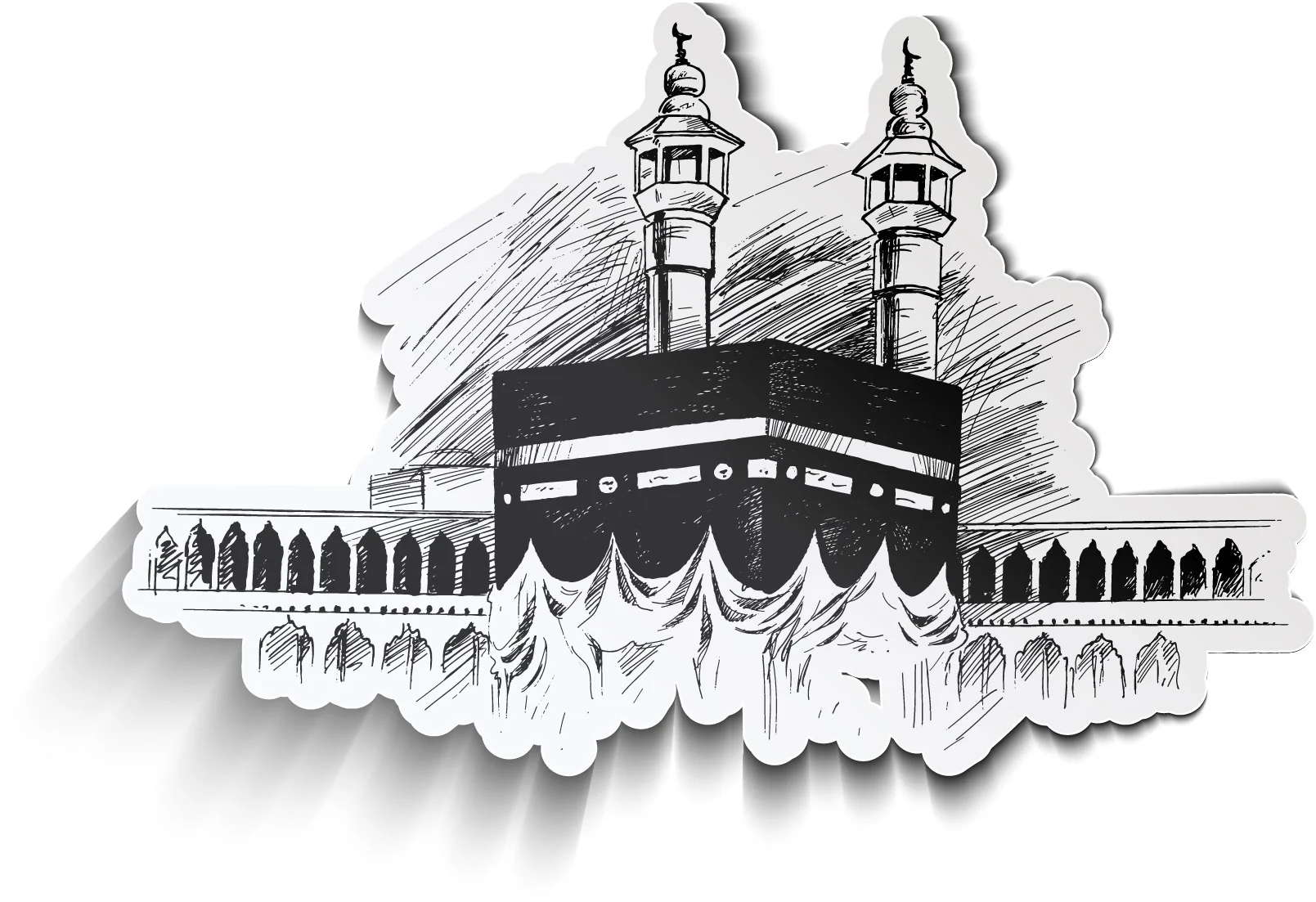
Creativity in drawings of the Holy Kaaba
Duha Abdulraouf Al-Mull
The Kaaba was and still is a favorite subject for Muslim arts through the ages. Coverings were made for it from the most expensive fabrics, and plated doors and lden keys were made for it. If it is today the subject of attention of photographers day and night while those seeking the Sacred House of d are organized around it in their white izars, it was similarly the subject of interest of Muslim artists from painters and pottery makers who depicted it in their works. Drawings of the Kaaba in Islamic arts have documentary importance before the emergence of cameras.
Does the geometric shape of the Kaaba allow for many imagined projections while contemplating it in the plastic art specifically, or are they just drawings driven by purely Islamic certainty? Or is it the rationality of visual analysis and the resulting questions towards the geography and existence of things?
The colors in many of the paintings, most notably the paintings of the Saudi artist "Ahmed Al-Bar", who dips various chromatic spectra without taking a fixed form of patterns according to rhythmic compositions in harmony with the structure of the concept of the Kaaba artistically. Also, the paintings of the Saudi artist "Ahmed Mater" and the magnetic idea of rotation and its ability to generate magnetism of things towards the main focus according to the dimensions of distances between part and part, to develop the paths of spaces through the creative imaginary, in his works that grant circumambulation an expressive spiritual physical essence with which the materialisms of lines are dedicated to becoming more abstract than other forms known in this art that stimulates the pleasure of discovery through the idea of magnetism and capturing differences that represent the part, the whole and the vanishing. Also the painting of the British artist "Idris Khan" and what is beyond the concepts he tries to broadcast his questions artistically, and also "Nosrat Jahan Nazli" from Bangladesh and the emotion liberated from the stability of things around us attempting to stimulate thinking with drawings based on various materials for the aesthetic expression of the continuity of life.
The Kaaba embodies with its angles the return to the standard or ideal geometric shape, and the ability to retain the self-meaning of the spontaneous kinetic gestures of all colors without exception for this reason we did not find in plastic art any change of the color of the Kaaba or even in the projections of its basic points because it loses the visual element attracting it in case of changing its color or its points or even the circumambulation of colors around black and its symbolism and its unique nature in urging on live imagination and the search for basics in the tangible and felt matter and the other intuitive resulting from the story of our master Abraham and the building of the House and the story of his son Ishmael or even to search for the foundations for the structure of this رزية nature crowned with a holy flow that attracts the senses of a brush searching for its existence through what it paints of feelings that translate the strength of the shape between colors and the line and its meanings between connection, separation and unity. It also translates the angles and points and their importance in granting the shape its prestige or its existential strength and therefore the metaphorical representation of the Kaaba takes the most vital human path in the style of circular or cosmic circumambulation formed in the basics of lines and colors in most paintings, and within geographical and historical contexts and other religious, and most importantly all that is faithfully for Muslim artists and rationally with abstraction for other artists. From the perspective of movement and stillness during circumambulation around the fixed and moving geometric shape or the material and felt, and thus the criteria of beauty differ in paintings in which the Kaaba was drawn from one person to another, and from one believer to another, is there a visual authority of the Kaaba over the mind when circumambulating it through the brush and colors?
The artist feels the principles of geometric formation while drawing the Kaaba, as he discovers the geometric dimension for it and for the colors around it and from the ratios of high and low and the effects that emanate from that, and it cannot be ignored even if the artistic identity differed among them, as one can distinguish between the whole and the part and the regular imaginary lines because the movement of circumambulation is similar to the movement of the Earth's rotation, and with equality between chromatic spectra and their transparency, which reflects the reality of the existence of the Kaaba through thinking and contemplating its physical characteristics and its being that pushes the artist to draw it regardless if he linked or adhered to the lden rule or did not adhere to it, the visual parallels in the Kaaba paintings are coordinates captured by the senses capable of tracking the movement of circumambulation in reality or through the brush that draws even if in an arbitrary way however it cannot depart from what is compatible with its material worlds and the other intangible or rather visual perceptions and their changes within light dimensions and the other intertwined with the system of square angles and some other line aspects through which we re-discover the geography of the place of the Kaaba and the development of movement around it between the fixed and the moving and the power of the static within the axis of light and light colors of them and the dark, does the artistic plastic painting of the Kaaba carry an aesthetic philosophy with mathematical concepts related to the general principles of the act of attraction towards the source or basic or point?
The white color in paintings in which the Kaaba was drawn constitutes the open spaces towards the absolute or infinite, felt things far from the materialisms of lines and their strength in...