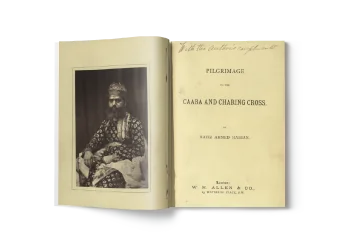
In a rare pilgrimage trip from Bombay to Mecca more than 150 years a, Indian pilgrim Hafiz Ahmad Hassan recounts details of the Two Holy Mosques and scenes of pilgrims
In a pilgrimage journey of the rare ones that didn't have the light shed on them much, the trip of the Indian pilgrim Hafiz Ahmad Hassan which he took in the year 1870 AD. The importance of the trip which he included in his book titled: Pilgrimage to the Caaba, refers to:
Pilgrimage to the Caaba and Charing Cross
to what the book includes of description of places, roads, travel, and the image of Mecca and Medina in the time of the trip that took place more than 150 years a.
As the book narrates the biography of events that lasted for three years between India and Mecca then England.
Hafiz Ahmad Hassan was an Indian Muslim and the treasurer and private advisor to Muhammad Ali Khan (died 1895), who was the Nawab (vernor) of Tonk. Tonk was an emirate in northwest India and is part of Rajasthan state. When the Nawab was ousted in 1867, the author accompanied him to exile. They set out first heading to Benares and then to Mecca and Medina to perform Hajj in 1870. Hafiz continued his travels to England after finishing Hajj rituals, where he spent a short period before returning to India.
The book centers on his travel to the Arabian Peninsula for the purpose of Hajj, and his description of its rituals. The book is a valuable record, in English, of the conditions and practices present in its author's era. The author describes the port of Jeddah, the buildings of Mecca and Medina and the surrounding areas and his fellow pilgrims. The book is considered an important addition to the classic works written in English by C. Snouck Hurgronje and Richard Burton about Mecca, Medina, and Arabia. The author concludes the work with a chapter on England and the English where he compares, among other topics, the strictness of the British judicial system in Britain and the hasty justice toward Indian subjects, which is often according to the whims of untrained British officials. The book was published in London by W. H. Allen, a leading publisher of works revolving around India.
The book, which was issued in the year 1871 and consists of (174) pages, is composed of seven chapters starting with the author presenting a sketch of his personal biography and early history titled:
Sketch of my early history
The second chapter came titled: The Tragedy and its Results, then a chapter titled: The Fragment, then starts from the fourth chapter narrating his trip to Mecca with a chapter titled: From Bombay to Jeddah:
From Bombay to Jedda
Where his ship traveled from the Indian Ocean passing through Yemen then the Red Sea then Jeddah. Then comes the fifth chapter titled From Jeddah to Mecca, covering landing in Jeddah then traveling to Mecca. Then he begins describing Mecca, the Holy Kaaba, the places of Prophet Ibrahim (peace be upon him), Zamzam well, the Holy Mosque and some other places. In the sixth chapter he covers his trip from Mecca to Medina and the Prophet's Holy Mosque and scenes of Muslims in Medina, and the state of Indian pilgrims, then returning to Jeddah again. Then he concludes the book with the seventh chapter From Jeddah to England. Where he moved from Jeddah to Suez, Cairo, and Alexandria, then Marseille port then Paris until reaching England.
In his book he describes Hajj season details and the great diversity in pilgrims' races, describes the Holy Kaaba in its black cover woven with Quranic verses, then begins describing Mecca saying: "The residents of Mecca drink from a canal built by Zubaida, wife of Caliph Harun al-Rashid. Its residents are fond of wearing silk and decorated and cheerful woolen textiles, of French and English make, and some of them believe they were made in Constantinople, and don't believe they were made in other countries, even if written so on them." Then he says: "The lands around Mecca seem barren, and it doesn't appear to grow anything, no greenery, gardens, or trees except for a few palm trees planted beside Zubaida's canal, and some shrubs. Mecca residents are characterized by courage and generosity and their houses are built on the slopes of the heights overlooking the Kaaba." Then he describes the Station (Maqam) and Zamzam well, the Holy Mosque and its gallery illuminated at night, the mosque courtyard, the seven minarets, and the number of the Mosque's forty gates and their names. Then after that he describes the trip to Medina and the Prophet's Mosque and the ruggedness of the roads he moved through.
References:
See article by Ahmed Mohammed Mahmoud on the author's trip in Hajj and Umrah Magazine, December 2017 issue, and see:
https://egypt.schoopedia.com/viewer?service=1&id=
And see:
https://www.wdl.org/ar/item/12982/