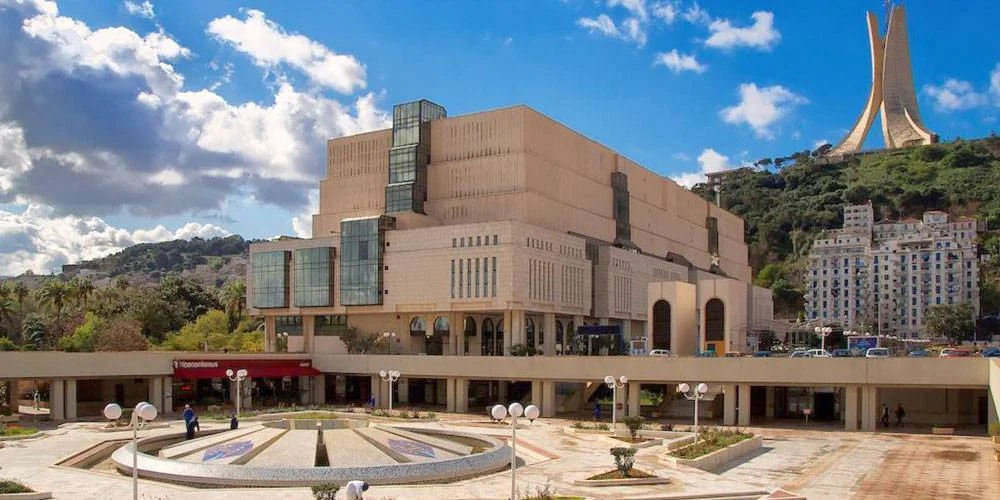
The Algerian National Library.. 182 years in the service of culture and knowledge..
Report: Special
On February 25, 2015, the Unified Arabic Catalog inaugurated the Algerian Libraries Portal within the series of Arabic portals it launches in the sky of Arabic knowledge, under the patronage of the Minister of Culture Mr. Azzedine Mihoubi and the Minister of Higher Education and Scientific Research Dr. Tahar Hadjar, and in the presence of the Director of the Unified Arabic Catalog Center Dr. Saleh Al-Musnad, the Charge d'Affaires at the Saudi Embassy in Algeria, the Algerian Minister of Education, advisors to the President of the Republic and a number of Arab ambassadors at the Palace of Culture. The Algerian National Library was one of the entities participating in the inauguration of the Algerian Libraries Portal.
One of the Oldest Cultural Institutions Ever
With important references, manuscripts, and titles that keep pace with the requirements of the scientific and intellectual movement in Algeria, the library is also considered the basic and central reference for national intellectual production printed in all fields and cognitive specialties. It is the main reference for publications in all specialties and the oldest documentation body in Algeria.
The Algerian National Library was established on October 13, 1835, by a decree from the Ministry of War at that time, headed by "Genty Debussy." At the time of its establishment, it did not contain any collection, but the decree paved the way for search and collection operations assigned to the first library curator, "Adrien Berbrugger," who accompanied colonial military campaigns to major Algerian cities. He collected approximately 700 manuscripts initially from the city of Constantine, which formed the first nucleus of the Algerian National Library's collection. This collection was deposited at the library's first headquarters in a residential house on "Soleil" Street formerly in Bab El Oued, then moved in 1838 to a Janissary military barracks in Bab Azzoun, where it remained until 1848.
Tasks of the National Library
Perhaps the als and tasks for which the library was established were modest and unclear, especially since its collection was negligible then. However, with the development of the library's status and the growth of its size, the tasks evolved to become the primary and central reference for printed national intellectual production in all fields and knowledge specialties. It is the oldest documentation body in Algeria, with its primary tasks being collecting, preserving, and communicating the national cultural heritage in whatever media, ensuring openness to global heritage, and participating in the development of the national library and documentation network. This includes collecting, processing, and permanently preserving documents subject to legal deposit. Among these tasks is also the acquisition and distribution of written, audio, and visual works and documents issued inside and outside the country.
Providing reading and research services to library visitors and participating in research programs related to its fields of activity, in addition to preparing and publishing secondary documentary materials related to identifying and locating the relevant documents (bibliographic catalogs, databases, information cabinets, and union catalogs....). It also participates in the development of library economics and documentation techniques, and improving the level and renewing information for librarians, technicians, and specialists in scientific information.
The Growing Role and Status of the Library
The role of the library continued to grow, especially with the increase of its collection and contents, which the old headquarters could no longer accommodate. It moved to a wider location in "Emile Maupas" Street formerly in the Casbah in 1863, then to Frantz Fanon Street in Telemly in the upper part of the capital in 1958. For the first time since its establishment, the library occupies a building worthy of it, where the area of the new headquarters was estimated at 4800 m², with a reading room accommodating 450 seats. As for the shelves, their total length was estimated at 17 km, containing 600,000 books, while the total capacity of the library reaches 2 million books.
A National Director After Independence
After independence in September 1962, the task of managing the Algerian National Library was assigned to Mr. Mahmoud Bouayad, who carried out a wide restructuring process where the National Library became a headquarters for legal deposit and began publishing the Algerian National Bibliography.
With the increasing number of researchers and the abundance of requests, it was not possible for this headquarters to meet the needs of readers, which made the authorities think of launching a project to build a new national library according to international specifications and equipping it with better facilities. El Hamma district south of the capital was chosen for its construction. It opened its doors to the public on April 16, 1996, on the occasion of Knowledge Day. This headquarters is characterized by a huge area and modern architecture, as its area reaches 67,000 m² distributed over 13 floors, and its storage capacity reached 10 million volumes, and it now includes one million books on its shelves.
With the availability of these capabilities and facilities, the library's activity increased, and it was no longer limited to reading only, but extended to hosting forums and lectures, organizing seminars, holding exhibitions, and other cultural activities.
Library Departments and Services
The Algerian National Library includes many departments, including the Manuscripts and Rare Books Department, Preservation and Binding Department, Photography Department, Maghreb Collection Department, Acquisition Department, Lending Management and Reader Orientation Department, General Reading Department, Children and Youth Department, and others. The library provides advanced and effective library services to all researchers, including:
Lending Service:
It is one of the most important services provided by the National Library. All citizens have the right to benefit from internal and external lending services according to the procedures in place. The library uses an automated electronic system in providing the lending service.
Reference Service:
It consists of providing the references, sources, and information requested by researchers, and preparing bibliographic lists for them when necessary. It also includes guiding readers and directing them to the departments they need in the library, in addition to answering reference questions submitted by beneficiaries directly, or by phone, fax, or email.
Current Awareness Service in the Periodicals Section:
This service focuses on reviewing documents and various knowledge sources arriving at the library, and selecting materials that suit the needs of beneficiaries and informing them through catalogs issued regularly by the Periodicals Section.
Deposited Publications Service:
The library provides its services represented in the national intellectual production of books, university theses, and other publications deposited at the library, in addition to audio and video tapes and CDs. It also includes newsletters, agreements, books, reports, studies, statistics, and other publications issued by the United Nations and international organizations. This service also includes all publications available at the library issued by some Arab organizations.
Automated Search Services in Databases and Internet Space:
This service is defined as an information and data retrieval system instantly and directly via terminals that provide researchers with information stored in databases.
The researcher can use the devices available in the internet space at the library.
Children's Library Services:
The library provides distinguished services for children according to their different ages and education levels, for example, internal and external lending of books, storytelling and song sessions, cultural competitions, and drawing.
Library Publications
The Publications Section is essential and necessary in any contemporary library aiming to create a dynamic scientific atmosphere through the scientific services it provides. it is concerned with preparing, publishing, and printing various documentary products in different intellectual fields where it relies mainly on the physical side of the document, represented in collecting information, reviewing its content, and producing it in its final form.
We point out that the theoretical vision presented in 2001 was not actually embodied until 2003, represented in preparing and issuing the Bulletin of the Algerian National Library. The library also issues "Risalat al-Maktaba al-Wataniya al-Jaza'iriya," which is a cultural news bulletin issued by the Algerian National Library, including all activities held at the library whether organized by its various departments or in cooperation with other institutions.
Digitization of Manuscripts
Algeria is among the Arab countries rich in manuscript heritage that simulate in their diversity and abundance the richness of Algerian history and the successive civilizations on it and on the Maghreb region in general.
For this reason, the concerned authorities paid attention to this wealth by preserving and valuing it on the one hand and facilitating researchers' access to it through the use of modern technologies in digitization and the internet on the other.
The Algerian National Library includes more than 4,200 manuscripts in addition to those found in the rest of the country's libraries such as university libraries and those held by individuals and in Zaouia collections located mostly in the western regions of the country, according to a statement by the Algerian Minister of Culture, which makes collecting, archiving, and documenting them electronically capable of preserving them from damage, loss, theft, or fire.
References
Algerian National Library website
Wikipedia
Unified Arabic Catalog website
Djazaïress website
Saudi Digital Library