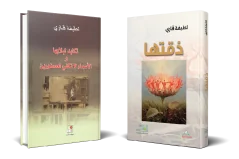
A poem that aspires to taste things through the senses – Latifa Qari between the collections: 'Dhagtuha' and 'Takabadu Liblabaha'
Abdullah Al-Samti
The keys of the poetic experience for Latifa Qari seem in their original foundation based on a group of rhetorical and stylistic elements that are aligned furnishing her work in a qualitative form. The poet focuses on lighting her rhythms and steps in a delicate form to the innovation of these rhythms to become an aesthetic obsession among the obsessions of creating the poem and entering into its secrets and fires – if the speech is allowed –
The poet moves from word to word with a delicate poetic awareness in which the words burn in the furnace of contexts to be reproduced in the freshness of the poetic sense that does not give up its weight and its music and the proximity of its various rhythms.
And the poet issued four collections which are: (Lulwat Al-Masa' Al-Sa'b, Hadeel Al-Ushb wal-Matar, Takabadu Liblabaha Al-Asma', and Dhagtuha).
That "Dhagtuha" is a poem/collection, a long poem, the title in one word, in a past verb assigned to the Taa of the doer and to the Haa of absence: "Dhagtuha" (I tasted it) to point to an unknown that needs its interpretation after reading this long text located between page (5-135)
That the presence of the E and its latency in the verb points to that the poetic self is the one that tasted, and the verb here is not a past verb on its absolute, for timing the poetry is different from timing the prose, for it is not informative entirely but rather it summarizes the other times, "Dhagtuha": includes the present and the past and the future together, because the verb: "Tasted" is still continuous, and the poet is still innovating her tasting and overseeing it.
A group of dimensions are manifested in the collection: "Dhagtuha" for Latifa Qari which are created through the reflection in the semantic biography of the long text, and moving between scene and scene, and between snippet and another snippet, for the poetic performance here is characterized by smoothness and harmony and consistency, while it is characterized by the phrase-pushing towards the innovations of the new meanings, especially that the long texts always lead us to summon the narrative question: "Then what?" for it is a question that faces us when we read the long texts that remain in a state of pushing forward for the sake of innovative sequential visions adjacent together, and for the sake of examining the meanings and connotations that the poet provides in the beginnings of the text.
Poetic dialogue:
Poet Latifa Qari starts her long poem located between page (5-135) which is included by one book titled: "Dhagtuha", starts with this scene:
We decide that the bird inhabits the lap of the mountains
We decide that we mate in summer
Like butterflies
Then we decide that we converse like the lazy comrades
If the night spilled over the couches
Then we dip our limbs in sleepiness
And we forget our decisions in the cushioned morning
In the balconies of the houses that its sparrows left us
To sleep on the lesson bench. / p. 5
The present verb: "We decide" at the start of the text carries us to that there is a binary or collective vision that moves the primary connotations of the text, and upon approaching the reading it appeared to us that there is a binary vision between the E and the Other running through the various orbits of the text from its start until its end.
That there is an implicit poetic dialogue that recurs before us between the poetic self and the other, it is a delicate visual dialogue, escalating between snippet and another until it touches the phenomena of nature and the four elements of the universe in its philosophical form, while it touches multiple spaces according to the contexts that the poem dives in.
We decide: an effectiveness of participation between two parties, and if the decision came, on certainty, with the voice of the poet, there is an agreement of some sort on approaching the awareness of the words and following the phenomena of the relationship between the two parties, which is a relationship that is revealed between line and another, and between scene and scene.
Takabadu Liblabaha:
That the poetic scales always through several stylistic and structural levels, and it is not provided like this suddenly before the reader in the text, it advances in an indirect form, that because it does not rely on a direct awareness, but rather leans on a group of tools that makes the effective reading search for what is behind the words not what moves before us of terms and meanings. and for this the diving into reading the text requires not being led directly behind the first meanings that we perceive, or being led behind the contexts that the poetic text provides to us, but rather we must be more cautious in our reading, for one word is capable of changing the semantic course of the text.