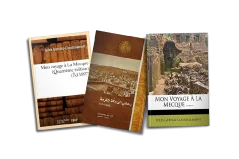
In the book: "My Journey to Mecca" by Jules Courtellemont, a transparent emotional document indicating a positive interaction from a Western intellectual toward Islamic civilization
Review: Abdullah Al-Samti
The book: "My Journey to Mecca" by Jules Courtellemont gained a specialty that distinguishes it from other texts of foreign travelers who wrote about the Arabian Peninsula, as its author was an illustrative artist who sought to elevate written images to the level of images captured by the camera.
Jules Gervais Courtellemont (1863-1931), was a French photographer who was living in Algeria in the late 19th century. He was one of the French who wandered in the East and loved its romantic life scented with sincere feelings and authentic human ethics and . He was attracted by the French consul Leon Roches' pilgrimage journey from Algeria to Mecca in 1891, so he decided in 1894 to undertake a similar trip on his footsteps to experience this unique spiritual experience himself. He traveled with a passport carrying the name: Abdullah bin Al-Bashir.
The book was titled: "My Journey to Mecca in the Year 1894." Dr. Ahmed Abish translated it into Arabic, and it was published by the National Library (Abu Dhabi). The original title of the book is:
Mon voyage à La Mecque
The book consists of 180 pages and includes at the beginning an introduction to the book and the trip, which came within journeys undertaken by the author to Greece, Turkey, China, India, Algeria, Palestine, Egypt, and Syria.
Courtellemont recounts the events of his journey to Mecca to perform Hajj, the steps he took for that, and working on representing the nature of atmospheres in another horizon based on characterized traditions and customs bestowed by the place, as well as representing the Hajj rituals as pilgrims move from place to place and from performing one religious ritual to another until the Hajj rituals are completed. He also recounts his journey to Medina to pray in the Prophet's Mosque. He describes his admiration for Islam and its virtues, announcing his Islam and practicing the rituals of prayer, fasting, and Hajj. He interacted with his friends from Algerians and the people of Mecca and Medina. The book constitutes a transparent emotional document indicating a warm positive interaction from a Western intellectual toward Islamic civilization.
He says about his visit to Mecca: "I wanted to reveal the secret of this holy city not to complete a trip like other trips, but the motive is to complete my research on the contemporary East, this Muslim East that I took upon myself to describe by crossing it in all directions. I spent my youth in it and I love it as everyone who knew it loves it."
Regarding his love for Islam and its people, he says: "As for me, I love the East with its blue sky, and I love Islam for its simplicity, and I admire its solid beliefs."
Jules set off on his journey in the year 1894 when he was 31 years old and announced his Islam and practiced the rituals of prayer, fasting, and Hajj with all piety, and interacted with his friends from the Algerians and the people of Hejaz with all affection. Although he was afraid of admitting his Islam in his book published in France in 1896, claiming he loves the East and Islam for its simplicity and solid beliefs, the book remains a transparent emotional document indicating a warm positive interaction from a Western intellectual toward our Islamic civilization. The book included (33) photos plus a panoramic photo of Mecca folded inside the book. The titles of the chapters were as follows: "Beginning of the Trip, Return to Algeria, From Algeria to Jeddah, From Jeddah to Mecca, Residence in Mecca, Departure from Mecca, Return to Jeddah, Departure from Jeddah, From Jeddah to Yanbu, Yanbu Al-Bahr, Suez, Return to France."
Courtellemont returned to the region again during his visit to Turkey and Syria and witnessed the construction of the Damascus - Medina railway. In early September 1910, he attended the inauguration ceremony of the railway line in Medina and took many photos, including photos of the Prophet's Holy Mosque, which are among the oldest color photos of this mosque. This historical document exists in the Robert-Lynen Film Museum in Paris. He was a brilliant photographer who documented many events of the First World War. He was the son-in-law of publisher Charles Lallemand and a friend of the famous French writer and traveler Pierre Loti and photographer Emile Frechon.
Travel books written by a large number of Western orientalists, as well as journeys to Mecca in general, constitute a broad knowledge and cultural mine crowded with human visions from all corners of the earth, filled with description, imagery, narration, and literary and emotional visions of Mecca and Medina and what they represent in status for Muslims worldwide.
These journeys have not ceased since ancient times until the appearance of Islam, continuing from the civilization of the Greeks, then the Roman era, then the Middle Ages and colonial times. Starting from the sixteenth century, the number of European travelers who sought the East doubled, either for trade, adventure, or inquiry. The Arabian Peninsula, the landing of revelation and cradle of the language of the Quran, and the places of Mecca and Medina received great interest from Western travelers. This book came to constitute a wonderful image of history.