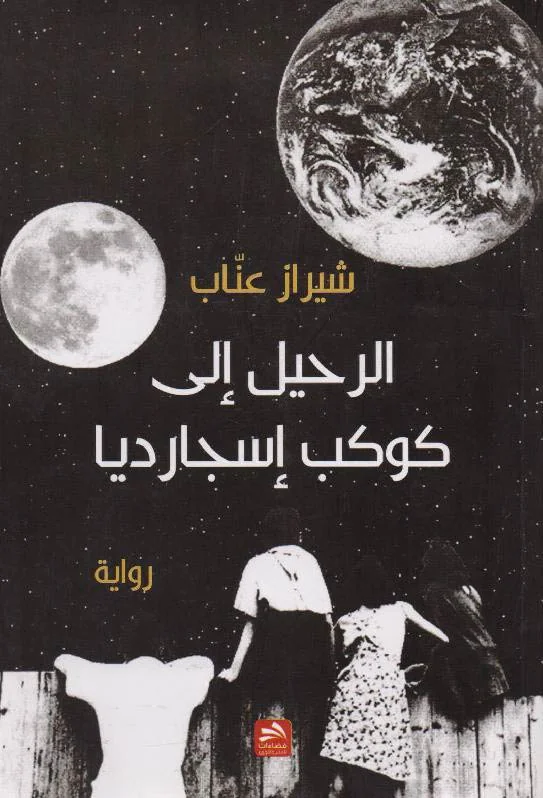
The effectiveness of written space in narrative openings for the novel (Departure to Planet Asgardia) by Shiraz Annab
Dr. Mazen Mowaffaq Siddiq Al-Khairu
First: Effectiveness of the Linguistic Structure
The novel was published by Fada'at Publishing House, Amman – Jordan (2017) first edition, by the Palestinian novelist (Shiraz Annab), and it is of medium size, reaching (190) pages. The structure of the title is aesthetic and poetic at the same time, in which the elements of aesthetic formation and striking strangeness were completed, which in turn is an innovative element. The novel was generally distributed over (30) narrative openings. The writer did not divide the novel into explicit chapters, indicating liberation from the constraints of traditional writing. The openings are like chapter thresholds for entering her narrative world. The subject of the study (written space) is a system of sentences explanatory of the text as an introduction outside the text notationally linked to the text semantically, and this introduction is one of the textual thresholds, acting as a summary of the narrative text. Every true critical reading of an artistic work must have an aesthetic character at its core; because it works to explore the intimate components that ensure its high effectiveness and continuous literary efficiency (1),. The meaning of the term (effectiveness) is "the extent of penetration into the narrative space of signifiers, which is the ability to produce with the least effort of words" (2) and (written space), i.e., semantic space, is considered a moral space, and is only perceived through semantic relationships established by the linguistic structure, and "writing in the broad sense is every visual and spatial semiotic system, and it is also in the restricted sense, a linear system for recording language" (3).
The first narrative opening is found in: (You are nothing more than an insect), a nominal sentence, a feminine discourse; the self resembles the linguistic signifier (the object of comparison) (You), the separate pronoun returning to a feminine addressed as an insect. The object signifier is in (You) and the signifier (the thing likened to) (insect) is indefinite to include all forms of insects referred to referentially in contempt. The tool (like) is omitted, and the point of comparison is omitted, which can be interpreted by the concept of insult and contempt for the status of the addressee. It is a reaction that was brought when the self expressed in its first opening: (Stop the world, I want to get out of it), so the response came with contempt for her in the style of stylistic symmetry based on simile; who are you but an insect? This opening is considered the focus of the novel, and without it, there would have been no departure to Planet Asgardia, for the description as an insect formed the significance of rejection as well as the desire to escape from this state to the state of building another free entity.
The second opening is embodied in: (You have defeated me, O Red one), a verbal sentence that provided approximation by the entry of the particle (qad) into the past tense (defeated me) and the style of vocative in: (O) and the called (Red one). Within the intended axis of proximity, the color Red (ant) was mentioned explicitly in the text (You have defeated me, O red one... truly O ant), a color metonymy for a described object. The defeat is a metaphorical defeat, for the ant does not truly defeat, but the action of the ant calling for the prevailing force. Paradox is used in calling the ant by its color; the self said (Red) and wanted the ant, so it called it by its closest attribute. Paradox is one of the most prominent manifestations of narrative poetry; it is equivalent in its functional importance to the role played by metaphor in poem poetry, due to its reliance on an essential property that agrees with metaphor: that it says something and means something else (4). The other opening is found in: (I was dancing like a bee on a flower / and walking like an ant on a hill / and flying like a butterfly in a valley). A triple-sentence opening, simile with three insects but they are not contemptible as Umm Zainab depicted her daughter Zainab as being no more than an insect, for among insects are those that dance, rise, fly, and play (the bee / the ant / the butterfly).
The appearance reflects the relationship between the third-person pronouns (he/she) in the story construction and between the pronoun (I) in the discourse, the relationship between the story character and the narrator (5). This is in the context of the opening based on simile images; we find the images follow one another, and the beginning with the referential pronoun (I) in her saying: (I was) with the conjunction of the past tense, a retrieval of a previous state for the self in which all components of activity were present. The verb structures lead us towards this understanding (dancing / walking / flying), and in them is a progression; from dancing begins the act of walking to be in the final result flying to the space extending towards the future (I was dancing like a bee on a flower) and the axis of stylistic symmetry based on simile. The likened is the hidden pronoun (I) returning to the story self, and the likened to (a bee on a flower) and the tool (like) and the point of comparison is omitted, indicating the activity enjoyed by the self in its previous era by the past tense (I was). The opening began with the simile with a bee because of the specificity of the likened to; for the bee is a feminine symbol productive of the highest production and characterized by the vitality inherent in the production of honey in all its productive attachments. The present tense (dancing) indicates comfort in employing that latent energy in the subject and object of simile. The second line of this opening came framed in the style of symmetry in (and walking like an ant on a hill), the beginning of this line with stylistic economy called in the rhetorical code (omission brevity) omitting some signifiers and the estimation: (I was walking), so the verb (I was) was omitted and the same likened pronoun (I) remains, and the likened to (an ant on a hill) and the tool (like) and the point of comparison is the challenge that no obstacle stands before. The choice of the ant by the self over others while it aligns beside the bee within the choice axis was not arbitrary, for both are a feminine symbol, and the ant within this hierarchy faces a challenge that blends with the self's challenge, for she with what characterizes her of small size, yet she walks on a hill. A huge difference; the size of the challenge does not match the size of the ant; but the will smoothed the difficulties so the self and its ant walked towards their hill, the hope for the future and ambition for new successes. This meaning is confirmed by the third line in her saying: (and flying like a butterfly in a valley), so the butterfly comes to stand beside both (the bee / the ant), so we have a triple developmental production that is considered a deep example of activity. We find omission brevity in omitting the verbal signifier (I was) due to the discourse context indicating it. The likened is repeated as the pronoun (I) and the likened to (the butterfly in a valley) and the tool (like) and the point of comparison is framed by the active productive feminine symbol, the butterfly diving into the depth of its self searching for truth and beauty (and flying like a butterfly in a valley). We find in this opening parallel expressive formulas based on the element of similarity between verbal expressive formulas articulated within identical discursive conditions, and the repetition of simile images is only evidence of that (6).
Second: Effectiveness of the Semantic (Contextual) Structure
The process of distinguishing between semantic contexts requires the presence of a (stylistic indicator) through the positions and events performed by the characters and noting their semantic direction to be a stylistic indicator of the type of context that leads the narrative structure. The indicator of this novel frames the concepts of self, freedom, and the private. The self left the universe that contains it and it does not know it, to begin searching for itself. What the novel is built on is to be what you are created for and destined for, something that is not easy to achieve, and each of us searches for his utopia in himself first and in his external surroundings second. From here, the writer began her rebellious game against silence in weaving the events of her novel that probes the depths of the self, and searches for the private that every individual among us seeks, and few are those who do not get involved in loss before reaching it, and they do not reach. Asgardia is a planet of salvation for "Shiraz", through which she was able to search in the social moral perspective, the self-psychological, and the cosmic temporal for elevation to the level of purity. The result, after this loss that stormed her in the journey of search, dispersion, and denial, is that she found what she started for, she found herself in a planet whose features she invented from the inspiration of her concern and the weaving of her freedom and rebellion, to reach it, and with her full feminine awareness that brings her closer to her supposed self as much as it grants her her freedom. The departure from humiliation to the horizons of manifestation and freedom, the journey of uncovering the world of love and virtue to complete life.
When examining the contextual semantic structure included in our talk about the novel, we find it pouring into several contexts (psychological / social / historical / mythological / emotional / religious), as we find that the social, psychological, historical, mythological, emotional, and religious significations appear on two levels: The first: its place is the material of the narrative discourse itself, and the second we observe from the movement of the characters and their fates through their progress towards a specific direction or a specific semantic context; as for the psychological context, we find it present in the depths of language and its hidden elements in the unconscious; as it requires the reader to dive into what is behind the language to explore the special dimensions of the psychological context. Reading the discourse according to the psychological (psychological) vision gives us a special reading in the artistic formulation that carries in itself the vision of the hidden human world (7). The field of psychology is described as connecting to the collection of complex psychological functions from specific concepts such as understanding, thinking, planning, and solving complexes and problems (8). It can be said that psychology is based on a set of energies that frame human life and they are the basis of the functions on which our psychological life is based (9). These energies do not appear sensually; they are latent in the language and occupy the highest position because they are the true face of the expressing self.
The first psychological features in the written space discourse are embodied in the first opening: (Stop the world, I want to get out of it). It is the survival instinct and the love of life. The process of leaving the earth world for the spatial planet (Asgardia) is like solidifying this instinct, and the survival instinct is countered by the death instinct on the other side which continues to haunt the self and cause it continuous suffering. We notice the eternal female tendencies that are characterized by the permanence of fertility in the self's saying in the triple simile images: (I was dancing like a bee on a flower, walking like an ant on a hill, and flying like a butterfly in a valley). Among other tendencies is narcissism and the power of possession in the self's saying in several places: (And I am in love with my myth, I will haunt it wherever it is, I will be) and in another place: (I was looking for my myth, and suddenly I was looking for my existence). The intended myth of the self is that planet (Asgardia). Mythologizing discourse "remains closer to what the Canadian critic 'Northrop Frye' calls the eternal righteous story, expressing the spirit of societies and their myths fixed in their essence, no matter how their external features change, considering that every human society - as he says - has a distinct form of linguistic culture, in which stories and narratives occupy a prominent place, and appear with supreme importance; as they represent what is related to society in the first degree, which makes them capable of explaining a number of fundamental features related to religion, law, historical and social structures, and grand cosmologies" (10). The self takes a specific perspective through which it sees characters, events, things, and the movement of society; it possessed the artistic side and was more modern and philosophical; it takes the narrative openings technique as a means to focus the states of (awareness / unconsciousness) for the recipient to soar in reading the social, psychological, and historical changes.
And in another place: ((My knowledge was without me knowing and my thoughts before I began thinking)). In another place: (This female summarizes by her existence all messages and most notable figures).
References:
- See: Narrative styles in the Arabic novel, Dr. Salah Fadl, Dar al-Mada for Culture and Publishing, Syria – Damascus, Beirut – Lebanon, 1st ed, 2003: 15.
- Dictionary of Contemporary Literary Terms: 170.
- See: Narrative concepts, Tzvetan Todorov, translation: Abdelrahman Mezian, Ikhtilaf Publications – Other Language Series, First Edition, 2005: 11.
- See: The structure of the narrative text (from the perspective of literary criticism), Dr. Hamid al-Hamdani, Arab Cultural Center, Beirut – Lebanon, 1st ed, 1991: 32.
- See: Methods of literary narration – studies, Publications of the Union of Moroccan Writers - Rabat, 1st ed, 1992: 58.
- See: Same source: 43.
- See: The psychological trend in the criticism of Arabic poetry, Dr. Abdelkader Faydouh, Arab Writers Union, Damascus, 1992: 11.
- See: Rhetoric of discourse and text science, Dr. Salah Fadl, Alam al-Ma'rifa series, Kuwait, Issue (164) for the year 1992: 245.
- See: Outline of Psychoanalysis, Sigmund Freud, translation: Dr. Sami Mahmoud Ali and Abdel Salam al-Qaffash, review: Dr. Mustafa Ziwar, Dar al-Ma'aref in Egypt, 4th ed, 1998: 34.
- Narrative styles in the Arabic novel, Dr. Salah Fadl: 17