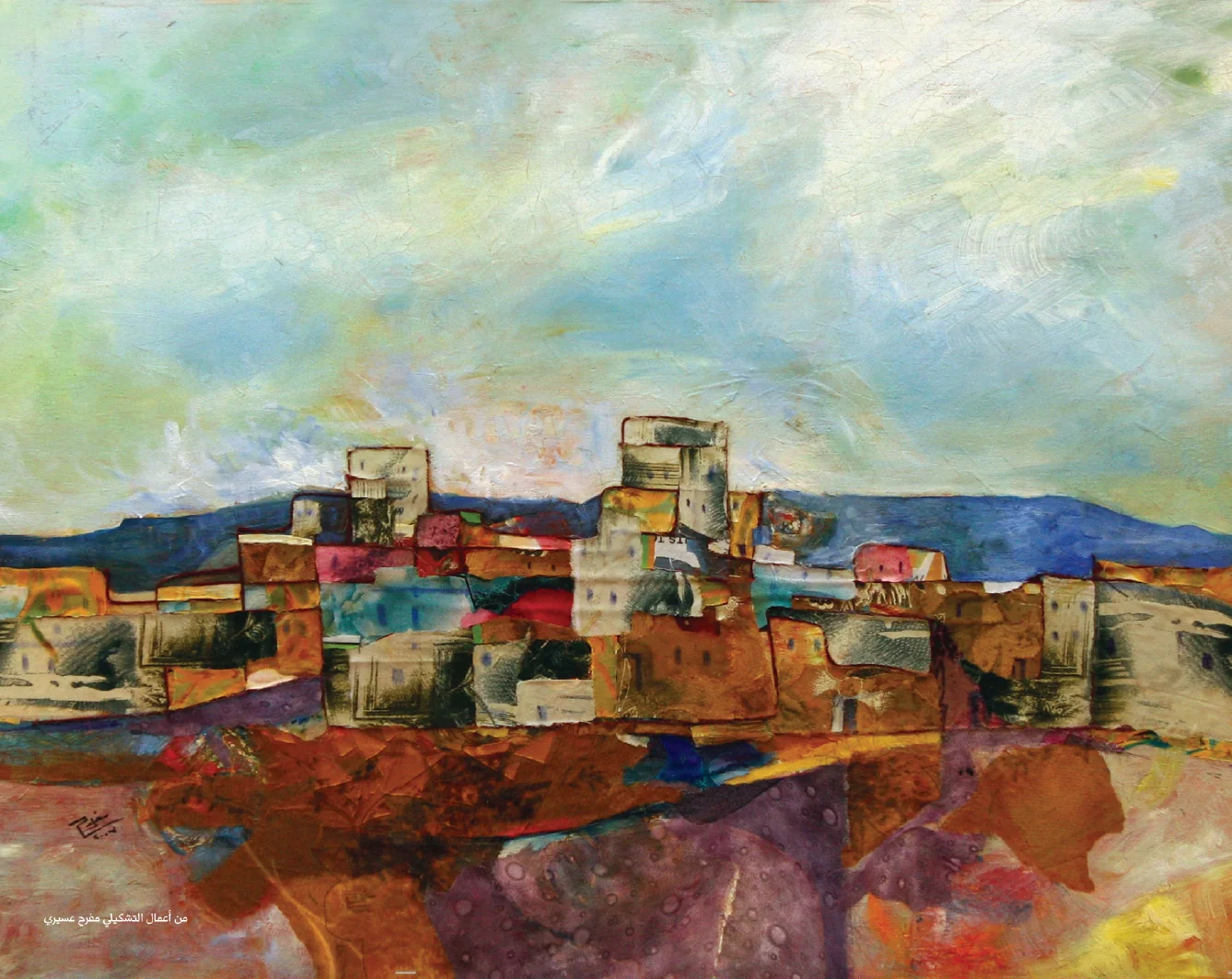
The City and the Countryside in the Poem "The Processions"
By: Ali bin Saad Al-Qahtani
odness in people is manufactured if they are forced
And evil in people does not perish even if they are buried
And most people are machines moved by
The fingers of time one day and then they break
So do not say this is a man of knowledge
Nor say that is the dignified master
For the best of people are herds driven by
The voice of shepherds, and whoever does not walk perishes
There is no shepherd in the forests, nor is there a herd in them
Winter walks but Spring does not compete with it
People were created as slaves to one who refuses to submit
So if he ever blows as a walker, everyone walks
Give me the flute and sing, for singing nurtures minds
And the moaning of the flute is more lasting than the glorious and the humble
The Document
This was the poem "The Processions" (Al-Mawakib) issued by Gibran Khalil Gibran in 1919 at his own expense. It came elegant, adorned with a group of artistic paintings, and was a real revolution in his poetic world. It came as one of the important documents in which he poured his philosophical ideas and visions on human issues such as od and evil, religion, truth, and justice. As Nizar Brik Hunaidi says in an extensive research within the publications of the Union of Arab Writers in his handling of the poem: "It is the only long poem that Gibran Khalil Gibran (1883-1931), composed on the traditional poetic meters and published in a separate book. Gibran said about it in a letter he wrote to Emil Zeidan: 'As for Al-Mawakib as a poem, it is a dream I saw in the forest, and when I intended to show it, I found myself like a carver trying to make a statue from the mist of the sea. What, I wonder, does a poet do with his dreams when he has nothing to build them with but words and meters, and they are chains and fetters?' The poem consists of two hundred and three verses and is built on a system of stanzas of multiple meters, beginning with a stanza from the Al-Basit meter followed by a stanza composed of four verses from the Majzu' Al-Raml meter, then a stanza consisting of two verses from the Majzu' Al-Raml as well but with a rhyme of different visions from the rhyme of the stanza that precedes it, then the stanzas follow in the same order until they end in a stanza from the Al-Basit meter with which they began. There is no doubt - according to Dr. Nizar Brik Hunaidi - that this succession between the stanzas is what suggested the idea of the existence of a dialogue between two voices inside the poem in the multiple readings that Al-Mawakib has enjoyed since its release. The poet Nassib Arida considers the stanzas written in the Al-Basit meter to be the voice of a wise old man, while the stanzas of Majzu' Al-Raml are the voice of a dreaming youth, and the poem is nothing but a dialogue between them." Dr. Nizar Brik Hunaidi concludes by saying: "If Plato called for the establishment of the Virtuous Republic and Thomas More imagined the establishment of the Utopia (Virtuous City), then Gibran calls for what we can call the Beautiful Forest World."
Nature in the works of Gibran Khalil Gibran
The writer Professor Lilian Buccianti Barakat gave a lecture on "Gibran Khalil Gibran and Nature: An Approach Based on Perceptual Geography" which is recorded in writing on the NOW LEBANON website. The professor asked in the introduction to her lecture: "How was a boy born in 1883 from a modest Maronite Christian family in a mountain village in northern Lebanon able to become a talented Lebanese writer, thinker, poet and painter whose writings were translated all over the world and whose drawings won the admiration of critics in the most important capitals?"
Professor Lilian, in her capacity as a geography scholar, believes that "Lebanon has throughout the ages fired the imagination of poets and writers, and was the focus of greed, the destination of invaders, and the paradise of Orientalists. Gibran was born in Bsharri, a mountain town located at an altitude of 1500m on the edge of two fertile and rugged slopes at the same time. The town, described by the French writer Alphonse de Lamartine in his book 'Voyage en Orient 1832-1833', is only a few kilometers away from the Cedar Forest, which is - according to Lamartine - the most famous natural landmark in the universe. About Gibran's memories with this dreaming valley, he says: The valley takes the shape of a censer whose incense was replaced by fog, and the villages scattered on its sides take the shape of a rosary, and Bsharri is the middle bead of it. In this area where wonderful nature is full of religious and spiritual symbols, Gibran grew up, discovering the natural and human riches in his surroundings, which formed a distinguished place for learning and play for him and his brother and sisters." The speaker Lilian Buccianti says: "His ears will not forget the roar of the waterfall, the gurgling of the spring, and the sweet song of the flute, as the song says:
Give me the flute and sing, for singing is the secret of immortality
And the moaning of the flute remains after existence perishes
And there Gibran spent a happy childhood."
Professor Lilian concludes in her paper by saying: "Gibran lived most of his life among the skyscrapers of New York, dreaming of the flute, the Qadisha Valley and the cedars of Lebanon... Thus, nostalgia for Lebanon and the deep feeling of returning to nature is nothing but a deep mirror reflecting the desire to return to the self." As we have seen, the beauty of nature surrounding his village "Bsharri" formed a source of inspiration that fed his imagination and mysticism.
Pessimism
Pessimism is inherent in creators since ancient times, such as Schopenhauer, Abu Al-Ala Al-Ma'arri, Nazik Al-Malaika, Abu Al-Qasim Al-Shabbi, and among them also Gibran. This pessimism leads the poet to rebel against realism and reject false civilization and try to escape to nature to throw himself into its arms. Gibran opened his poem with his pessimistic vision towards human civilization and made it like a "bell" with which he draws the attention of the recipients:
odness in people is manufactured if they are forced
And evil in people does not perish even if they are buried
And most people are machines moved by
The fingers of time one day and then they break
And the two verses have counterparts among other poets like Abu Al-Qasim Al-Shabbi, who confirms his alienation and depression in this sad world and chants in the poem "The Unknown Depression":
I am a dune
I am a stranger
My depression disagreed with its counterparts
Strange in the world of sadness
My depression is an idea
An unknown word from the ears of the homeland
And this pessimism is repeated by Nazik Al-Malaika, who believes that life is all secrets, absurdity, and chains in her long poem:
In vain you dream, my poet, there is no morning for the night of this existence
In vain you ask, the secret will not be revealed
And you will not enjoy breaking the chains
And Badr Shakir Al-Sayyab's "Rain Song" is adorned with fear, insomnia, sorrow
And death and darkness:
Do you know what sadness the rain brings
And how the lonely one feels loss in it. I can almost hear the palms drinking the rain
And I hear the villages moaning, and the immigrants
Struggling with oars and sails
The Gulf storms and thunders, chanting
Rain... rain... rain
This pessimistic vision of Gibran at the beginning of his poem "The odness in people..." is what called him to reject the city with its fleeting civilizations, factories and modern machines that destroyed the environment and burned life... and led him to escape towards the dreaming nature "The Imagined Forest" in the mind of Gibran Khalil Gibran. This "imagined forest" appears to us as a reflective image of what Gibran Khalil Gibran lived during his days of play and youth in the Cedar Forest in his village "Bsharri" in Lebanon. The forest to the poet appears to us as forests adorned with imagination, legends and beauty in which winter and spring reside, without sadness or worries. in these forests there is eternal happiness in which they are given a cup of the elixir of the clouds. in the "imagined forest" of Gibran Khalil Gibran, there is no death nor are there graves and the months of Nisan "April" always follow one another, for spring resides in it for eras, times and centuries "perhaps an image that Gibran quoted from the Holy Quran in describing Paradise."
The Image of the City
The image of the city appears distorted to our poet Gibran, just as it does for the Romantic poets who always had their creative texts shimmering with nature, feeling constrained by the city walls and weary of their reality with all its pleasures, lusts and distractions. They chant the dream on the banks of nature and its beautiful carpet that has not been polluted by the winds of change and the impurities of civilization and the falsity of the era with all its innovations and developments. This dream is always renewed in many of their poems. For this poem "The Processions" there are counterparts in modern Arabic poetry, including the poem "For Your Eyes" by the deprived poet Abdullah Al-Faisal, which was sung by the "Star of the East" (Umm Kulthum), in which the poet dreams of leaving the world and living in the lap of nature and sipping cups of love with the beloved:
Would that we, O love, lived in it for an hour.
We wake the boat or set its sail
And we call upon its two banks in supplication
It awakens the heart and does not heal the burning longing
The deprived poet lost his life in the love of the beloved and went seeking her approach in the hope of convergence. Time passes with its hours and seconds, and the spectrum of his beautiful dreams fades away at the beginning of the autumn of his life. The water of his generous eyes falls in their footsteps and the tears become like embers on the cheek as they flow. His life becomes a complaint, distraction, misery, shadows whose branches have withered, and his heart continues to rage. Gibran is considered a pioneer for that secret that he cannot reveal, and poets have secrets and mysteries.
Overwhelming his longing, how much has he endured? He loves her if she is absent or present, he loves her in solitude and in the evening chat.
Do you remember what was between the two banks
The day we and love were sweeping through us like two flowers
When we emitted from our love and our sorrow two sighs
And we poured on the surface of the river from us two tears
The poem "The Processions" is also contrasted by Romantic poems in modern Arabic poetry, the poem "The Ruins" (Al-Atlal) by Dr. Ibrahim Nagi, composed by Riad Al-Sunbati and sung by Umm Kulthum in 1966:
O my heart, may d have mercy on love; it was a castle of imagination that collapsed.
Water me and drink on its ruins, and tell about me as long as tears have told.
How did that love become news and a story among the stories of passion.
The Flute
The imagined forest of Gibran Khalil Gibran is not complete without the moaning of the "flute" (Nay). Singing nurtures minds and the moaning of the flute remains more lasting than the glorious and the humble. The moaning of the flute is eternal and remains playing - as he imagines - after life and suns perish and stars are extinguished. The "Nay", as Wikipedia the free electronic encyclopedia says: "The Nay: an Oriental wind musical instrument that an Oriental musical ensemble is not without. It is one of the basic instruments in Arabic music. It is made of wild reed and is a hollow tube open at both ends. The flute has been used since ancient times; the Babylonians and ancient Egyptians used this instrument. The flute consists of nine nodes with six holes in one line and another hole on the back controlled by the thumb." As for Louis Ma'louf, he es in his dictionary to say that: "Al-Nay, plural Nayat: one of the musical instruments that is blown into." Al-Munjid in Language and Information: 714/1. It seems that Gibran Khalil Gibran chose the instrument "Nay" specifically in his poem and turned away from other musical instruments such as the oud, trumpet, tambourine, violin and qanun due to the connection of this instrument "Nay" with sadness. For the suitability of the poem and its gloomy atmosphere enveloped in sadness from all sides, the poet chose this musical instrument to accompany him in his imagined forest. Gibran Khalil Gibran is considered a pioneer in Romanticism, and Romantic poets exaggerate in depicting their pains and sorrows and painting their fears and anxiety in this desolate world. The Romantic poet must be sad, as the poet Nizar Qabbani says in his poem "Sadness": A person without sadness is the memory of a person. The Romantic poet must be sad, and if he is not sad, he will remain a ghost tossed by the winds in every place, and therefore he is keen on his existence and presence in this universe by staying at the ruins crying, complaining and sad.