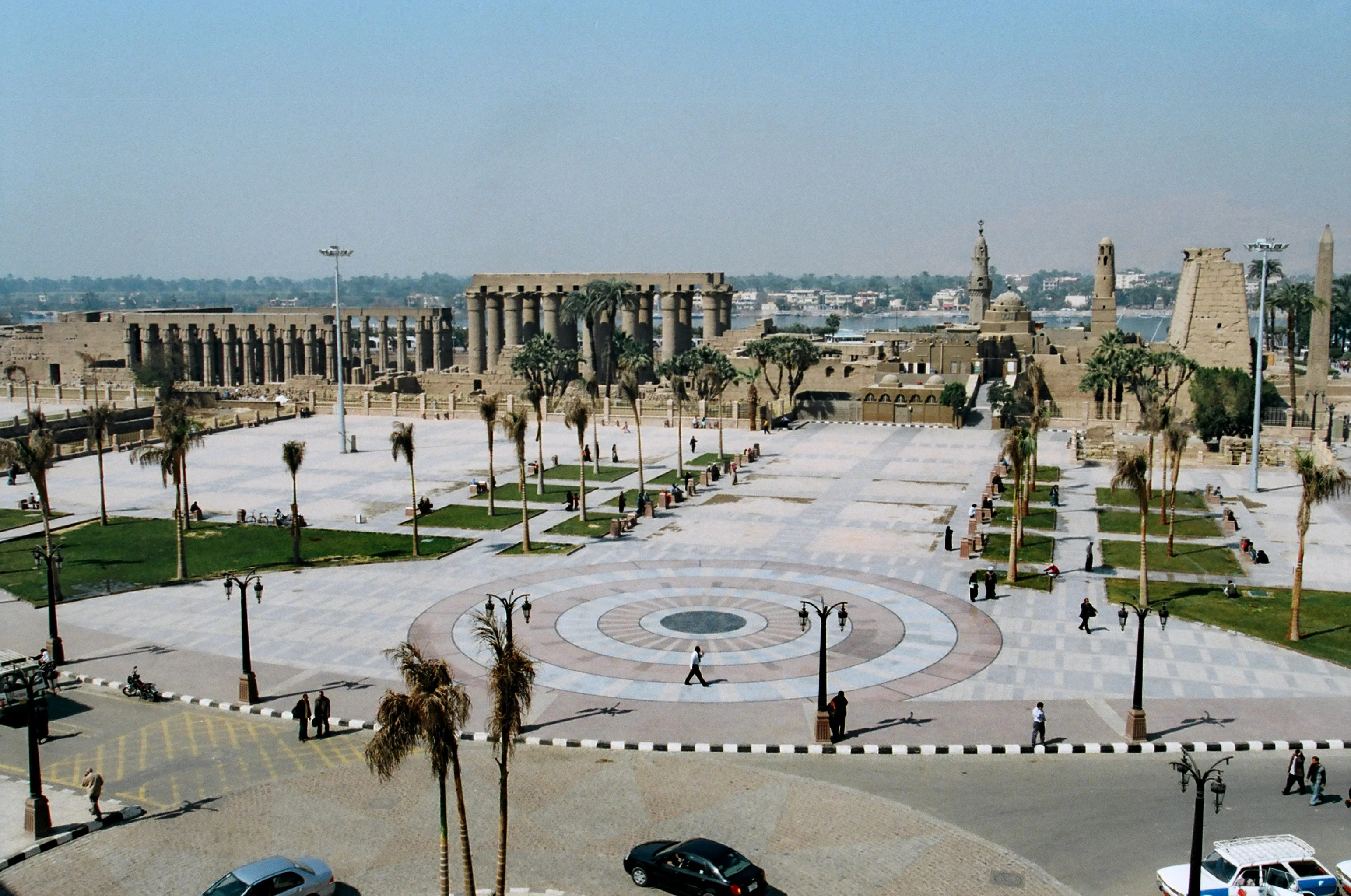
Luxor.. a city that returns its visitors to the time of poetry in ancient Egypt .. temples and tombs whose walls record love and romance poems 3,500 years old
Haggag Salama
The poet Mahmoud Ghoneim says in a poem entitled "Luxor Anthem":
O town of Luxor
Ages have yielded to you
Your valley is like lines
In the page of eternity
To the kings of your valley
Your enemies have witnessed
How many temples are in you
Established from the mountain
O Kaaba of the West
In the state of the Arabs
How many caravans are in you
How many delegations are in you
How many travel books are in you
That were written with ld
From ancient times
Inscribed on papyrus
Your bright monuments
Have made Egypt
Among the world entirely
A sign of glory
In your pure soil
A glory past for us
Nasser will restore it
With determination and hard work
The poet Muhammad al-Buraiki – director of the House of Poetry in the Emirate of Sharjah – describes the city of Luxor as "the poem of the Nile and the song of poets", and says in a special article about it: "Near "Karnak, and Luxor" and the history deep-rooted in them, sing birds fly and stop for their song the streets crowded with contemplators, and those who stay up over monuments that speak in an eloquent southern tongue that says to the world: here is a magical history to which many hearts yearn, and to which great dreams fly, the dreams of poets sons of the raining cloud and the captivating performance, so you find poetry has preceded them as it recites its melodies on its theaters and around its monuments and in the hearts of its people."
The poet Hussein al-Qabbahi evokes some of the history of the immortal city in a poem of his entitled "Inscriptions on the walls of Karnak":
In the holy of holies
You sing two verses whose letters we exchanged weaving
And the obelisk of "Hatshepsut" indicates to her that come on
And as the first lady who entered a southern heart she entered
The dead people between the shore and "Karnak" are gathered
"Yahya al-Tahir" closes the temple gates
The poet Hussein Khudairi sings in the introduction to his book "Luxor in International Poetry and Art" about his city Luxor, saying:
The sun travels in your forehead
And its news in the extent
It shines if you smile once
And sleeps – if you frown – in the imagination
Many are the talks of poetry and poets about "Luxor", that ancient Egyptian city rooted in the depths of history, where the age of its temples and tombs remaining as a witness to the civilization and cultural status of the city exceeds more than 3500 years, while the history of some of its destroyed archaeological monuments dates back to more than 5000 years.
The city which has become today one of the most important cultural tourism destinations in the world, includes within its borders hundreds of tombs and dozens of temples built by kings, queens, nobles and noblewomen of ancient Egypt, who made it a capital for ancient Egypt and for the world for hundreds of years, where it was known as Thebes.
Many names and attributes have been given to the city. The Greek historian Herodotus, nicknamed the father of history, gave it the name "City of a Hundred Gates" due to its vastness and the many gates of its towering temples..
It is the city of the "Scepter" symbol of authority and rule, and it is also "Nut" and "Waset" and "Southern City" and "Thebes" as the ancient Egyptians called it, and it is the "Mistress of all Cities" as the Ptolemies called it..
It was also known as the City of Palaces because of the many towering buildings it has, then the Arabs called it its current name "Luxor".
Luxor is famous for its civilization and its ancient arts and architecture, which the people of the city pass down from generation to generation, and it is remarkable that this city knew poetry and poets, and poems of love, ghazal and romance thousands of years a, where the ancient poets recited their poems in the middle of temples and on the shores of the immortal Nile River, and in the middle of gardens and fields.
Time of Poetry
According to archaeologists and Egyptologists, and ancient and contemporary historians, the walls of tombs and temples in Luxor, along with papyrus papers and ostraca pieces, record many of the poems written by the poets of ancient Egypt, between chants that were sung in temples, and ghazal, love and romance poems, and poetic texts glorifying the army and the homeland.
Along with poems, the writers of Luxor in ancient Egyptian eras wrote literary stories, religious chants and hymns, poems and stories of travels and adventures, love stories and poetic plays, and myths and legends of high imagination, but the finest of those texts and writings were in the field of romantic poetry.
The poets and writers of ancient Egypt documented many love and passion texts on the walls of the tombs known as the tombs of the nobles and elites in Luxor "and on pieces of pottery and limestone called "ostraca" on which the ancient Egyptian recorded his feelings of love and longing like one of them describing his beloved in an ancient manuscript: "She is the unique beloved who has no equal, the most beautiful of the beautiful in the world, look at her like the bright star in the New Year on the threshold of a od year.. she who shines and whose skin glows with a delicate brilliance, and has eyes with a clear look and lips with a delicate speech, and never a trivial word comes out of her mouth.. she with the long neck and the shining breast her hair of a bright color, her arms exceed the brilliance of ld, and her fingers resemble the cups of the lotus flower.. she with the slender waist. She whose leg bears witness to her beauty.. with a noble gait when she puts her feet on the ground".
Egyptology books have recorded many love and ghazal poems in ancient Egypt, where a lover says describing his beloved:
"My beloved is unique and has no equal.. she is the most beautiful woman in the world.. she is a bright star in the New Year.. she speaks beauty and her skin shines like the sun.. and her lips speak sweet talk.. her fingers are like lotus stems.. her kiss takes my heart.. and men''s necks crane when they glimpse her".
A girl in love says to her beloved in a poetic text: "Come towards me my beloved.. let me taste your beauty.. and let your father be happy and let your mother be happy and let everyone rejoice for us my beloved".
Another girl says addressing her beloved: "I don''t know how to avoid you.. will I meet you my beloved.. the river seems like a path for me.. because I lost my mind.. I will tell him that I am for him.. and he will chant my name".
A girl wrote in grief over the separation from her beloved: "I do not wear my beautiful clothes nor put on kohl nor perfume myself with the most beautiful perfume".
House of Poetry
Among the modern cultural landmarks in the city is the "House of Poetry in Luxor", which was established under the patronage of His Highness Sheikh Dr. Sultan bin Muhammad Al Qasimi, member of the Supreme Council, Ruler of Sharjah. It is the house that has become a destination for Egyptian poets and intellectuals from all Egyptian vernorates, through its activities managed by the Egyptian poet Hussein al-Qabbahi – the house director.
The House of Poetry in Luxor has returned the immortal city to the time of poetry between its temples and on the shores of its Nile and in the middle of its gardens and fields, where the poets of ancient Egypt used to chant poems of love, ghazal and romance.
In the annual Arabic Poetry Festival, which the House of Poetry in Luxor organizes annually, in the presence of a group of Egyptian, Emirati and Arab intellectuals, contemporary poets recite their poems in the middle of Luxor temples, similar to what used to happen in the city thousands of years a.
Generations of Poets
Luxor has known poetry since the times of the Pharaohs as we mentioned, and the ancient Egyptian poet inscribed his poems on the temple walls, and Luxor remained rich with its poets throughout history.
During the past 200 years, Luxor was famous in the Egyptian poetic movement for a number of its poets who had their place among Egypt''s poets at that time.
Nasser Al-Fouly, a researcher at the Foundation of Abdulaziz Saud Al-Babtain Cultural Encyclopedia, told us the biographies of some of these poets such as: The poet Ahmed al-Tahir al-Hamidi - 1258-1332 AH 1842-1913 AD - received his early education at the hands of his father, then at Al-Azhar Al-Sharif, and undertook the delivery of religious lessons to the people of Armant, south of Luxor, refusing to work in the poetic judiciary, or teaching at Al-Azhar Al-Sharif.
Not all of "Al-Hamidi''s" poetry was collected in a collection, but his son collected 20 poems from it in a book about his father''s life, and his poetry belongs to the poetry of the Sufis, most of it in the Prophet''s praise, in preaching, and lamentation, and its dictionary is religious Sufi, its language is traditional, and its prosody is Khalili.
The poet Muhammad Musa Karim Al-Luxori - 1298-1375 AH 1880-1955 AD – who was born in Luxor and died in it, memorized the Holy Quran early, then studied at Al-Azhar Al-Sharif, and worked as an imam in Luxor mosques, and was famous for his relationship with the leader Saad Zaghloul, leader of the 1919 revolution, and was one of the pillars of the "Al-Ma''qal Al-Ashhab" salon held by the poet Olivia Owaida, one of the Luxor poets of that period, and he has a printed collection entitled "Thoughts of Youth" and it was published in 1340 AH/1921 AD, and he has other works like "Time and Friends", which is an ethical literary message he placed in the form of dialogue and debate.
The poet Muhammad al-Sharqawi al-Hamidi - 1295-1392 AH 1878-1972 AD – who grew up in a religious family with knowledge and literature, learned from his father, memorized the Holy Quran and studied religious and Sharia sciences, and worked as an imam and khatib of the Karnak Mosque, as he worked as an agent for Al-Islam magazine in Luxor, and used to participate in a number of newspapers and correspond with them until he was dubbed the old journalist, and was active in social and political work through participating in political parties and participated in celebrating religious, social and national occasions as a poet and orator, and his poetry was composed in the purposes of lamentation, praise, pride and congratulations, and his poetry was associated with social and national occasions.
The poet Al-Kamil al-Tahir al-Hamidi - 1298-1334 AH 1880-1915 AD – who memorized the Holy Quran, and received an Azhari education, until he obtained the high license from Al-Azhar.
He worked as a khatib and imam, besides working in dawah, he was affiliated with Sufism and Sufi orders, and he has a long poem in lamenting his father (106 verses) printed in a special publication, and he has an educational poem (urjuza) explaining issues of the science of eloquence.
He is a jurist Sufi poet, and his remaining poem in lamenting his father follows the habit of the ancients, and draws his images and linguistic structures from traditional poetry benefiting from the dictionary of the Prophet''s praises and ancient ghazal poems.
From contemporary generations, Luxor knew bright poetic faces starting from the pioneer generation represented by the poets, Mahmoud Mansour, Muhammad Adel, Abdulaziz Labib, Abdul Rasul Abdul Hakim, Ezz Al-Arab Abdul Hamid Thabit, and others.
They were followed by the generation that carries the banner of poetry in the city today, and leads the continuous and extended poetic movement from Luxor, passing through all parts of Egypt and even the Arab world, and among those faces that contributed to enriching the poetic movement in Luxor are the poets: Hussein al-Qabbahi, Dr. Al-Nubi Abdul Radi, Ahmed Fouad Juwaili, Muhammad Jad Al-Mawla, and from the youth generation: the poet Hassan Amer, winner of the State Encouragement Award, and Ahmed Al-Iraqi, Yahya Samir, and others, and from the female poetic faces: Azza Sharqawi, Amal Mansour, Shaimaa Ibrahim, and others, and from colloquial poets we mention Bakri Abdul Hamid and Mahmoud Marai and others.
Among Luxor poets who achieved a high position in the world of poetry outside the country, the Luxor poet Dr. Arif Karkhi Abu Khudairi, who is nicknamed the Asian Diaspora Poet, and from translators the poet, writer and translator Al-Hussein Khudairi.
Luxor in the eyes of world poets
Throughout the ages Luxor was not absent from the eyes and imaginations of poets starting from "Homer" who described it in his famous "Iliad", and the chain of international poets who wrote about Luxor, and drew inspiration for their poems from the scent of its history, and read above the temple walls verses of loftiness and immortality, starting from Shelley, the companion of Keats and Lord Byron, and one of the most famous English Romantics, who formulated many poems for ancient Thebes (currently Luxor), and Teresa Holly, the English poet who loved Egypt and wrote about the land of Thebes and its glory, and the American poet Henry Abbey who described the Nile and palm trees and Thebes and its temples in a long poem entitled "Across the Nile", as well as the English poet Bryan Waller Procter.
The English poet Nicholas Michell, a lover of ancient kingdoms, also wrote about Luxor with unparalleled infatuation, where he wrote several.
Poets of the Victorian era also wrote about Thebes (now Luxor), including Joseph Ellis, owner of the Brighton Literary Group, as did Richard Milnes, the first Lord of the English city of Houghton, who was a member of the English Parliament at that time.
As for the English poet and novelist Florence Margaret, she did not resist the charm of the Colossi of Memnon, which inspired her with a wonderful poem. The list of those who wrote about Luxor among world poets, whom the book "Luxor in the Eyes of International Poetry and Art" mentioned, included the Canadian poet Michael William, the Irishman Barry N. Williams, Don Manuel Ekakino, the Nigerian poet and novelist, the American poet and playwright Kale Young Rice, and the English poet, priest, teacher and historian Arthur Wentworth Hamilton Eaton.
We choose from among those poems written by the world''s poets about Luxor, the poem "Ancient Thebes" by Nicholas Michell, an English poet and writer who died in 1880 AD, and it was translated for us by the poet and translator Al-Hussein Khudairi:
Thebes still
hears the spiritual melodies of Memnon
where Egypt''s first kings
built their thrones
Inside the beloved Queen with a hundred gates
Though she has fallen - she remains great - calm, though she is unhappy
with cold and wonder the blood runs in our veins
While we approach its extended ruins, giant it remains.
Forests of columns crown the face of Nilus
With arts beneath them, obelisks rose to the sky
leading to satisfied temples and tombs just as great
Giant leaders, sitting closely, in granite
immersed in thought, drowned in deep sadness.
Giants or ds built these walls that stand defying the years, and the hands of destructive ruins
Extremely vast and majestic is the scene we see
And we were not comprehensive but we set examples.