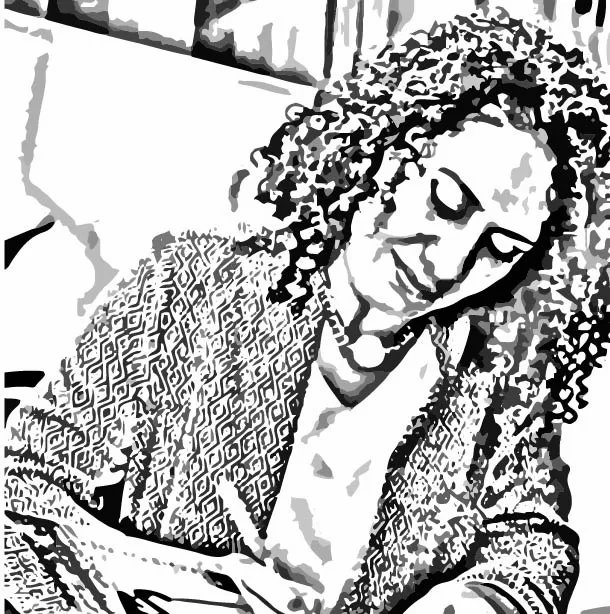
Palestinian poet and storyteller Sheikha Helaiwi: Palestinian literature is the voice of our cause outside the homeland
Interview: Ahwal Al-Ma'rifa
Her soul resembles sunbeams, white threads scattering from it to remove darkness. She doesn't write but plays, for she turned letters into a violin .. her letters arouse astonishment, for disappointments have acquired scents, and she learned to fly outside seasons, and she turned her face away from autumn for its cruelty, and she conversed with the shadow that does not separate from its owner. She is the Palestinian poet and storyteller Sheikha Hussein Helaiwi. We congratulate her on the publication of her short story collection "Mistresses of Darkness" and her book "Outside the Seasons I Learned to Fly" and we learned from her that she is currently working on a new collection of stories and a novel.
*What does morning mean to you and when does it fall?
ــ In another text I said "the assassination of morning". Morning always comes, it doesn't hide and isn't late. For me, it is a new chance to repair the soul's damages. I rely on it to regain some of my soul and repair what life has corrupted from it. And when it comes (and it always comes) the morning is assassinated or dropped by something, someone, a word, a feeling that accumulated from the night and became a mountain. It steals it from me and I have nothing left but to rely on another morning that might escape falling or assassination. In the morning too, I read what I wrote at night and when I don't find myself in it, I erase it. I don't like texts I am not in during the morning.
*Only with Sheikha Hussein Helaiwi do disappointments acquire a scent?
ــ It seems because they are my disappointments and I alone give them color, scent and sound. Some leave a mark in my soul and some in my clothes and songs. Disappointment is my creation sometimes, I know it well and almost touch it. And I know its scent well when it slaps me on my forehead. I can distinguish its scent from the scent of victory. I think it is without scent. Disappointment exceeds for me the lump in the throat and the prick in the folds of the soul and becomes a scent that sticks in my things.
*Sadness turns in your texts into a guard dog (I will tie sadness at the entrance of my house behind the door like a naughty guard dog)?
ــ Sadness stays with me, let it guard me as long as it is so. But it is a dog, faithful sometimes, loyal sometimes it takes care of me, and thus I have a chance to swear at it comfortably without bothering it so it doesn't turn on me. And another chance to pamper it like dogs, I don't deny its credit to my humanity.
*Why did you learn to fly outside the seasons?
ــ What I wouldn't have learned inside the seasons. Seasons are the constraints of nature and the sequence of logic. Seasons are the frame in which we are imprisoned and barely breathe. If I had submitted to the seasons, wings wouldn't have grown, and the slogan of my environment was "The girl if she grows a wing, it must be clipped." It was necessary to manipulate the seasons and break them so that I keep my wings, master flying and breathe. But I confess: I still don't master it completely, and my wings are still inhabited by the fear of the seasons. I fly sometimes with confidence and sometimes I fall on my face.
*How great is the Palestinian woman to endure occupation, hardship, loss of sons and loved ones?
ــ Indeed, how great she is. If we accept that this is her fate, we have contributed to her death. This is not her fate but rather the creation of the other, the occupier, the unjust laws. Before we demand her to blow up all that and conquer it, let's look at society, what did it offer her? What will it offer? Society is full of contradictions! It gambles on her strength to endure and works to weaken her. It demands sacrifices from her and then excels in burying her alive. How great she is!
*Is it easy for a person to address their shadow, and what are the implications of that address?
ــ Yes, one might address their shadow to verify their existence, when you sense yourself and don't find it you address your shadow which is the closest to your soul. Perhaps it restores your confidence in your existence. The shadow is not inhabited by your fear or your weakness and therefore you might find it an image of the ego you want.
*Does Palestinian literature follow the trail of Arab literature?
ــ I don't believe that Palestinian literature should differ from Arab literature. It is human literature, that's how I see it and how I like it to be. I don't deny the specificity of its existence under occupation, but it carries the concern of the individual, their dreams, longing and pain. I might write about the suppression and oppression of the occupation and I might write about the suppression of seasons and the oppression of tradition and habit. Some might disagree with me but this is my opinion. Palestinian literature walks in the train of Arab literature and must do so.
*And how do you evaluate Palestinian poetic and narrative output?
ــ I am too humble to evaluate literary output. Honestly. Evaluation I leave to the reader and the critic. But as a reader, I know that it has found an important place for itself in Arab literature. In poetry, prose and innovation as well. Many names have reached international levels, crossing the borders of the Arab world. This says a lot about Palestinian literature.
*Are there specific obstacles to creative publishing in Palestine?
ــ Of course. And is Arab publishing in general well? The Arab creator suffers two bitter things for the sake of publishing! He pays from his own money to publish his book. He becomes a seller, marketer and promoter and these are things that distract him from creativity and frustrate him. Where are we from publishing and its origins in the West? Most publishing houses, if not all, are commercial interests first and foremost. Few deal with the creator with honesty, sincerity and appreciation.