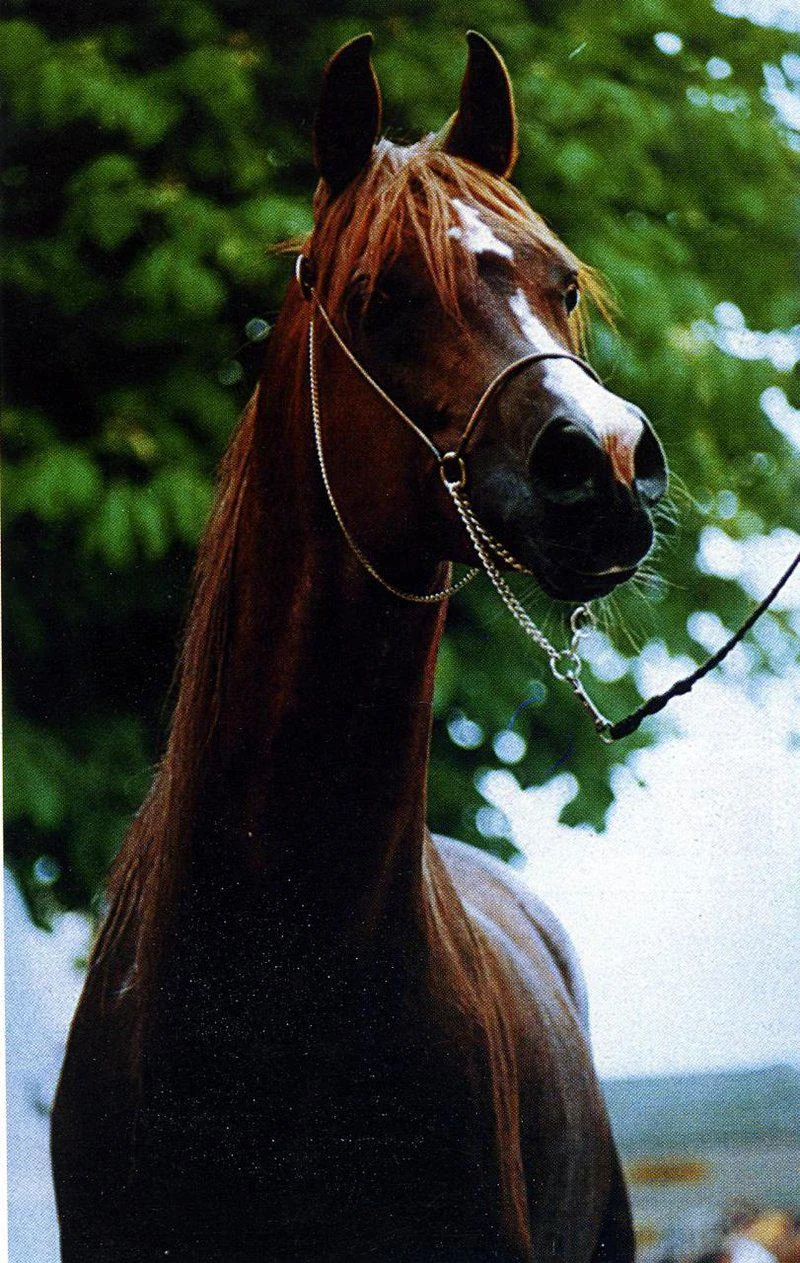
Pure Blood .. Two Russian authors: Arabian horses are the only purebred breed of horses in the world
Two Russian researchers confirmed in a rare book revealed by the King Abdulaziz Library through its specialized center for Arabian horses, which is the Equestrian Studies Center, that the Arabian horse breed is the only purebred horse breed in the world. This came in a book entitled: "The Purebred Arabian Horse" co-authored by Russian researchers: A. G. Sherbatov and Count S. A. Stroganov. It is one of the rarest books in the library, in which the authors talked about the Arabian horse and its importance, the distinction of the Arabian horse, and the breeding of Arabian horses in Europe, and they presented a set of Russian views on Arabian horses. The book also included appendices on Arabian horse breeds, and Bedouin families famous for their horse breeds.
Count Stroganov writes: "Of all existing horse breeds, the Arabian breed alone is the one that satisfies, without the slightest possibility of doubt, the concept of (pure blood) and because of that, it is capable, in a way that is incomparable with all other breeds, of generating its characteristics and features, and then improving all other breeds. In this context, it can be said: the originality of Arabian horses does not require proof, it has been tested practically, for with the blood of the Arabian horse, dozens of different types of breeds have been improved and reproduced." Thus Stroganov motivates the ideal value of Arabian horses, which is a continuous value for thousands of years.
There are not a few scattered references in Arab history to the importance given by ancient Arabs to horses. Before the era of Prophet Muhammad (peace and blessings of d be upon him), Arabs did not play a prominent role in the lives of other peoples, according to Stroganov, and for this reason their histories consist of lineage tables and descriptions of the places of origin of their various tribes. Stroganov talks about the habits of the Arabs with purebred and hybrid horses, about the places where the Arabs lived and the impact of the desert on Arab life, and the types of horse breeds. He believes that there are five main and most famous breeds: Kuhailan, Saqlawi, Abeyan, Hadban and Hamdani. The branches of the Kuhailan breed exceed 60 branches, while the branches of the Saqlawi breed are few and some claim they are only three: Saqlawi Jidran (the most precious), Saqlawi Abiran, and Saqlawi Al-Abd. As for the Abeyan breed generation, it includes: Abeyan Sharrak, and Abu Jreiss branched from it. The Hadban breed is divided into three branches only: Hadban Al-Nazhi, Hadban Al-Fard, and Hadban Mashatib. There is only one branch for the Hamdani generation, which is: Hamdani Simri.
The authors monitor the specifications of Arabian horses in terms of color, the most common being bay (red) horses in various shades of red, and there are white and gray horses. The authors also talk about the stature of the horse, its length and body, limbs, head and neck. Sherbatov believes that the Arabian breed is the only purebred breed of horses in the world. Horses of all other breeds should be called well-bred horses and not purebred horses with pure blood. The Arabian horse is characterized by dignity of lineage and endurance, and their continuity created the fame for this horse.
The Arabian horse is distinguished among all other breeds by its nobility of form, as there is no other horse breed that has that elegantly drawn neck, the wonderfully composed tail, the beautiful expressive head, and the large bright eye, similar to what is in the Arabian horse. It is also characterized by strength and endurance, and the wonderful ability of Arabian stallions to pass on their distinct traits and internal characteristics to their offspring even when they remain without adding Arabian blood for up to a whole century. Because of these mentioned qualities, the Arabian horse will always retain its importance for the sake of raising the level of horse breeding in all countries.
Sherbatov identifies 16 branches of Arabian horses in addition to the five main branches. The sixteen branches are: Ma''anagi, Sa''dan, Dahman, Shuwaiman, Jilfan, Tuwaysan, Samhan, Wadnan, Rishan, Kubayshan, Melihan, Jreiban, Ja''ithni, Freijan, Tarifi, Rabdan. The authors highlight the aesthetic value of the Arabian horse. The Arabian horse is an example of perfection for horses. Its stature is 14 hands, with an appropriate length. its structure is strong and sound, with extraordinary flexibility and agility. It is a wonderfully consistent creature in all respects. The essence of all horse qualities lies in its small size. The horse must be seen to appreciate the elegance and beauty of the head, eyes, ears, jaws, mouth and the lower and middle part of the nasal bone. There is nothing in the world more beautiful than the Arabian horse, both in terms of stature and in terms of nobility and lineage, and its structure is at the highest degree of perfection.
The Equestrian Studies Center includes a large and diverse collection of fundamental books, sources and Arabic and foreign references in the field of equestrianism, reaching more than 7,000 books, publications and cognitive materials. A scientific committee at the library monitors, collects and organizes what has been published and what is being published about horses and equestrianism from Arabic and foreign intellectual output represented in books, articles, manuscripts and periodicals, so that it formed a distinguished information base in this field. The center issued many studies and encyclopedias concerned with Arabian horses, and the center acquired a large number of studies and rarities that talked about Arabian horses of all kinds and related breeding, origin, descriptions and features.
The Arabic and Islamic heritage system receives great attention from the King Abdulaziz Public Library. Among the library''s strategies is the care of heritage in its various forms, shapes and patterns, whether it is written and manuscript heritage or heritage related to customs, traditions and folklore or related to places and historical stages.