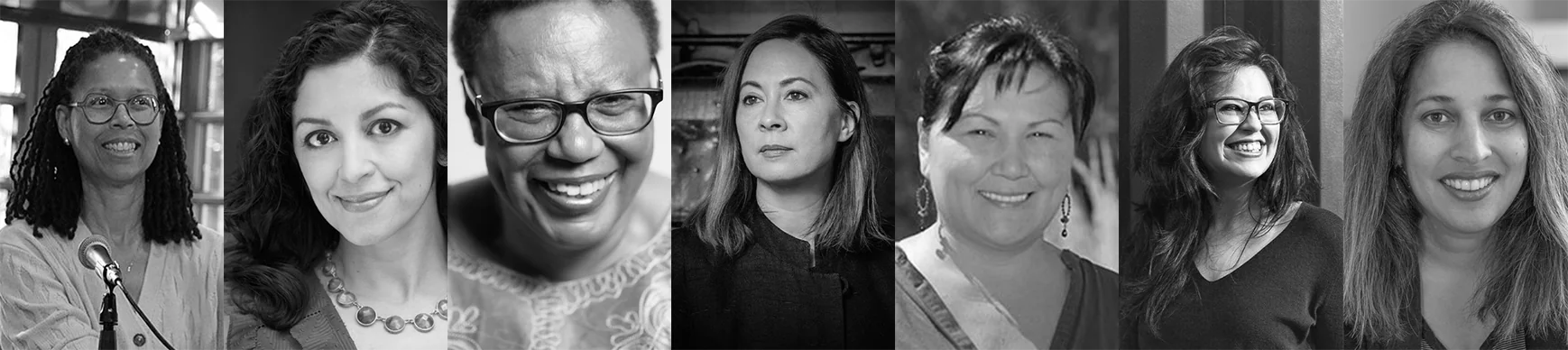
Seven Poetry Collections by Seven Women of Color Who Shatter the American Sentence
Translated article by American poet: Diane Mehta
Since the time of the American poet Walt Whitman, the shape of the American sentence has changed in and out of forms, from the lyrical lines of race cars coming off the page to storm fields of words floating in white space in a manner resembling visual art, and back to quasi-formal stanzas swinging around a pentameter-like rhythm. I designed my poetry collection "Tiny Extravaganzas" around experiences that conflict with the boundaries of the American sentence. My sentence focuses on identity, dialect, and rhythm—often indirectly, but in a radical democratic slang that moves toward and away from lyrics. I am interested in chasing and cutting rhythm, and generally finding new ways to shatter the traditional American sentence with style and poetry. I have veered from the talkative to the incantatory, with the tone changing from jazz to elegy. I work on the assumption that the sentence is fluid and women must move the sentence in new directions. The following are collections by women who relentlessly design the American sentence, applying power through phonetics and rhythm while documenting harsh history. Some poems are elliptical or visually fragmented, others appear organized on the page but the sentences boil inside. Some pretend to be prose, but they are not. All these poetesses, like me, work in a style closer to music and chanting than conversation. One of them is Sumita Chakraborty; in her collection "Arrow" we find a language so cosmic and expressive that you can only wonder if her larger project is about the failure of language to express. "Some bright and bright, some dark and broken, / Your blood and our blood across the burnt orange schist," she exudes. Her tone is flowing, and her style is lush. But beneath her sweeping lyrical lines and the intimacy of her dialogue lies linguistic play and argument. The heart of Chakraborty's collection, and the showcase of her radiant talent, is her eleven-page elegy for her sister, "Dear, Beloved," perhaps the most poignant and skillful short epic in contemporary poetry. Her book exists in the liminal space of grief, but it is grief that gives shape to the book. Her high emotional pitch is set by poems in conversation with other writers—grief does not marginalize her intellectually, and she is determined to make use of it. Chakraborty tells us that language is meaningful, even if time is unorganized. She works to know what pain is. She says: "Please leave the window open."
Witness Document:
In Paisley Rekdal's project, we find that it is a hybrid polyphonic poem documenting two histories: the transcontinental railroad and Chinese immigrants detained at the Angel Island immigration station during the Chinese Exclusion Act. The book is part oral history, and part "translation" in which the American sentence is transformed into a witness document. Poems often move down the page, without stanzas, as in the poem "Soil": "General, / we have worked your grade to the point of monument, by the thousands / dug and blasted, tore the foundations of earth until these hills filled with our fresh / camps." She takes different methods to educate us. She naturally leans toward lyric poetry but resorts to journalism in this book. She works in the field of dialogue, correspondence, photographs, illustrations of torn maps or torn notes, and mini-essays or elegies.
Prageeta Sharma’s Sequence of Grief
Every variety of mood appears in Sharma’s sentences, which are sometimes so internal that they uniquely transcend the American line and sentence—yet still exist physically within them. Sharma’s sequence combines elegy, letter, memoir, conversation, and obituary. It is sadly od and accessible. Sharma has expanded the tradition of elegy in poetry, as an original experience in understanding and processing grief as well as anyone has written. This sequence mimics the cycles of grief themselves, an intimate journey into the mystery of knowing when your lover is no longer there. As you write, and write, trying to find life in it, and the life of expression in the form of a sentence, you can only wonder what a sentence is, if not an extended verb. And when the sentence ends, what memory remains? Sharma brilliantly creates memory through her sentence, breaking any cycle of grief that occurred before.
In Patricia Spears Jones’ "The Beloved Community," her imagined international and political documentary sentences resemble conversation but stop you in your tracks. Her opening in "Celia Cruz Snow Angels" is electric: "The Great Gatsby disturbed summer sorrows." In one sentence, she summarizes the novel’s tone and sweep, the angry parties, and the way they "abuse" their sad, rich, empty lives. She is deeply invested in the ability of American discourse, whether conversational or slang, to reveal the consequences of materialism: inequality, poverty, murder, violence, and masculinity. In "Poverty," her style and sentences match the reserve of the condition itself: "[Poverty] a broken tooth / no smile — // are bones ill-set / weak limbs, the paramedics are different."
In Nanook Okaypik’s "Blood Snow," I wonder: what grammatical tension excites Okaypik’s poems! The poetic line is a metaphor for flight. Her sentences mimic that by moving forward as monosyllabic syllables accumulate and slow you down, drawing your attention to the ground, to a single syllable. It forces you to look, recite, and listen. Her sentences are dense while the book has emotional spaciousness. Some of this is pure style: multiple beats on the line. The accumulation of her strong rhythms and delivery reminds us of Gerard Manley Hopkins' amplified speech, measured by duration in what he called "sprung rhythm." She is closer than anyone else to approximating this technique with contemporary fervor.
In Aimee Nezhukumatathil’s "Oceanic," one thing to know about Nezhukumatathil’s poems, even when they resemble fragments on a visual level, is that she always writes clear sentences whose meanings turn on themselves or slowly reveal more narrative. Nezhukumatathil has a tendency to thicken sentences with fleshy sounds like "silencing the tassels" and inserting phrases connected by consonants ("chalcopyrite crystals") in a poem full of simple monosyllables.
Suddenly We:
In Evie Shockley’s "Suddenly We," we find that Shockley’s homophones and verbal play work to tear the sentence into its basic units. The result is charming and fun. Her book explores inheritance: what we inherit from history and from language. She undermines the value of language itself with a masterful style. She plays with opposites and form in "Carolina," a beautiful poem with alternating quatrains and tercets: "I am dark except where I am / darker," followed by a catalog of memories to show us how resilience works. It is a rare collection in which poetic forms vary this much from page to page.
Margin:
The article was published on (Electric Literature) website on October 27, 2023, titled: https://electricliterature.com/7-poetry-collections-by-women-of-color-that-shatter-the-american-sentence/. Here is a brief translation of it. *The writer of the article, Diane Mehta, was born in Frankfurt, grew up in Bombay and New Jersey, studied in Boston, and now lives in New York City. Her second poetry collection "Tiny Extravaganzas" was published with Arrowsmith Press in 2023. Her essay collection "Happier Far" was published in 2024. Her recent works have appeared in The New Yorker, Virginia Quarterly Review, Kenyon Review, American Poetry Review, and A Public Space.